Saint Sebastian
Ca. 1619. Oil on canvas.Room 004
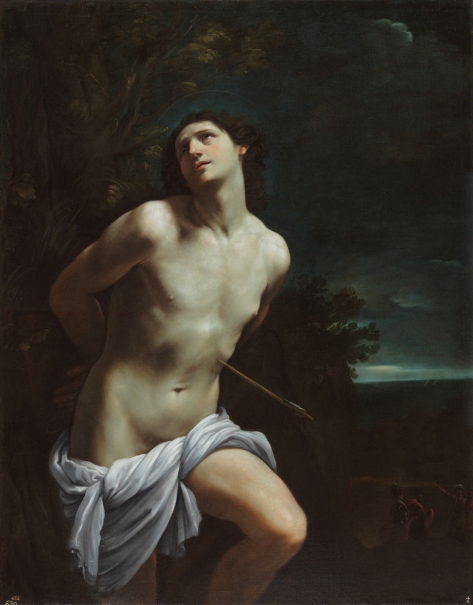
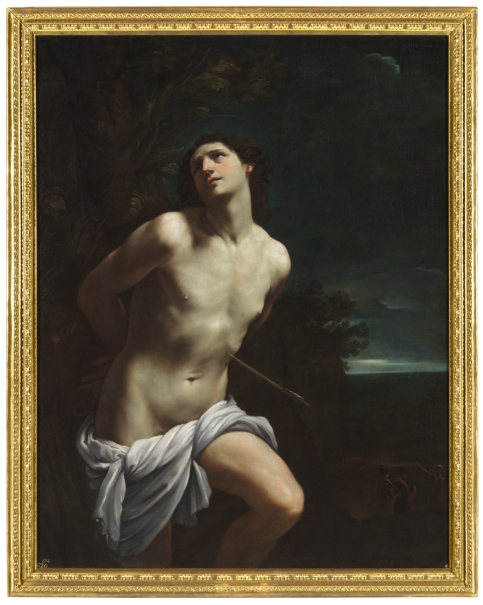
The Museo del Prado Saint Sebastian is one of five paintings of identical or similar composition that are traditionally ascribed to Guido Reni, and whose attributions and dating have sometimes been the object of heated debate – the four other works are in the Musée du Louvre, the Dulwich Picture Gallery, the Museo de Arte de Ponce, and the Auckland Art Gallery Toi o Tamaki. Stylistically, the Madrid, Paris, and (possibly) Ponce versions can be dated to about 1619, while the impressive London “replica” was most certainly executed in the late 1630s – the highly intriguing Auckland painting presents many singularities, which makes its attribution to Guido a matter of great complexity.
Assuming that the first known versions of this composition were produced around 1619, it is possible to identify one of them with a Saint Sebastian commissioned from Guido by Pellegrino Lintrù, the descendant of a Flemish family that had settled in Bologna by the end of the sixteenth century. In a letter of 23 February 1619, the Bolognese poet and friend of Guido, Cesare Rinaldi, wrote to the master: “Our Signor Pellegrino Lintrù is waiting with extreme desire for the image of the arrow-pierced Martyr [Saint Sebastian], made by Your Lordship; the ornament [frame] is already finished, though it is not commensurate with such a precious work for it would require a frame of solid gold, and not just decorated with the thinnest gilding on the surface”.
It is impossible to establish whether this Saint Sebastian might be the same as the one mentioned by Cornelio Malvasia, Carlo Cesare’s cousin, in a letter of 20 January 1633 to Francesco I d’Este, Duke of Modena, on whose behalf he was looking for paintings. “I have also seen”, he writes, “the painting of Saint Sebastian, a work by Guido, which was however made many years ago, approximately three braccia high, or a little more, and of a proportionate width, with around it a gilded frame of mediocre quality. This is considered most beautiful by people of the art, but his owner also recognizes it as such, and keeps its price high, saying to me that he will not give it up for less than two hundred scudi of our currency, which will be exactly a hundred sequins’”.
The Bolognese braccio is approximately 64 centimetres; the Saint Sebastian described by Cornelio Malvasia was over 192 centimetres high, which may correspond to the average size (170 centimetres) of Guido’s versions of this composition if the frame was included in the measurements. It may be a coincidence, but the “mediocre” quality of the frame remarked upon by Cornelio Malvasia resonates with Rinaldi’s description of the Lintrù painting’s frame as “decorated with the thinnest gilding on the surface”.
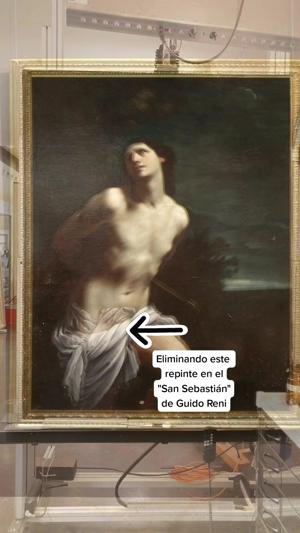
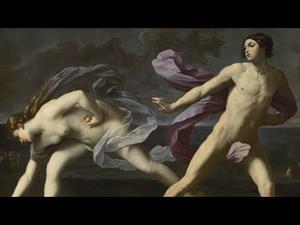
It is usually believed that the Prado Saint Sebastian originally belonged to Juan Alfonso Enríquez de Cabrera, 9th Admiral of Castile (1599–1647). In the inventory of his estate, drawn up on 25 June 1647, there is mention of “a canvas of Saint Sebastian, half-figure, by Guido Reni”, decorated with a rich frame. Because the measurements are omitted, this mention may or may not refer to the Prado work, which instead is certainly listed in 1746 as part of the collection of Isabella Farnese, Queen of Spain (1692–1766), in her palace at La Granja de San Ildefonso. A recent cleaning carried out by the conservators of the Prado has opportunely removed later repaints such as an elaborate addition to the loincloth – made to better cover the saint’s lower abdomen – thereby revealing the previously overpainted contour of the upper left arm that extends down almost to the level of the diaphragm, as well as the silhouette – blocked out directly from the red brownish priming – of the left hand behind the right hip along with the loop of a rope. It is now possible to appreciate the compacted modelling of Sebastian’s nude torso – which, more vulnerable to shadows than Hippomenes’ in the almost contemporaneous Prado Hippomenes and Atalanta, is not yet eroded by darkness like the Saviour’s in the Malta Risen Christ embracing the Cross of about 1620. Despite some abrasions determined by excessive cleaning in the past, the torso shows Guido’s sophisticated handling of “thinly applied paint with quite highly impastoed, broadly hatched highlights”, which accentuate the grandiose torsion of the upper body in exposing itself to the intense lighting of the foreground.
A black chalk drawing at the Walker Art Gallery in Liverpool has been rightly regarded as a preliminary study from life for Sebastian’s foreshortened head – Guido seems to have portrayed here the same model as the one he used for the Luigi Zambeccari Bacchus and Ariadne. It is noteworthy that, in modifying the foreshortening of Sebastian’s head as initially captured in the drawing, Guido bore in mind the famous marble bust of the so-called Dying Alexander from the Medici collection now in Florence. This Roman copy of a Hellenistic prototype must have caught Guido’s imagination, for in the painting he clearly evokes the thrust of Alexander’s elongated neck, the strenuous upward tilt of his head in the throes of agony, his low triangular forehead crowned with curly hair. But whereas the antique exalts Alexander’s masculine vigour by stressing, for instance, the jaw’s massive relief, Guido smooths out his hero’s features into ephebic softness. In the Prado painting, Sebastian’s head, beautifully distorted in foreshortening, is delicately caressed by subtly rippling brushstrokes, a few touches of lead white – on the chin, the bridge of the nose, and below the left eye – contrasting with the vermilion infused in the flesh, or fully displayed on the lips.
While the Prado painting is not as extensively worked over as its counterpart at the Louvre, and although, at that point in Guido’s career, the multiple reiterations of a composition no doubt required the workshop’s contribution, there are no grounds to consider it a studio copy. It is nevertheless true that, in particular, Sebastian’s loincloth in the Prado version, even after the removal of its repaints, may fail to reach the standards of the master’s craftsmanship due to an excess of chromatic saturation and definition slightly at odds with the nude body’s more nuanced chiaroscuro and modelling. In any case, it is urgent to renounce the notion that there is an original Saint Sebastian from which the others would have stemmed. The point is that paintings such as the Prado and the Louvre Saint Sebastian might have been sketched on the canvas and begun contemporaneously, the artist finishing them at different moments and to differing degrees, most likely in accordance with the requests of the customers who visited his workshop.
Pericolo, Lorenzo, 'Guido Reni. Saint Sebastian'. In: Guido Reni, Madrid, Museo Nacional del Prado, 2023, p.196-198 nº 19