
Loading...
1939: The Art Treasures Return to Spain
Ángel Macarrón Serrano, Transportation of Works (Casa Macarrón), 1937-19391939: The Art Treasures Return to Spain
Ángel Macarrón Serrano, Transportation of Works (Casa Macarrón), 1937-1939
One of the reasons why I went with my Uncle Juan was that I was the oldest son who could accompany him. That was the main reason, but I also spoke some French, because I’d studied it, so that came in useful to my uncle, so that I could speak to the employees over there. Given that it was going to be a quick thing, they gave me a diplomatic passport. And I went to Geneva with a diplomatic passport, because it was just a temporary thing. I wasn’t even nineteen yet; I was eighteen.
Our first trip was up to Burgos, when the Government was still in Burgos. The day we went we travelled in the car belonging to don Pedro Muguruza. We had lunch in Burgos and when we’d finished eating, he was called by telephone from I don’t know where. Franco was still in Burgos. Muguruza returned and said “we’re not going to continue; I shall be going to Geneva because they’ve asked for an extension”. So they gave the Swiss a little more exhibition time in the History Museum. Franco told them he would only give them another month, because things were getting pretty ugly in Europe. So me and my Uncle Juan returned to Madrid, and in September we returned for the second time in a car belonging to the Art Treasures Committee. They took us to the border and in Hendaya we took a train to Geneva. We took it at twelve at night more or less, I don’t recall the exact time, but it was night-time. And by eight in the morning we were on our way to Geneva to begin working, without any break whatsoever. They allowed me and my uncle to have breakfast and then we got to work with all the mess.
Fernando Álvarez de Sotomayor was there with Pedro Muguruza and Manuel de Arpe, all with their respective families. Arpe had his wife there with their two daughters, who had come to see him. And Sotomayor, I don’t remember who he had there. I knew Sotomayor from the shop, because I knew all our customers. He called me “Angelito”. I met his wife, his daughters and his son; I met all of them. They had already contracted a company, I don’t know which, a packaging company. We were in a tremendous hurry, because whilst we were in Geneva, the Second World War broke out. I wasn’t able to see Geneva; I didn’t have a single afternoon off, because I was working the whole time with my uncle.
Franco issued an order not to wait any longer and to purchase a wagon and load all of the works directly onto it. And that’s what we did when they gave us the wagon. We were told not to make boxes or anything, simply to package the works directly on the wagon, creating the compartments that were necessary. And that’s how we packed them, with the necessary compartments so they wouldn’t be damaged. We built compartments inside the wagon and loaded them there. I don’t remember whether the loading platform was brought to the wagon; that aspect I don’t recall, because my uncle took care of that. I stayed with rest, packing the works and placing the already-packaged paintings in boxes, so that they could be loaded onto the trucks and driven to the wagons. Don Fernando Álvarez de Sotomayor was there, together with don Pedro Muguruza and Arper’s daughters, taking the pictures down from the trucks to bring them to the train.
It was a terrible thing; we didn’t want those works to depart at that time, having to cross a country again in the middle of a war, this time in Switzerland. And our train was only able to cross because they didn’t close the border with France so that our train could pass which came from Geneva. And as soon as we’d passed, they closed the border. Each time we stopped it was because we had to let another train pass. We always had to allow the army trains to pass, because the French were at war at the time, and the trains were loaded with war materials and troops. At each station they stopped us, and we stood there for half an hour or a whole hour, until the military train had passed on its way to the north, to the border with Germany. It was terrible. We were frightened because we didn’t know whether something had happened in France. That train carried me and my Uncle Juan on the one hand, and Arpe with his wife and daughters on the other. Sotomayor only accompanied us during the first part of the journey, because then he got off the train and had to go to Paris. Pedro Muguruza didn’t travel with us. There were also some employees and a diplomat who came with us; I don’t know whether the diplomat was involved in the affair or he simply took advantage of the journey. And then there were the train workers, none of whom I knew. A man got down and said to me, “stay here and look after the train, after our wagon, because if someone gets on they could take whatever they like”. The only others who stayed in the wagon were Arpe’s wife and his daughters, who were young. That’s why he said, “you stay, at least, to watch our wagon, in case someone gets on with malicious intentions”. During the journey through Spain, we continued in the same manner; every time we stopped, we checked the works. In Spain I got off several times with my Uncle Juan. I think in Irún we were given an escort, although I can’t be sure. Including the trip through Spain and France, the whole thing lasted around three days, no more. We took a long time in San Sebastián because of the change in rail gauge, which took longer. And they also had to repair a wagon, whose axle was heating up; so they repaired it there in San Sebastián. I don’t remember what else they did. We visited Sebastián, so we got to know what that was like.
Our train arrived at Estación del Norte (Madrid). When we got off, the train continued with its escort to unload at Estación de las Pulgas [Estación de Imperial]. It was at this station, close to Atocha, where the wagons were unloaded, using various trucks belonging to the Committee for the Confiscation and Protection of Art Treasures. On the official news service, NO-DO, I appeared handing a picture to the employees inside the Museum. I hadn’t seen the news reel, but one day my sister said to me “hey look, I’ve seen you on NO-DO”. And I replied, “what do you mean, you’ve seen me on NO-DO?!” And she said, “you were handing a picture to one of the employees”.
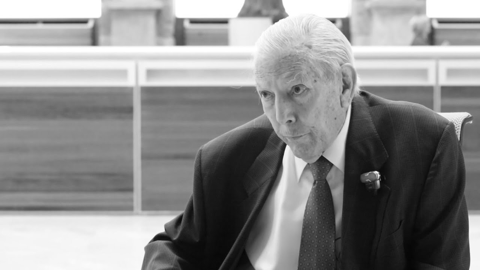
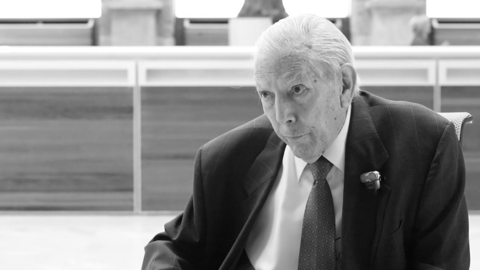
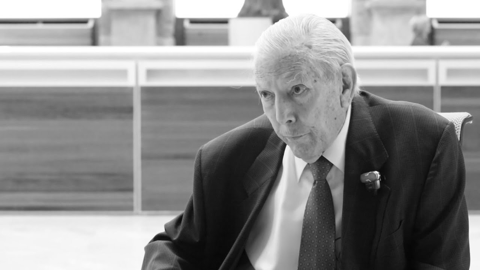
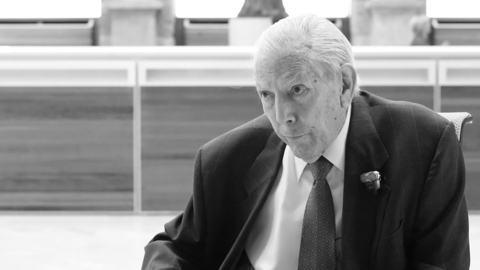
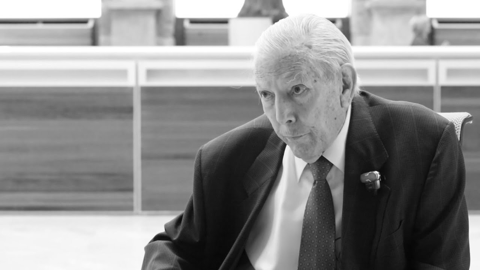
He is the grandson of the founder of Casa Macarrón, a company dedicated to transporting works of art, and helped to evacuate works from the Museo del Prado during the Spanish Civil War, and later return it.
Interview recorded on September 12, 2013
Interview index
6 / 6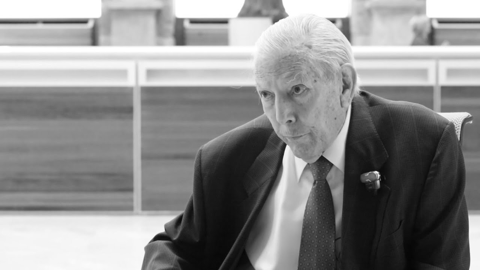
- Included in themes
- A crucial chapter: The Spanish Civil War
- Collective
- Transportation of Works
- Chronology
- 1930-1940
- RDF
- RDF
Theme
--
Voces del Prado