formularioRDF
The itinerary <em>TITULORECORRIDO</em> has been successfully created. Now you can add in works from the Collection browser
<em>TITULOOBRA</em> added to <em>TITULORECORRIDO</em> itinerary

Exhibition Museo del Prado - Fundación BBVA

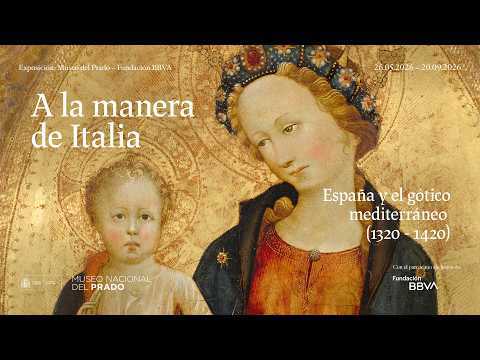
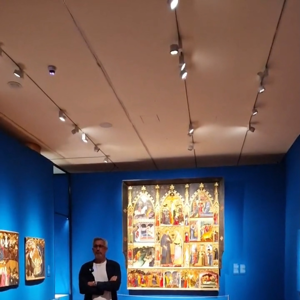
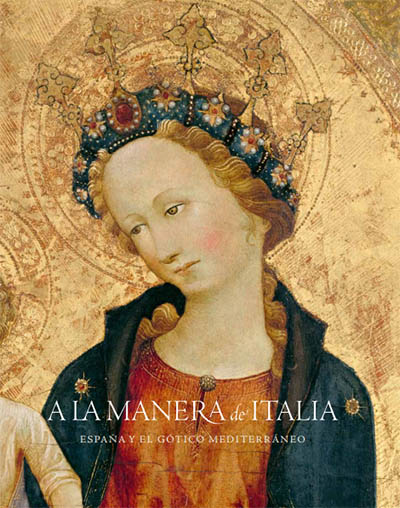
In the Italian Manner. Spain and the Mediterranean Gothic, 1320-1420

Museo Nacional del Prado. Madrid 5/26/2026 - 9/20/2026

Calendar Add to the calendar

The Museo Nacional del Prado and Fundación BBVA are presenting an ambitious exhibition that reassesses how, long before the emergence of the Renaissance, Italy set the pace for a profound transformation in which the Hispanic kingdoms were one of the principal spaces of reception.

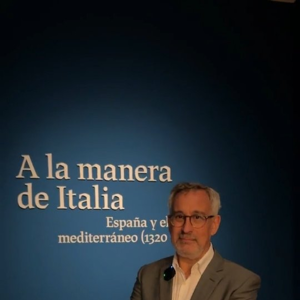
Curated by Joan Molina Figueras, head of the Collection of European Painting up to 1500, the exhibition features more than one hundred works in a range of techniques (painting, sculpture, goldsmithing, illuminated manuscripts, drawings, embroidery, silk textiles, and more), loaned from 31 Spanish and 25 international institutions. These works allow for an analysis of how Italian Trecento models were assimilated and reformulated by Spanish artists, resulting in a hybrid, sophisticated and highly original visual language.

The works on display include examples by both leading Italian masters, such as Ambrogio Lorenzetti, Gherardo Starnina, Lupo di Francesco, Barnaba da Modena, Andrea di Petruccio and Geri Lapi, and prominent Hispanic figures, such as Ferrer and Arnau Bassa, the Serra brothers, Pedro de Córdoba and Miquel Alcañiz.

Far from presenting a one-sided narrative, the exhibition underscores the complexity of these artistic exchanges and includes a revealing final twist: the impact of Spanish art on Italy. The result is a two-way dialogue that challenges the traditional boundaries between centres and peripheries of late medieval European art.

Long before the Renaissance swept across Europe, Italy was the birthplace of an artistic revolution spearheaded by masters such as Giotto, Duccio, Simone Martini and the Lorenzetti brothers, a revolution destined to resonate across the continent. It is not by coincidence that the Hispanic kingdoms were among the first Western regions to embrace the artistic manifestations of the Italian Trecento, where they astonished viewers due to their innovative aesthetic and technical refinement. In addition to the highly effective Mediterranean communication networks (commercial, diplomatic, political, etc.,) that facilitated the arrival of artists and works, Spanish masters paid particular attention to the innovations emanating from the Italian peninsula. This was a fascinating creative sensibility.

Among the principal arguments demonstrated in this exhibition is the fact that in the hands of Hispanic masters, the Trecento style was a true lingura franca, open to a wide range of versions and adaptations. It thus served as a starting point for refined, hybrid works that transcend conventional artistic categories. In the creations of Ferrer and Arnau Bassa, for example, Italian formulas merged with elements of French and Neo-Byzantine origin, resulting in a synthesis unparalleled in the Italian world. Images not only travelled: they were translated and acclimatised, generating diffuse and hybrid identities arising from the fertile conjunction of different aesthetic approaches.

The Spanish masters’ creativity is evident in areas other than purely formal ones. These include iconography, with the appearance of interesting variations on themes and compositions of Italian origin, from Roman Marian icons to the extensive imagery generated by the new Franciscan saints. In other cases, the change is reflected in the meanings acquired when imported works were introduced into different visual and mental contexts. In this sense, Italian models and prototypes took on a new life and a second nature through their transfer to the Iberian Peninsula.

The originality of the Hispanic masters is evident in their use of distinctive formats for panel painting, such as the monumental altarpiece, the preferred “stage machinery” for presiding over places of worship. Altarpieces were also the favoured medium for experimenting with sophisticated, mixed-method painting techniques. As in Italy, the application of gold was not just decoration but rather an aesthetic strategy that allowed for the emulation of the textures and sumptuousness of costly fabrics, brocades and jewels. This was continued further, transforming the surfaces of large altarpieces into active backgrounds that absorb and modulate the light according to its intensity and the viewpoint. In the hands of the Hispanic Trecento painters, the altarpiece became an optical and symbolic experience.

The exhibition concludes with an unexpected twist that illustrates the extent to which the vagaries of artistic exchange defy any preconceptions or categories established by traditional art-historical approaches. While the exhibition’s principal focus is the influence of Trecento Italian models on the artistic landscape of the Hispanic kingdoms, the final section is devpted to analysing the reverse. The key figure here is Gherardo Starnina, a Tuscan master who, following a period spent in the Crowns of Castile and Aragon, agitated the artistic milieu of early 15th-century Florence with the innovative late Gothic style he had adopted during his time in Valencia. The example of Starnina reveals that the permeability of artistic contexts, observed up to this point in the exhibition from the Hispanic perspective, also affected the Italian world. This offers further proof that artistic circulation in the western Mediterranean generated realities rich in distinctive characteristics and alternatives: “In the Italian manner” becomes “In the Spanish manner”.

The exhibition includes over one hundred works in a range of techniques (painting, sculpture, goldsmithing, illuminated manuscripts, drawings, embroidery, silk textiles, etc.), loaned from 31 Spanish and 25 international institutions. Among them are examples by renowned Italian masters such as Ambrogio Lorenzetti, Gherardo Starnina, Lupo di Francesco, Barnaba da Modena, Andrea di Petruccio and Geri Lapi, as well as prominent Spanish artists such as Ferrer and Arnau Bassa, the Serra brothers, Pedro de Córdoba and Miquel Alcañiz.

The exhibition is accompanied by a book by its curator, Joan Molina Figueras, which presents a detailed study and analysis of the themes addressed and the works on display. Many of them will also be the subject of critical analysis at an international conference to be held at the Museo del Prado from 9 to 11 September.

Restoration

The Museo del Prado has restored thirteen of the works included in the exhibition In the Italian Manner. Spain and the Mediterranean Gothic (1320-1420). Three are paintings in Museum’s own collection and the remainder are in other collections. It should be noted that some of them are ensembles comprising several paintings, such as the Altarpiece of Saint Mark and Saint Anianus from Manresa cathedral and the Polyptych of the Virgin lactans from Córdoba cathedral. Also included among these works are two sculptures from the Sanctuary of Lluc.

Over time, many of these paintings suffered from neglect and lack of conservation and in some cases were even modified to adapt their appearance to changing aesthetic tastes. Preparing the present exhibition has involved significant research and restoration, reinstating the transparency of the colours and the gilding, which were obscured and dulled by previous interventions. The restoration undertaken at the Museum by specialists in sculpture, painting, wood supports and frames has largely succeeded in recovering the original luminosity and technical perfection of the works.

Curator:
Joan Molina Figueras, Head of the Collection of European Painting up to 1500

Access

Room A, B . Jerónimos Building

RDF

RDF

With the sole sponsorship of:
Fundación BBVA

Multimedia

Exhibition

The exhibition

The exhibition
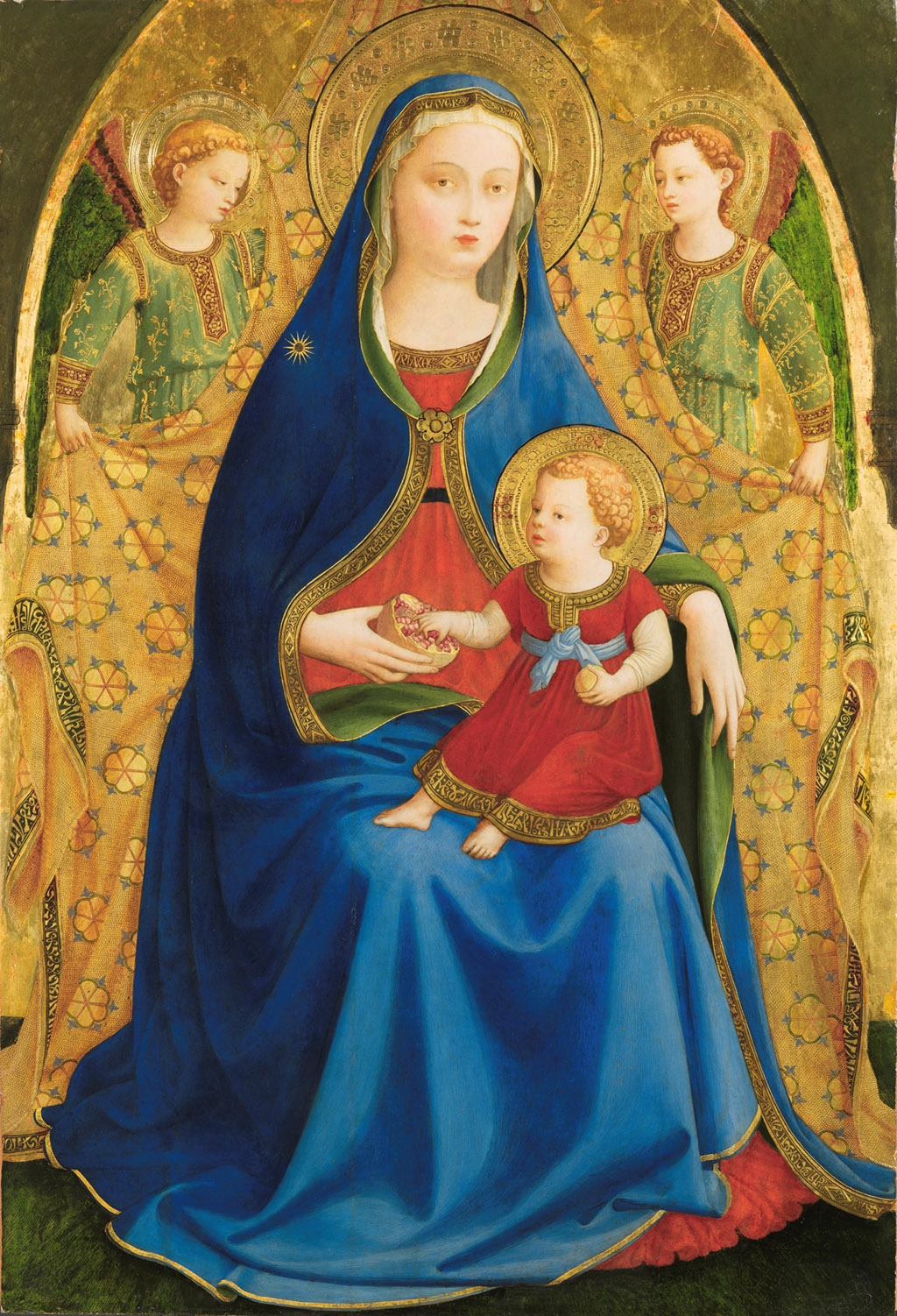
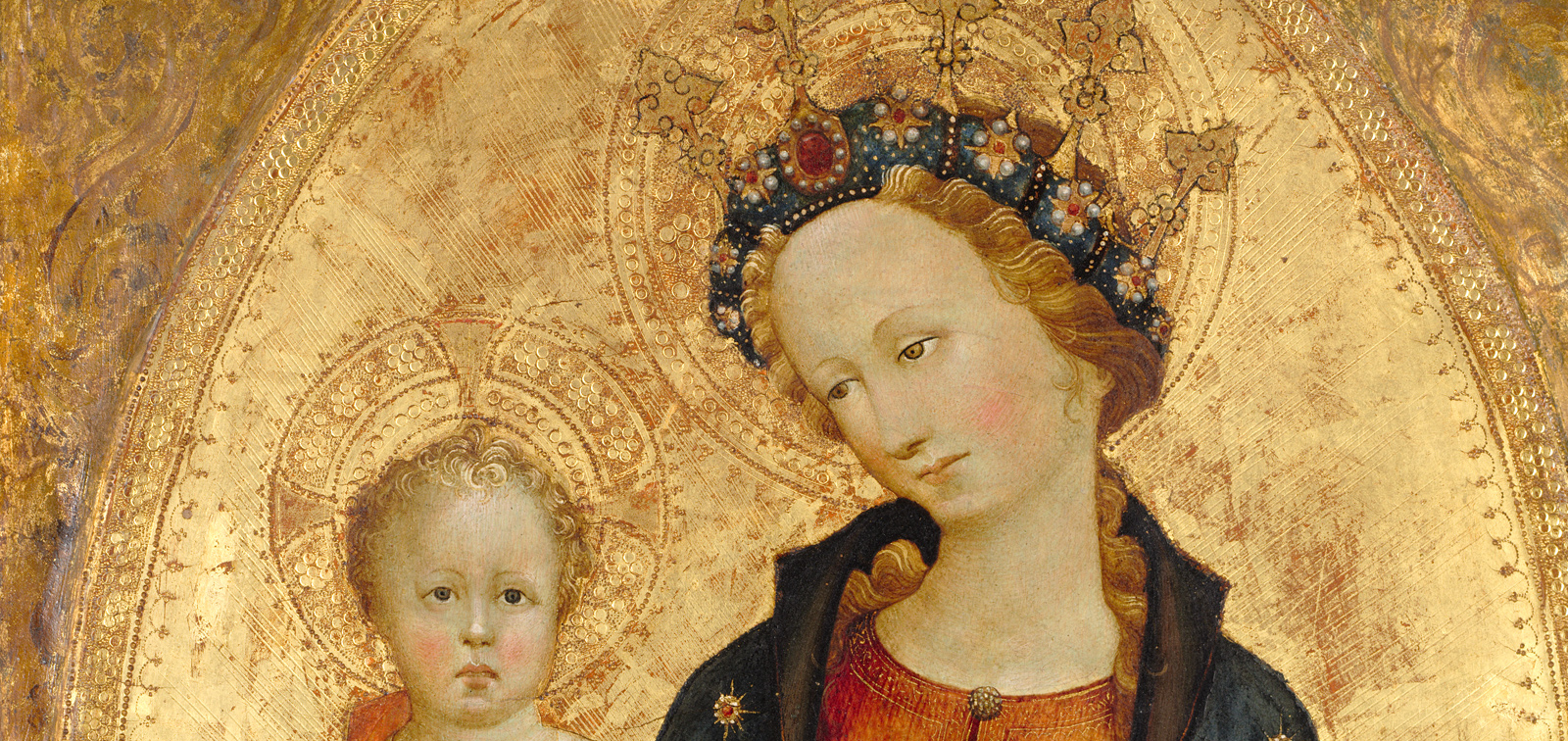
The Virgin with the Pomegranate

Fra Angelico
Ca. 1426
Tempera on panel
87 x 59 cm

Madrid, Museo Nacional del Prado

As a result of intense exchanges across the Mediterranean, the Spanish kingdoms were the first areas of the West to be receptive to the artistic expressions of the Italian Trecento. Championed by Giotto, Duccio, Simone Martini and the Lorenzetti brothers, among others, these artworks amazed viewers on the Iberian Peninsula with their innovative aesthetic and technical sophistication. 

In the hands of Spanish masters, the Italian Trecento language became something of a lingua franca prone to all kinds of versions and adaptations, a starting point for creating refined works that were excitingly original (in aesthetic, iconography and type) and defy conventional artistic categories. Images did not just travel; they were interpreted and became acclimatised, and in the process gave rise to blurred and hybrid identities stemming from the productive convergence of different approaches. This atmosphere of fruitful creativity also saw the emergence of new forms of multi-material painting: the application of gold became a technical strategy that made it possible to mimic the textures of luxury fabrics and, especially, to transform large Spanish altarpieces into scenic devices that generated optical and symbolic experiences. 

Far from proposing a one-sided narrative, the exhibition highlights the complexity of these artistic exchanges with a revealing ending: the impact of Spanish Late Gothic culture on Italy. This final twist demonstrates the extent to which the Mediterranean routes erased the traditional boundaries between centre and periphery, replacing them with a world of crossroads and fascinating alternatives.

1. Before the Black Death. Inflections of Italian Art

1. Before the Black Death. Inflections of Italian Art
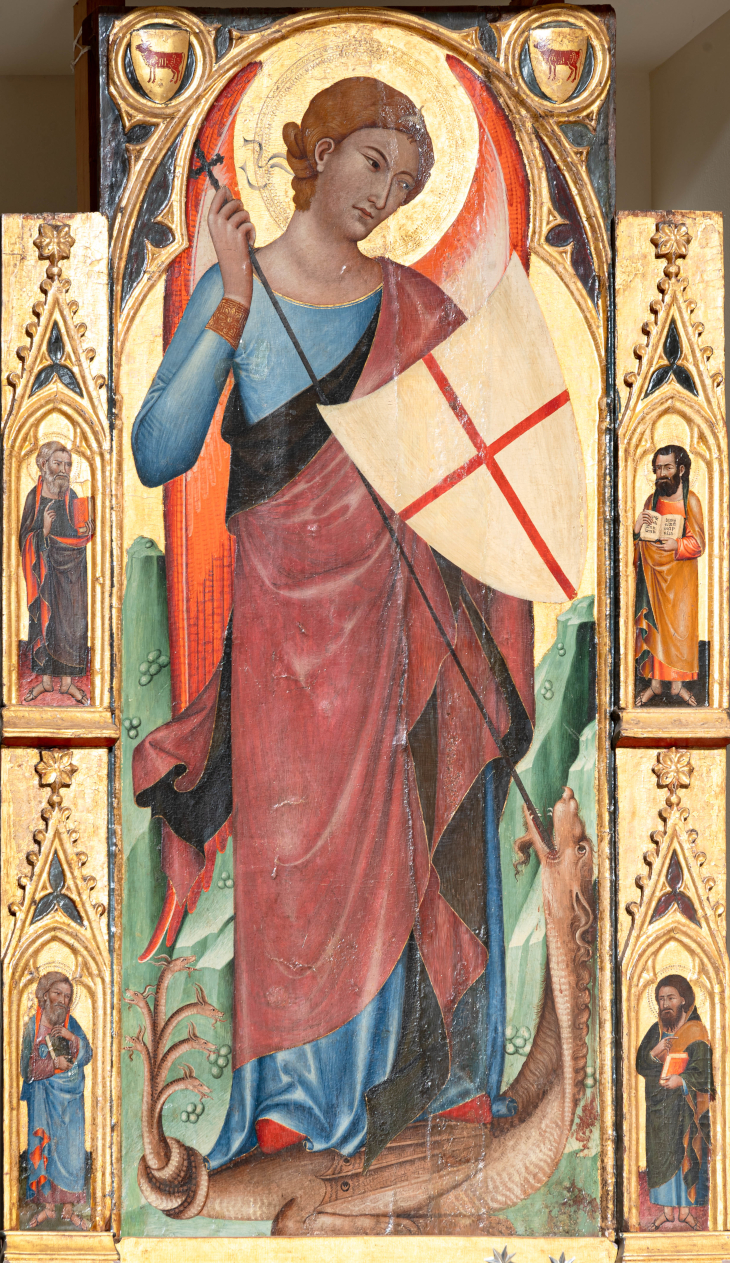
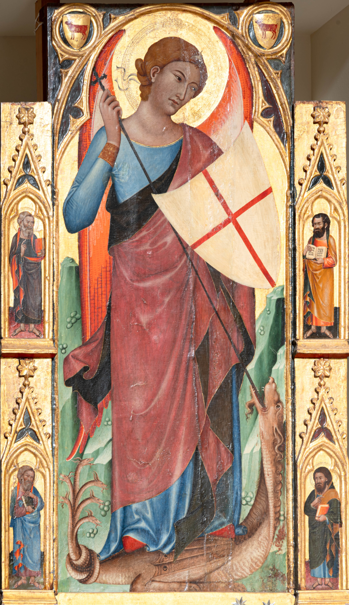
The Archangel Saint Michael 

Ferrer Bassa 

Tempera and gold leaf on panel, 182 × 111.5 cm

c. 1335

Sot de Ferrer (Castellón), Iglesia parroquial de la Inmaculada Concepción

The assimilation of the new aesthetic trends that emerged in Italy was stimulated by the most distinguished patrons of Aragonese and Mallorcan society. Beginning in the 1320s, they encouraged the arrival of Italian masters and the importation of works from the Italian peninsula, but above all they fostered the activity of local artists familiar with the new artistic language, particularly painters and miniaturists. Joan Loert in the kingdom of Mallorca and Ferrer Bassa and his son Arnau in the Crown of Aragon were the most prominent artists. Their respective interpretations or reworkings of Italian models gave rise to hybrid designs that were highly original both in their formal features and in their application to new supports – such as altarpieces – and innovative cycles of images. The result is a series of works that have a heavy Italian accent yet are unmistakeably Spanish. This output speaks for itself about the distinctive character of the visual language created by these local masters’ brushes. Although the devastating Black Death claimed the lives of the main architects of this renewal, its seed sprouted.

On a Mediterranean Island: Joan Loert and Collaborators

Located at the intersection of Mediterranean trade routes, the short-lived kingdom of Mallorca (1276–1349) was one of the earliest scenes of hybridisation between local artistic styles and Italian Trecento models. A prominent figure in the 1330s and 1340s was Joan Loert, known as the Master of the Privileges, a painter and miniaturist first documented in Perpignan and later in Palma de Mallorca, where he worked for the court of James III, Bishop Berenguer Batle and institutions of the urban oligarchy. As a painter of altarpieces and illuminator of luxury manuscripts, he relied on the collaboration of other masters. This explains the various hands that are recognisable in his works, despite the evident unity of language.

Ferrer Bassa: Pioneer and Master

Following a more than likely trip to Italy, in Barcelona Ferrer Bassa developed his own personal interpretation of Tuscan painting, particularly Sienese, which he combined with elements of the linear French Gothic tradition and even Byzantine art. From the Italian world he also incorporated religious iconographic themes – particularly from the Gospels – and ideas for developing the new format of the monumental altarpiece. The result is a more complex and innovative artistic language than that proposed by Joan Loert. From the 1330s onwards, it captivated the most refined circles of the Crown of Aragon, from King Peter IV – who gave him numerous commissions – to the members of the wealthiest guilds. Beginning in 1340, Ferrer was aided by his son Arnau. After both artists died during the Black Death epidemic, their visual innovations became an essential reference for the masters of the second half of the 1300s, from his workshop’s successors, such as Ramon Destorrents, to the prolific Serra brothers.

Arnau Bassa and Bassian Mannerism

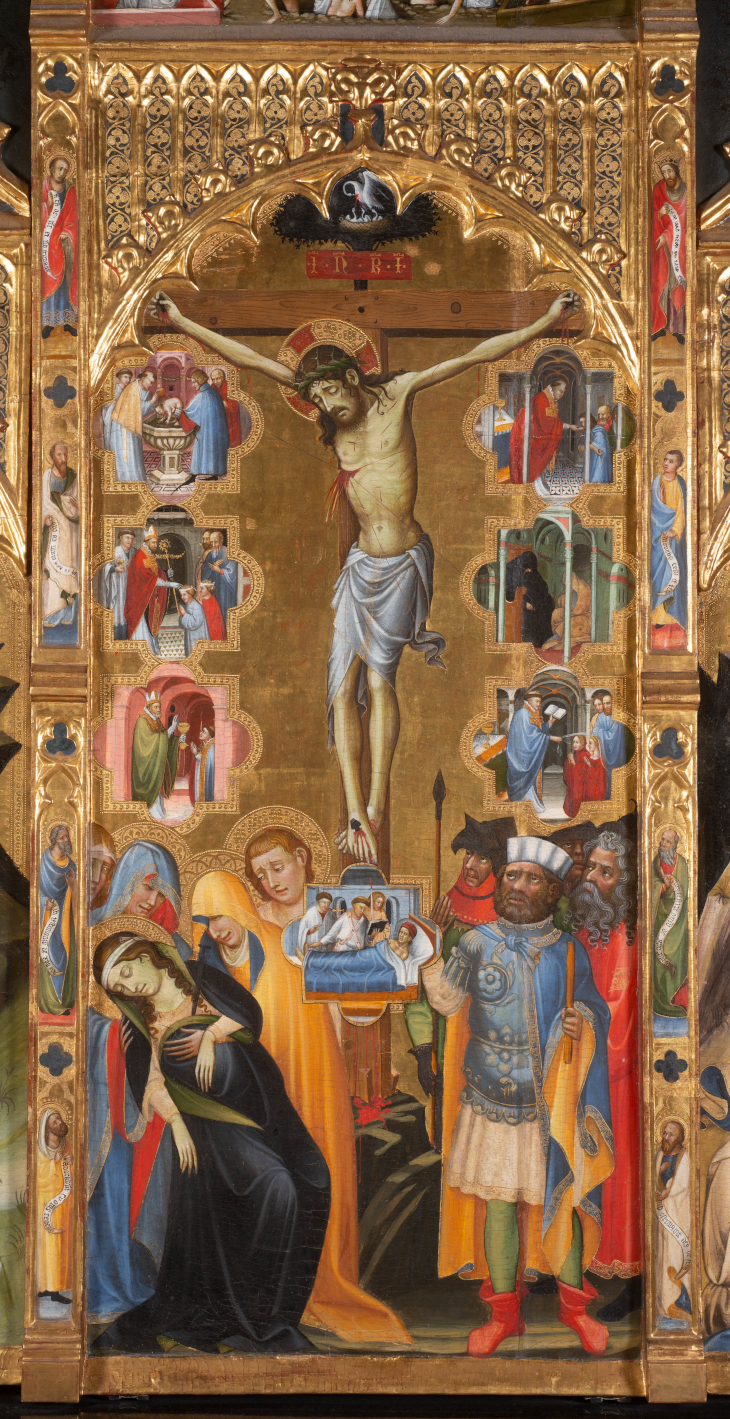
Arnau Bassa brought a new twist to his father’s pictorial language during the final years the family workshop operated. Drawing on the new Sienese approaches practised in Avignon by Simone Martini and his numerous followers, Arnau developed a sort of formal mannerism that progressed towards more sophisticated and innovative solutions. He accordingly sought three-dimensional effects, while also embracing a greater formal stylisation and, above all, enhancing the multi-material aspect of his paintings through a growing use of gold and goldwork techniques. As demonstrated by the altarpiece of Saint Mark and Saint Anianus, Arnau also built on his father's contributions to the establishment of the monumental type of altarpiece: a large-scale structure with a fixed format, several sections and pilasters and a marked vertical thrust, which foreshadowed the evolution of these scenic constructions in the Gothic art of the Iberian Peninsula over the following centuries.

2. The Bridge of Avignon. Mediterranean Exchanges

2. The Bridge of Avignon. Mediterranean Exchanges
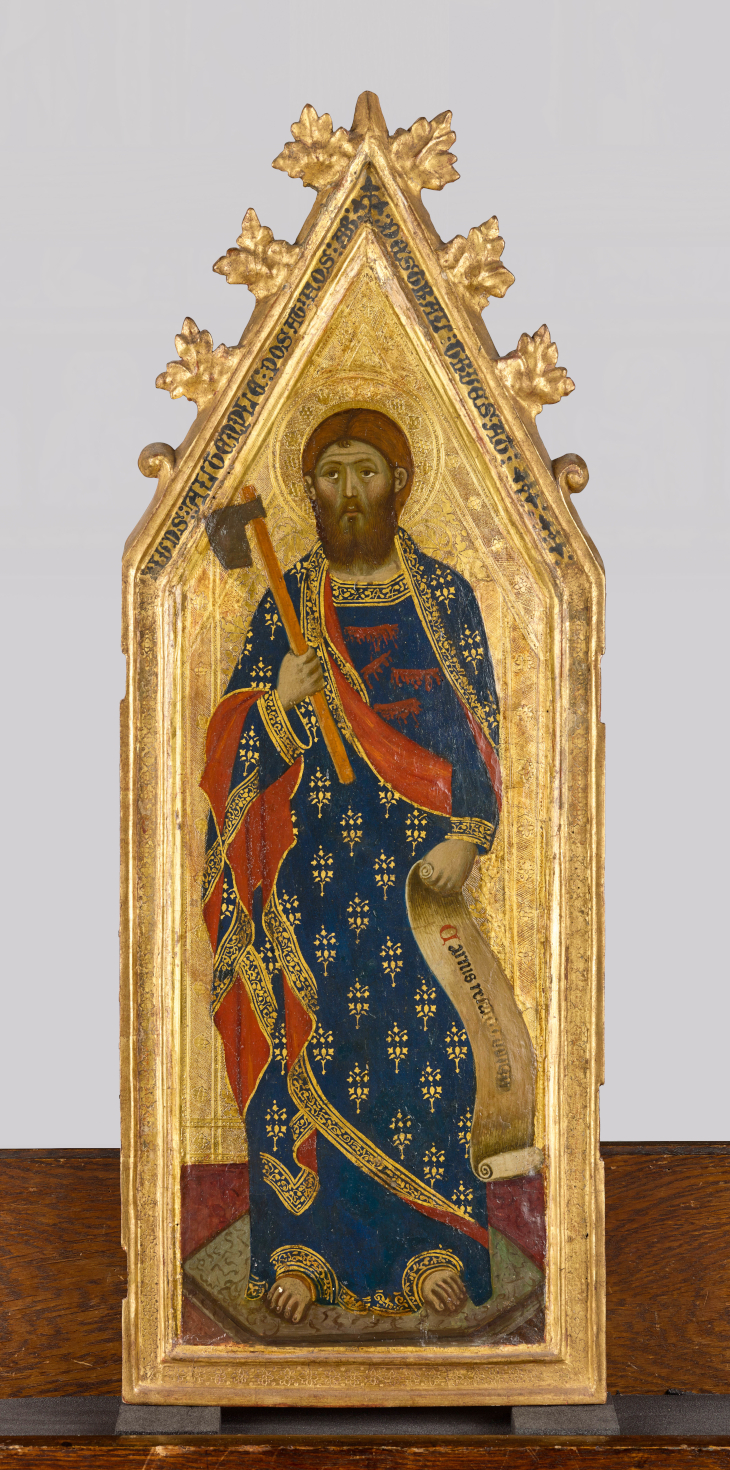
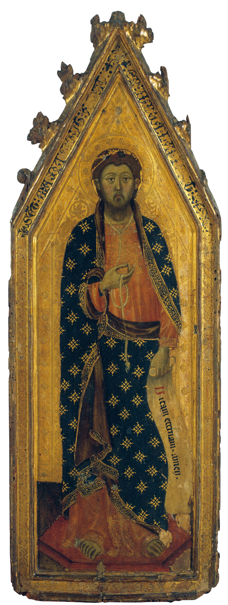
Saint Jude 

Ramon Destorrents and workshop

Tempera and gold leaf on panel, 76.5 × 28.5 cm (each)

c. 1355–60 

Lille, Palais de Beaux-Arts, p798, p799 and p800 

Geography is a determining factor: the sea erases borders and is conducive to cultural exchanges. Notable among the Mediterranean hubs that fostered artistic relations in the early 1300s was Avignon, the papal capital between 1307 and 1403. Reached by sailing up the Rhône, it was a cosmopolitan city that welcomed Italian painters and goldsmiths, particularly Sienese, headed by Simone Martini and his circle. Some of them arrived in the Crown of Aragon, where they influenced the careers of masters such as Arnau Bassa and helped shape the artistic landscape of the mid-1300s. In addition, works produced in Avignon were acquired by Spanish clergymen: at the papal court, such as Benedict XIII or Cardinal Gil Álvarez de Albornoz. And merchants from the western Mediterranean satisfied the aesthetic and devotional concerns of the elites of the Iberian Peninsula with innovative and sophisticated Italian works. This occurred in Castile, where this trade coincided, perhaps not by chance, with Henry II Trastámara’s accession to the throne: dynastic change went hand in hand with a shift in artistic taste.

The Neo-Byzantine Aesthetic of Barnaba da Modena

Beginning in around 1360, Barnaba da Modena ran a workshop in Genoa that achieved great success by blending Neo-Byzantine formulas with the precepts of fourteenth-century Bolognese and Sienese naturalism. Merchants plying the western Mediterranean transported some of his works – which he proudly signed – to places far beyond the Ligurian city. The three on display here found their way to Murcia. Two were acquired by Queen Juana Manuel, wife of Henry II of Castile: the Dossal of the Virgin nursing the Child (which shows her and her father kneeling before the Virgin) and the side panels of a triptych (in one of which she is depicted beside her cousin). The third, the Polyptych of Saint Lucy, may have been commissioned by Fernando Oller, a member of the Murcian oligarchy, who is portrayed with his wife in the Crucifixion scene. The paintings reflect devotional concerns and a desire for self-representation and prestige. However, Barnaba's attractive and exotic works were most likely chosen as visual statements by members of the elite who supported the new Trastámara dynasty and wished to distinguish themselves from traditional tastes.

3. Between Court and Convent. New Images for New Themes

3. Between Court and Convent. New Images for New Themes
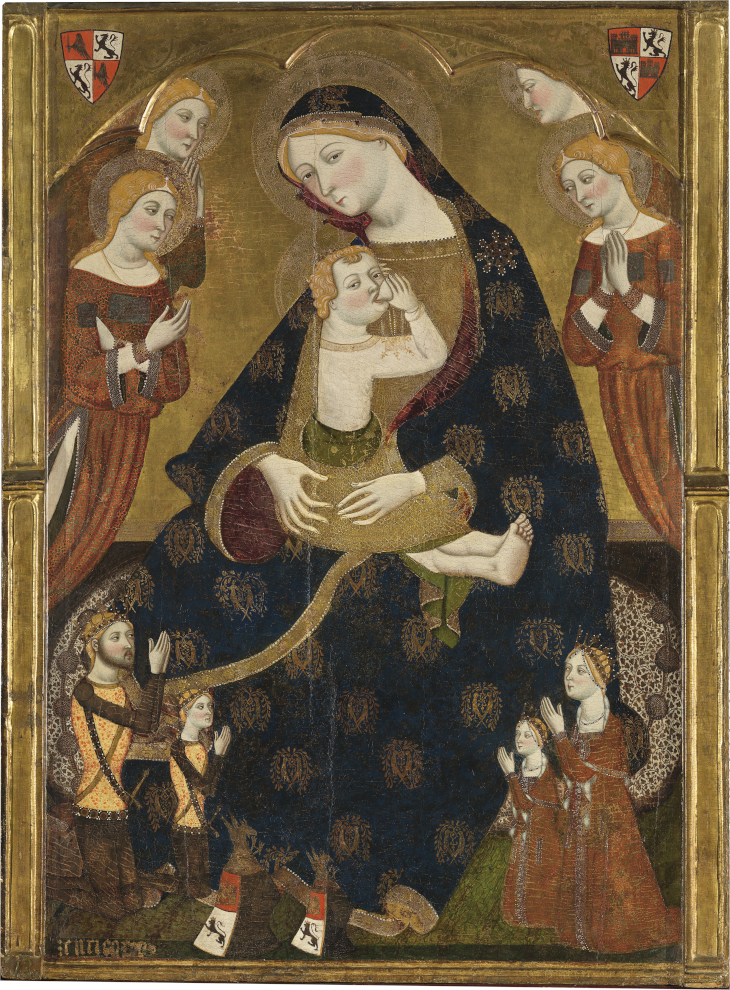
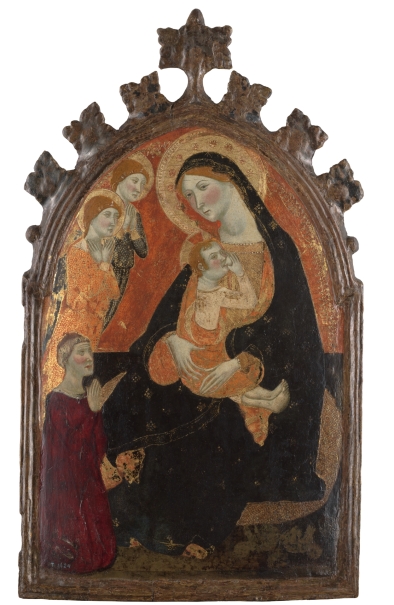
Virgin of Humility with Donors Henry II of Castile, Juana Manuel and their Two Children (Virgin of Tobed)

Jaume Serra 

Tempera and gold leaf on panel, 161.4 × 117.8 cm 

c. 1366–69

Madrid, Museo Nacional del Prado, Várez Fisa Family Bequest, 2013, p-8117

The assimilation of Italian models also involved incorporating themes originating from Italy, albeit translated and adapted to the reality of the Spanish kingdoms. Monarchs and their courts were particularly active in this regard. They reworked highly symbolic images, such as the Veronica of the Virgin (based on Roman models) or the Virgin of Humility (derived from prototypes developed by Simone Martini in Avignon). In their hands, expressions of piety and culture became displays of power and prestige. Similarly creative iconography is found in certain distinguished convents – Santa Clara in Palma de Mallorca, Santa Maria in Pedralbes (Barcelona) and the Santo Sepulcro in Zaragoza – where the nuns’ way of life was closer to courtly customs than to the rule they had professed. They were refined and permeable spaces, ideal settings for the development of original images and cycles linked to the new forms of mendicant spirituality, as well as of privately commissioned works that reflect the devotions and expectations of their prominent patrons.

The King’s Veronica

Collecting sacred objects was a common practice among medieval monarchs as an expression of their Christian devotion and a means of enhancing their prestige. Notable among the items in the treasure trove of relics assembled by Martin I of Aragon in the chapel of his royal palace in Barcelona is the Veronica of the Virgin, considered an acheiropoietic image (not made by human hands). It is based on the prototype of the Roman Marian icons of the Maria Advocata, a series of Virgins attributed to Saint Luke, though the royally owned image is a close-up of the Virgin’s face, ending at her shoulders. The Veronica of the Virgin achieved great fame and began to be copied soon after 1400. These copies were based primarily on two iconographic prototypes: one very faithful to the original; the other, a freer version. Nowhere in the late medieval West did true images of the Virgin enjoy such success as in the Crown of Aragon.

In the Convent

Themes linked to Franciscan spirituality were subject to particular interpretations in convents inhabited by noblewomen. The cloistered convent of Santa Clara in Palma is a case in point, as it boasts one of the most fascinating collections of early 14th-century paintings, three of which are displayed here: a Dossal of the Passion, probably the work of a Genoese painter with echoes of Byzantine culture (as seen in the scene of the mockery of Christ, featuring musicians playing various instruments); a small panel with an unusual Crucifixion, from the Adriatic region; and a majestic image of Saint Clare by a Mallorcan artist influenced by Pisan-Sienese models. These three works, which are original in iconography, format and aesthetic, illustrate the hybrid approaches characteristic of the art produced in Mallorca, a crossroads of Mediterranean paths and routes. The selection also includes a refined portable altar. A courtly tribute to Franciscan religiosity, it is the result of exchanges between the Balearic Islands and Naples.

Devices for Telling Stories

Building on the Italian-inspired formulas employed by the Bassas, the Serra brothers developed a distinctive pictorial variant in Barcelona. Based on formal elegance – both in the figures and in the decoration of the gilded backgrounds – and on experimentation with iconographic models, it dominated the art scene of the Crown of Aragon throughout the second half of the 1300s. Jaume and Pere progressed towards an aesthetic centred on the combination of colour and gold, of pigment and gilding, which elevated Marian and hagiographic themes to new forms of multisensory perception. Although they employed various formats – some highly innovative, such as the self-contained horizontal panel or bancal – their primary means of expression were altarpieces, to whose typological and monumental development they contributed decisively. With the Serras, altarpieces became ideal supports for structuring narratives, establishing a hierarchy of figures and proposing devotional itineraries. They were scenic storytelling devices.

4. An Enthralling Sight. Fascinating Techniques

4. An Enthralling Sight. Fascinating Techniques
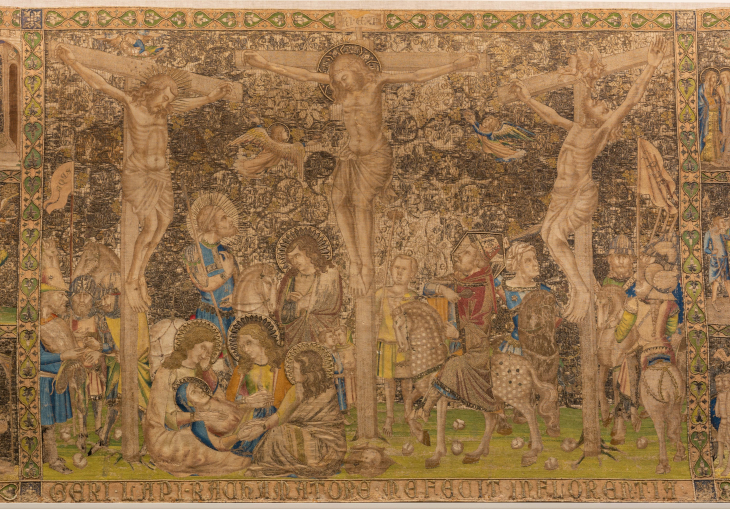
Frontal of the Passion (detail)

Geri Lapi 

Linen cloth embroidered with coloured silks and gold and silver threads, 90 × 331 cm

c. 1346–50

Manresa, Basilica de Santa Maria de la Seu de Manresa–Bisbat de Vic

Technical sophistication and the use of precious materials were another of the defining features of Italian Trecento art and contributed to the success it enjoyed beyond the Italian peninsula. Embroidery with gold and silver threads (opus florentinum), translucent Sienese enamels, polychromed and gilded sculptures, and, especially, paintings – where the refined manipulation of gold made it possible to mimic the texture and sumptuousness of luxury fabrics and jewellery – set the aesthetic standard for patrons and artists in the Spanish kingdoms.

Works crafted from costly and gleaming materials have always aroused curiosity and wonder, reactions that are the prelude to sensory pleasure. When this is combined with the intrinsic complexity of the craftsmanship, the viewer’s admiration is directed both at the excellence of the materials employed and at the technical quality of the end product. As Ovid had stated centuries earlier, ‘Materiam superabat opus’ – the workmanship surpasses the material by transforming it into something dazzling, exceptional and almost inexplicable to the spectator, enthralled by the sight of such sophistication.

From Ivory to Bone: The Triumph of Ingenuity

Combining the techniques of bone carving and intarsia, several Florentine workshops – which moved to Venice in 1395 – produced sumptuous objects such as wedding caskets, mirror frames, and triptychs for private devotion in an almost standardised way. Thanks to the skilful imitation of ivory and the business acumen of Baldassarre Embriachi, they became coveted items on the luxury market, sought after by wealthy Italian merchants and European courts. Their success was also due to their reproduction of scenes from the Trojan cycle, myths taken from Antiquity and reworked into poems and romances in the vernacular language. In keeping with their nuptial function, the caskets on display celebrated the eternity of love, the fidelity of a heroic lover, or female beauty.

5. Return Journeys. In the Spanish Manner

5. Return Journeys. In the Spanish Manner
Altarpiece of the Seven Sacraments 

Gherardo Starnina 

Tempera and gold leaf on panel, 249 × 189 cm

c. 1396–97

Valencia, Museu de Belles Arts, inv. 246

This survey ends with an unexpected twist that illustrates how the vagaries of cultural exchanges refute any a priori assumptions or categories established by traditional historical narratives. Although the exhibition’s argument has so far been centred on the profound influence Italian Trecento models enjoyed in the Spanish kingdoms, this final section examines the situation in reverse. It focuses on Gherardo Starnina, a Tuscan master who, after living in the kingdoms of Castile and Aragon between 1393 and 1402, revolutionised the art scene in early 15th-century Florence with the innovative Late Gothic language adopted during his stay in Valencia. His return journey reveals the extent to which certain artists’ adventures in other parts of the western Mediterranean and the works they left behind gave rise to plural and hybrid realities that are difficult to categorise but essential to understanding the evolution of art forms. It arguably demonstrates how In the Italian manner can end up becoming In the Spanish manner.

Italians in Toledo Cathedral

In the final decade of the 1300s Toledo cathedral became one of the centres of Italianate art outside Italy thanks to Bishop Pedro Tenorio, who commissioned two projects closely linked to Florentine Trecento painting: the great high altarpiece (c. 1388–94) and the chapel of Saint Blaise (c. 1399–1404). Although the altarpiece was replaced by the current one and all that remains of it are a few heavily retouched panels depicting Christological scenes and three figures of apostles, there is every indication that it was the work of Gherardo Starnina. The frescoes decorating the chapel of Saint Blaise are still preserved, but badly deteriorated. Another as yet anonymous Tuscan master was involved in their creation, together with a varied group of painters who, influenced by his style, applied the visual models used in the Toledo chapel to a few works on panel and canvas. Four examples are shown here.

Valencia 1400. The Prodigious Decades

Around 1394 Gherardo Starnina moved to Valencia, one of the most dynamic ports in the western Mediterranean and home to one of the most cosmopolitan artistic communities of the European International Gothic. It was made up of masters from other parts of the Iberian Peninsula, mainly elsewhere in the Crown of Aragon, as well as from all over the continent, from Flanders to Italy. The Valencian art scene from 1390 to 1410 was a dazzling and diverse visual laboratory, a creative melting pot where various aesthetic trends coexisted and blended with each other. As the works in this section demonstrate, there was a preference for whimsical curvilinear forms and intense colours, as well as for gold backgrounds and luxurious fabrics reproduced using a variety of materials. Most commissions, particularly altarpieces, were undertaken by several artists – often from varied backgrounds – working in partnership, a system which fostered artistic exchange.

Gherardo Starnina’s Conversion to Valencian Late Gothic

The International Gothic traits adopted by Pere Nicolau and Marçal de Sas steered Starnina’s Florentine visual culture towards an approach defined by the coexistence and blending of the two models then in vogue. Formulas based on volume and space – learned as part of his training in Agnolo Gaddi’s workshop and consolidated in the high altarpiece of Toledo cathedral – were accordingly adapted five years later to the decorative exuberance of golden surfaces, saturated colours and flowing lines. After leaving Toledo and coming into contact with the dynamic artistic milieu of late 14th-century Valencia, Starnina evolved into a more complex and hybrid painter who defies the strict categories established by art historical studies. The presence of drawings by both Starnina and Marçal in the Valencian sketchbook now in the Uffizi confirms this fascinating convergence.

The Return of a Gentle and Courteous Painter

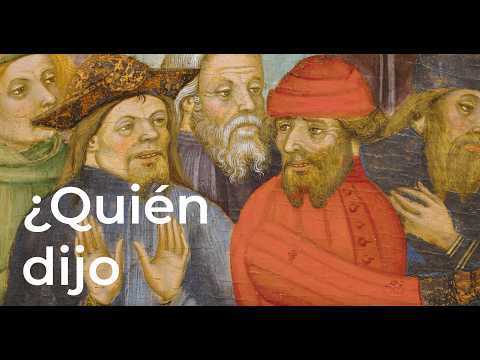
The Gherardo Starnina who returned to Florence in 1402 was a master who, rather than eschewing outright the spatial sense and solidity of form characteristic of his Tuscan culture, succeeded in blending them with a fluid and rebellious line, a kaleidoscopic use of colour, and a profusion of fantasy in his handling of the gilded areas. Giorgio Vasari described this transformation in the 16th century, noting that when he left Italy, he was ‘exceedingly harsh and rude’ and that in Spain ‘he learned to be gentle and courteous’. What is beyond doubt is that when he returned to Tuscany his sophisticated Late Gothic language was something of a provocation in early 15th-century Florence, which was still dominated by conservative trends stemming from the post-Giottesque tradition.  Together with Lorenzo Ghiberti, Starnina spearheaded the introduction of International Gothic to Florence, a style that attracted a legion of followers, most notably Lorenzo Monaco and Fra Angelico. It is fair to say that it all began with Starnina.

Artworks

1
Saint Nicholas resuscitates a Young Boy and The Miracle of the Grain Ships

Ambrogio Lorenzetti 

Tempera and gold leaf on panel, 95.8 x 52.3 cm

c. 1332–34

Florence, Gallerie degli Uffizi, inv. 1890 n. 8349

2
Candle-bearing angels from the reliquary tomb of Saint Eulalia

Lupo di Francesco 

Carved and gilt marble (angels), chased metal plate (wings) and turned wood (candle), 93 × 46 × 45 cm

c. 1327–39

Barcelona, Santa Església Catedral Basílica Metropolitana, inv. 2521058 and 2521073

3
Candle-bearing angels from the reliquary tomb of Saint Eulalia

Lupo di Francesco 

Carved and gilt marble (angels), chased metal plate (wings) and turned wood (candle), 93 × 46 × 45 cm

c. 1327–39

Barcelona, Santa Església Catedral Basílica Metropolitana, inv. 2521058 and 2521073

4
Virgin and Child (from the Della Gherardesca tomb)

Lupo di Francesco

Marble, 110 × 55 × 35 cm

c. 1320–30

Pisa, Museo Nazionale di San Matteo, iccd 00235635

5
Innocentii Papae IV. Apparatus in quinque libros Decretalium

Central Italian miniaturist 

Illuminated parchment, 470 × 300 mm

c. 1335–45

Paris, Bibliothèque nationale de France, Département des manuscrits, Ms. Lat. 3988

6
Altarpiece of Saint Quiteria

Joan Loert (Master of the Privileges)

Tempera and gold leaf on panel, 202 × 247 cm

c. 1337

Palma de Mallorca, Museu de Mallorca, long-term loan from the Societat Arqueològica Lul·liana, da05/09/0019 

7
Llibre dels Reis. Còdex de franqueses i privilegis del Regne de Mallorca

Joan Loert (Master of the Privileges)

Illuminated parchment, 410 × 325 mm

c. 1339–41

Palma de Mallorca, Arxiu del Regne de Mallorca, Cod. n. 1

The Archangel Saint Michael
8
The Archangel Saint Michael

Ferrer Bassa 

Tempera and gold leaf on panel, 182 × 111.5 cm

c. 1335

Sot de Ferrer (Castellón), Iglesia parroquial de la Inmaculada Concepción

9
Psalterium Cantuariense (Anglo-Catalan Psalter, also called Canterbury Psalter)

Ferrer Bassa and workshop

Illuminated parchment, 480 × 332 mm

c. 1180–1200. Catalan part, c. 1340–45

Paris, Bibliothèque nationale de France, Département des manuscrits, Ms. Lat. 8846

10
Scenes from the Life of Christ, the Life of the Virgin, and Saints (Morgan Polyptych)

Ferrer Bassa

Tempera and gold leaf on panel, 57.2 × 105.4 cm

c. 1340–45

New York, The Morgan Library & Museum, Purchased by Pierpont Morgan, 1907, az071

11
Altarpiece of Saint Mark and Saint Anianus

Arnau Bassa 

Tempera and gold leaf on panel, 225 × 254 cm

1346

Manresa, Basilica de Santa Maria de la Seu de Manresa–Bisbat de Vic

12
Saint James the Greater, Crucifixion and Saints (from the altarpiece of Saint James the Greater in Santa Maria de Jonqueres, Barcelona)

Arnau Bassa 

Tempera and gold leaf on panel, 246 × 103.5 cm

c. 1347

Barcelona, Museu Diocesà, mdb 30

13
Annunciation, Magi and Saints (from the altarpiece in the Col·legiata de Sant Vicenç in Cardona)

Arnau Bassa

Tempera and gold leaf on panel, 282.9 × 151 cm

c. 1347–48

Barcelona, Museu Nacional d’Art de Catalunya, Adquisició, 1906, mnac 015855

14
Saint Stephen preaching in the Synagogue

Bassas’ workshop

Tempera and gold leaf on panel, 55 × 44 cm

c. 1347–48

Barcelona, Museu Nacional d’Art de Catalunya, Adquisició, 1950, mnac 44527

15
Jesus Christ receiving Saint Stephen’s Soul

Bassas’ workshop

Tempera and gold leaf on panel, 55 × 44 cm

c. 1347–48

Barcelona, private collection

16
Gamaliel revealing to the Priest Lucian where Saint Stephen is Buried

Bassas’ workshop

Tempera and gold leaf on panel, 55 × 44 cm

c. 1347–48

Barcelona, private collection

17
Maimonides’ Guide for the Perplexed

Bassas’ workshop

Illuminated parchment, 194 × 133 mm

c. 1348

Copenhagen, Det Kgl. Bibliotek - Royal Danish Library, Cod. Heb. 37

18
Crucifixion

Master of Pedralbes (formerly called Master of the Cross of Mombaroccio) 

Tempera and gold leaf on panel, 120 × 152 cm

c. 1350–55

Oviedo, Museo de Bellas Artes de Asturias, Colección Pedro Masaveu, inv. 143

19
Tabernacle of the Virgin of Humility

Francesco di Vannuccio 

Tempera and gold leaf on panel, 64 × 37 × 11 cm

c. 1355–60

Siena, Collezione Fondazione Monte dei Paschi di Siena, fmps 101551 (2642)

20
Liber Sextus Decretalium cum apparatu Ioannis Andreae

Lippo Vanni 

Illuminated parchment, 471 × 298 mm

c. 1345–50

Vic, Arxiu i Biblioteca Episcopal, Ms. 141, fol. 1

21
Chalice and paten of Saint Secundus

Andrea di Petruccio 

Embossed gilt copper, decorated with enamels, 23.5 × 12.5 cm (chalice) and 22.5 cm diam. (paten)

c. 1340–55

Ávila, S. A. I. Catedral del Salvador

22
Chalice and paten of Saint Secundus

Andrea di Petruccio 

Embossed gilt copper, decorated with enamels, 23.5 × 12.5 cm (chalice) and 22.5 cm diam. (paten)

c. 1340–55

Ávila, S. A. I. Catedral del Salvador

23
Crozier of Pope Luna (Benedict XIII)

Sienese goldsmiths

Silver and enamel, cast and embossed, 51 × 13 × 4.5 cm

c. 1310–20, with modifications dating from 1342–55 and after 1394

Madrid, Museo Arqueológico Nacional, inv. 52160

24
Last Judgement and Double Intercession of Christ and the Virgin (upper register) and Birth of the Virgin and Presentation in the Temple (lower register), paintings decorating the tomb of Miguel Sánchez de Asiáin, bishop of Pamplona

School of Avignon

Mural painting in tempera transferred to canvas, 395 × 243 cm

c. 1360–75

Pamplona, Museo de Navarra, ce000046

25
Saint Paul, Saint Matthew and Saint Jude

Ramon Destorrents and workshop

Tempera and gold leaf on panel, 76.5 × 28.5 cm (each)

c. 1355–60 

Lille, Palais de Beaux-Arts, p798, p799 and p800 

26
Saint Paul, Saint Matthew and Saint Jude

Ramon Destorrents and workshop

Tempera and gold leaf on panel, 76.5 × 28.5 cm (each)

c. 1355–60 

Lille, Palais de Beaux-Arts, p798, p799 and p800 

27
Saint Paul, Saint Matthew and Saint Jude

Ramon Destorrents and workshop

Tempera and gold leaf on panel, 76.5 × 28.5 cm (each)

c. 1355–60 

Lille, Palais de Beaux-Arts, p798, p799 and p800 

28
Saint John the Evangelist and Saint James the Greater

Ramon Destorrents and workshop

Tempera and gold leaf on panel, 75.5 × 28.2 cm (each)

c. 1355–60 

Krakow, The National Museum in Krakow, The Princes Czartoryski Museum

29
Saint John the Evangelist and Saint James the Greater

Ramon Destorrents and workshop

Tempera and gold leaf on panel, 75.5 × 28.2 cm (each)

c. 1355–60 

Krakow, The National Museum in Krakow, The Princes Czartoryski Museum

Saint Matthias
30
Saint Matthias

Ramón Destorrents and Workshop

Tempera and gold leaf on panel, 77.5 × 28.3 cm

c. 1355–60 

Barcelona, Museu Nacional d’Art de Catalunya, Legado de Rosa Lorenzale, 1919

31
Saint Gabriel and Virgin Mary

Florentine workshop (?)

White marble with remains of gilding, 55 × 29 × 14 cm and 52 × 13 × 18 cm

c. 1375–1400

Escorca (Mallorca), Santuario de Lluc 

32
Saint Gabriel and Virgin Mary

Florentine workshop (?)

White marble with remains of gilding, 55 × 29 × 14 cm and 52 × 13 × 18 cm

c. 1375–1400

Escorca (Mallorca), Santuario de Lluc 

33
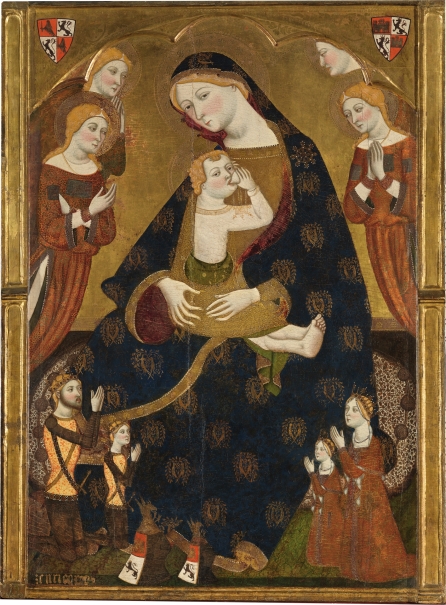
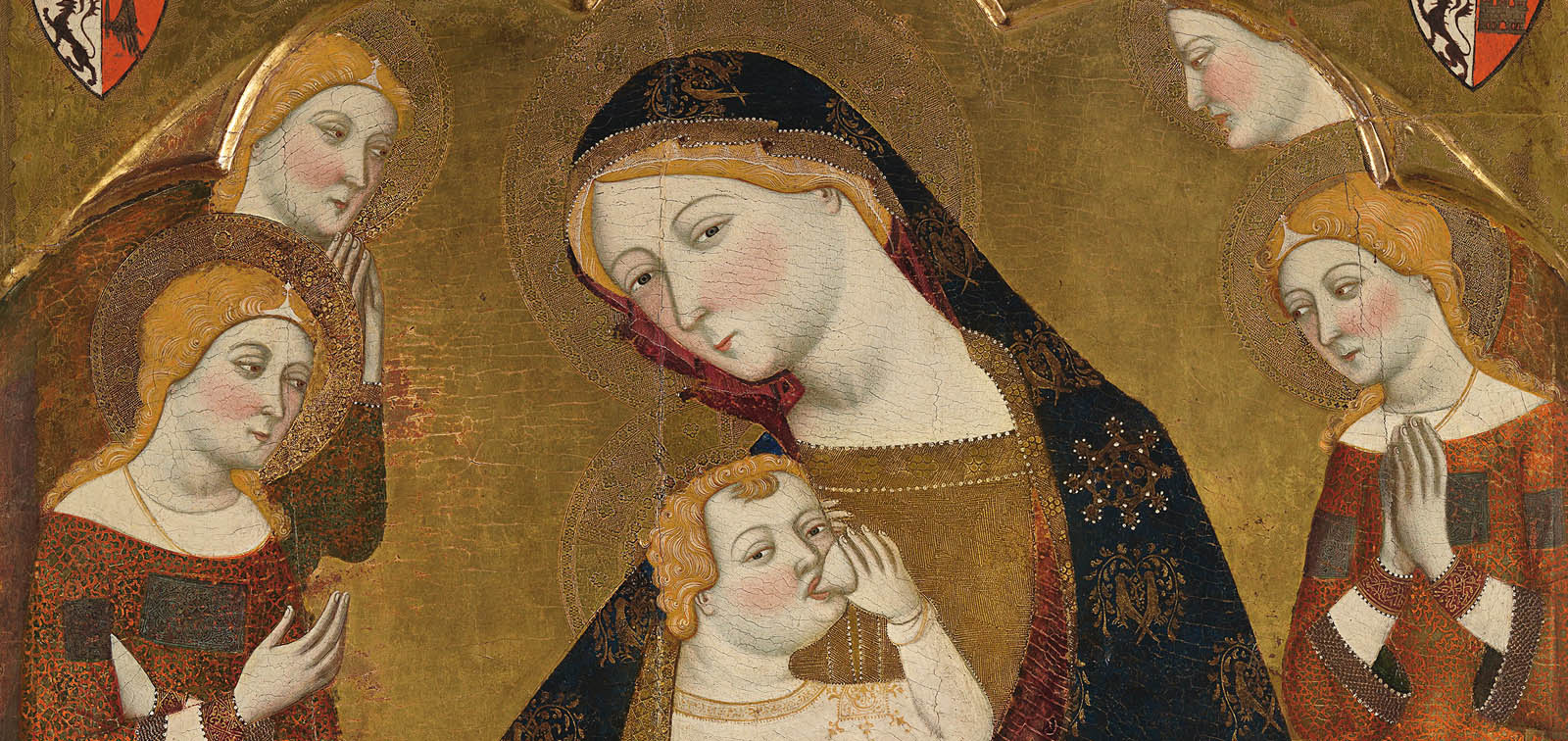
Polyptych of the Virgin nursing the Child

Pedro de Córdoba 

Tempera and gold leaf on panel, 165 × 83 cm (central panel) and 142 × 50 cm (each side panel)

c. 1360–70

Córdoba, Museo Diocesano, inv. 226 and inv. 192–195

34
Dossal of the Virgin nursing the Child

Barnaba da Modena 

Tempera and gold leaf on panel, 106 × 223 cm

c. 1369–72

Murcia, Museo de la Catedral, iic Murcia, 3

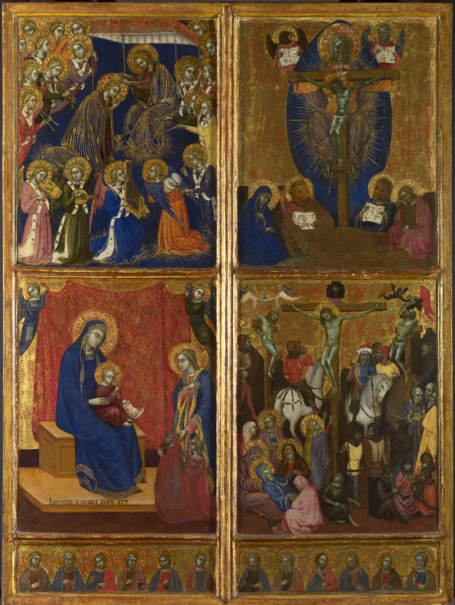
The Coronation of the Virgin; The Virgin and Child; The Trinity; The Crucifixion and The Twelve Apostles
35
The Coronation of the Virgin; The Virgin and Child; The Trinity; The Crucifixion and The Twelve Apostles

Barnaba da Modena 

Tempera and gold leaf on panel, 82 × 60.7 cm 

1374

London, The National Gallery, Presented by Rosalind, Countess of Carlisle, 1913, ng2927

36
Polyptych of Saint Lucy

Barnaba da Modena 

Tempera and gold leaf on panel, 289 × 223 cm

c. 1375–77

Murcia, Museo de la Catedral, ii Murcia, 4

37
Leges Palatinae. Sanctiones regie sacram ipsam domum concernentes

Joan Loert (Master of the Privileges) 

Illuminated parchment, 405 × 254 mm

1337

Brussels, Royal Library of Belgium, Manuscript Department, Ms. 9169 

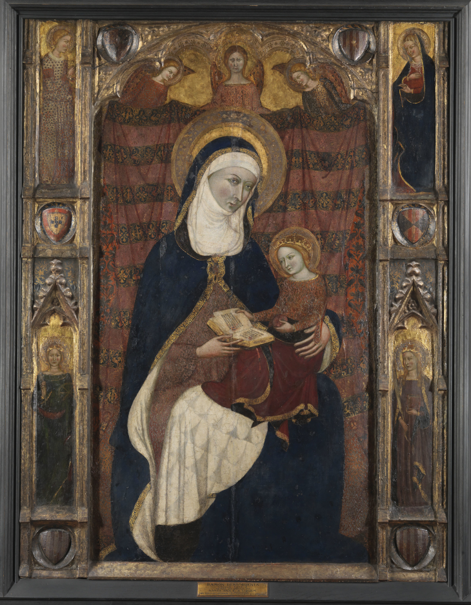
Saint Anne teaching the Virgin to read
38
Saint Anne teaching the Virgin to read

Ramon Destorrents, begun by Ferrer Bassa and Arnau Bassa 

Tempera and gold leaf on panel, 156 × 112 cm

c. 1343–58

Lisbon, Museu Nacional de Arte Antiga, inv. 1643 Pint

39
Crucifixion

Ramon Destorrents, begun by Ferrer Bassa and Arnau Bassa

Tempera and gold leaf on panel, 134 × 107 cm

c. 1343–58 

Palma de Mallorca, Museu de Mallorca, long-term loan from the Societat Arqueològica Lul·liana, da05/09/002 

40
Saints surrounding Archbishop John of Aragon’s tomb in Tarragona cathedral: Saint Tecla; Saint Elizabeth of Hungary; Saint Louis of France; Saint Louis of Toulouse and Saint Fructuosus

Pere de Guines (?)

Marble with remains of polychrome, 78 × 28 × 28 cm (each)

c. 1340–50

Tarragona, Excel·lentíssim Capítol de la Catedral de Tarragona

41
Saints surrounding Archbishop John of Aragon’s tomb in Tarragona cathedral: Saint Tecla; Saint Elizabeth of Hungary; Saint Louis of France; Saint Louis of Toulouse and Saint Fructuosus

Pere de Guines (?)

Marble with remains of polychrome, 78 × 28 × 28 cm (each)

c. 1340–50

Tarragona, Excel·lentíssim Capítol de la Catedral de Tarragona

42
Saints surrounding Archbishop John of Aragon’s tomb in Tarragona cathedral: Saint Tecla; Saint Elizabeth of Hungary; Saint Louis of France; Saint Louis of Toulouse and Saint Fructuosus

Pere de Guines (?)

Marble with remains of polychrome, 78 × 28 × 28 cm (each)

c. 1340–50

Tarragona, Excel·lentíssim Capítol de la Catedral de Tarragona

43
Saints surrounding Archbishop John of Aragon’s tomb in Tarragona cathedral: Saint Tecla; Saint Elizabeth of Hungary; Saint Louis of France; Saint Louis of Toulouse and Saint Fructuosus

Pere de Guines (?)

Marble with remains of polychrome, 78 × 28 × 28 cm (each)

c. 1340–50

Tarragona, Excel·lentíssim Capítol de la Catedral de Tarragona

44
Saints surrounding Archbishop John of Aragon’s tomb in Tarragona cathedral: Saint Tecla; Saint Elizabeth of Hungary; Saint Louis of France; Saint Louis of Toulouse and Saint Fructuosus

Pere de Guines (?)

Marble with remains of polychrome, 78 × 28 × 28 cm (each)

c. 1340–50

Tarragona, Excel·lentíssim Capítol de la Catedral de Tarragona

45
Reliquary of the Veronica of the Virgin

Roman master and Bartomeu Coscollà 

Tempera on parchment, gilded silver, enamels and precious stones, 70 × 26 × 22.5 cm

14th century (image), c. 1398 (reliquary)

Valencia, Catedral de València, inv. 4-0025-209

46
Saint Luke receiving from Mary the Veronica of the Virgin

Llorenç Saragossà 

Tempera and gold leaf on panel, 74.5 × 46.5 cm 

c. 1375–1400

Valencia, Museu de Belles Arts, inv. 249

47
Veronica of the Virgin

Jaume Cabrera 

Tempera and gold leaf on panel, 41.5 × 29.8 cm

1414 

Vic, Museu Episcopal de Vic, mev 1885

48
Veronica of the Virgin and Annunciation

Gonçal Peris Sarrià and Pere Nicolau 

Tempera and gold leaf on panel, 44.4 × 37 cm

c. 1410–15

Valencia, Museu de Belles Arts, inv. 406

49
Dossal of the Passion of Christ

Master of the Mallorca Passion 

Tempera and gold leaf on panel, 198 × 300 cm

c. 1300–15

Palma, Capítol de la Catedral de Mallorca, 0034-inv. masm

50
Crucifixion with Saint Francis

Adriatic Master

Tempera and gold leaf on panel, 24 × 16 cm

c. 1330–40

Palma, Monasterio de Santa Clara

51
Saint Clare of Assisi

Master of Saint Clare

Tempera and gold leaf on panel, 247.5 × 125.4 cm

c. 1325–30

Palma de Mallorca, Monasterio de Santa Clara

52
Portable Altar of the Virgin and Child

Mallorcan painter and Italian sculptor

Tempera and gold leaf on panel (altarpiece), alabaster (sculpture), 50 × 78 × 19 cm

c. 1330–40

Brno, Moravská Galerie, inv. a559

53
Stories of Saint Onuphrius

Master of Saint Onuphrius (Francesc Serra?)

Tempera and gold leaf on panel, 65 × 275 cm

c. 1355–60

Barcelona, Santa Església Catedral Basílica Metropolitana, inv. 2522731

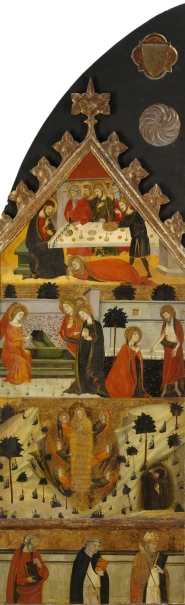
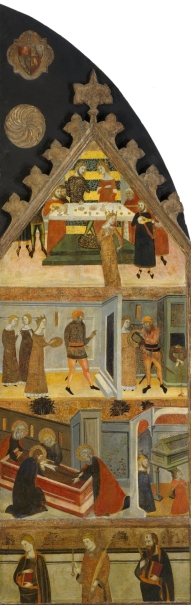
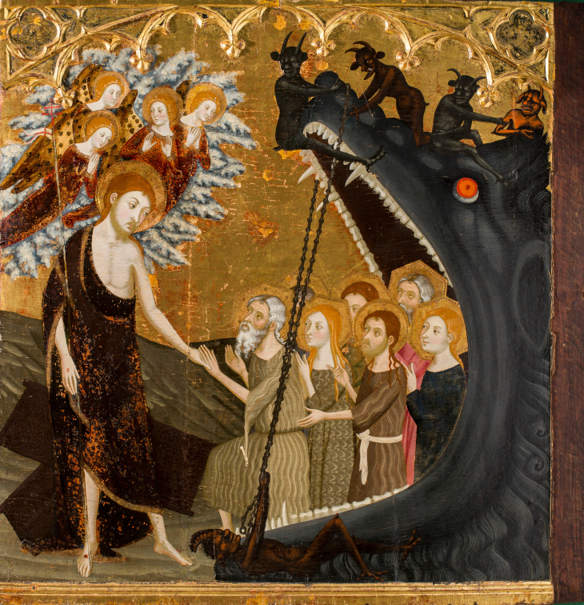
Two panels from the Altarpiece of the Resurrection: Christ’s Descent into Hell and Last Judgement
58
Two panels from the Altarpiece of the Resurrection: Christ’s Descent into Hell and Last Judgement

Pere Serra and Jaume Serra 

Tempera and gold leaf on panel, 133 × 115 cm and 116 × 115 cm 

c. 1381–82

Zaragoza, Museo de Zaragoza, inv. 10007 and inv. 10005

59
Two panels from the Altarpiece of the Resurrection: Christ’s Descent into Hell and Last Judgement

Pere Serra and Jaume Serra 

Tempera and gold leaf on panel, 133 × 115 cm and 116 × 115 cm 

c. 1381–82

Zaragoza, Museo de Zaragoza, inv. 10007 and inv. 10005

Altarpiece of Saint Julian and Saint Lucy
60
Altarpiece of Saint Julian and Saint Lucy

Pere Serra and Jaume Serra 

Tempera and gold leaf on panel, 370 × 330 cm

c. 1384–85

Zaragoza, Monasterio de la Resurrección, Canonesas del Santo Sepulcro

61
The Lord reprimanding Adam and Eve

Bartomeu de Robio 

Alabaster with traces of polychrome, 51.4 × 65.4 × 12.1 cm

c. 1360–63

San Francisco, Fine Art Museum of San Francisco, Museum purchase, M. H. de Young Museum Society, inv. 59.40

62
Enamel cross

Catalan goldsmith

Silver, silver gilt and enamels on a wooden core, 135 × 85 × 15 cm

c. 1340–50 

Girona, Capítol de la Catedral de Girona, inv. 134

Frontal of the Passion
63
Frontal of the Passion

Geri Lapi 

Linen cloth embroidered with coloured silks and gold and silver threads, 90 × 331 cm

c. 1346–50

Manresa, Basilica de Santa Maria de la Seu de Manresa–Bisbat de Vic

64
Chasuble with scenes from the life of Christ

Italian

Crimson silk velvet with orphrey bands embroidered with metallic threads, coloured silks and folios from a rag paper manuscript, 127.5 × 79.5 cm (front and reverse; in the image showing the front of the chasuble, the white lining of the reverse has been digitally added)

c. 1370

New York, The Hispanic Society of America, h3910

65
List of the silks and related designs that the Panciatichi family sent to the Spanish market in 1408

Ink on parchment, 301 × 228 mm

Prato, Archivio di Stato, fondo Datini, busta 850, fasc. 4, cod. 9291405

66
Textile fragment with animal and plant decoration

Italian (Lucca)

Lampas of silk and metallic thread, 48.5 × 21 cm

c. 1350–1400

Lyon, Musée des Tissus et des Arts décoratifs, mt. 22.736

67
Textile fragment with animal, plant and calligraphic decoration

Italian

Lampas, twill ground, cream silk and metallic thread tabby, 54 × 53.2 cm

c. 1350–1400

Florence, Museo Nazionale del Bargello, inv. 630f

68
Textile fragment with plant decoration

Italian 

Lampas of silk and metallic thread, 82 × 50 cm

c. 1390–1410

Florence, Museo Nazionale del Bargello, inv. 603f

69
Textile fragment with dog or lion decoration

Italian

Lampas, brocade, silk and metallic thread, 29.7 × 26.4 cm

c. 1375–1425

Lyon, Musée des Tissus et des Arts décoratifs, mt. 25439

Saint Bartholomew and Saint Bernard of Clairvaux
71
Saint Bartholomew and Saint Bernard of Clairvaux

Pere Serra 

Tempera and gold leaf on panel, 145.8 × 96.2 cm

c. 1395 

Vic, Museu Episcopal de Vic, mev 1784

72
Saint Martha and Saint Clement

Gonçal Peris Sarrià 

Tempera and gold leaf on panel, 115 × 75 cm 

c. 1412

Valencia, Catedral de València, inv. 3-0305-207

73
Sacrament of Extreme Unction

Valencian sculptor

Polychromed and gilded wood, 72 × 59 × 11.5 cm

c. 1400–25 

Clonmellon, The Montpascal Art Foundation

74
Triptych of the Crucifixion

Workshop of the Embriachi and Rossello di Jacopo Franchi

Tempera on panel, wood and bone, 63 × 34.5 cm (open)

c. 1400–25

Madrid, Museo Arqueológico Nacional, inv. 52108

75
Casket of Saint Severus

Workshop of the Embriachi 

Wood and bone, 33.5 × 43 × 22.5 cm

c. 1400

Barcelona, Santa Església Catedral Basílica Metropolitana, inv. 2521046

76
Casket of Calixtus III

Workshop of the Embriachi 

Wood and bone, 28 × 36.5 × 19.5 cm

c. 1400

Valencia, Catedral de València, inv. 4-0006-209

77
Saint Simon the Apostle and Saint Matthew the Apostle

Gherardo Starnina

Tempera and gold leaf on panel, 188 × 88.5 cm (each)

c. 1388–93

Toledo, Cabildo Primado de la S. I. Catedral, inv. 01/3842.1 and inv. 01/3842.2

78
Saint Simon the Apostle and Saint Matthew the Apostle

Gherardo Starnina

Tempera and gold leaf on panel, 188 × 88.5 cm (each)

c. 1388–93

Toledo, Cabildo Primado de la S. I. Catedral, inv. 01/3842.1 and inv. 01/3842.2

79
Virgin and Child with Saint Catherine and Donors

Master of the Altarpiece of Sancho de Rojas 

Tempera and gold leaf on panel, 59 × 37 cm

c. 1420–25

Valladolid, Museo de Valladolid, inv. 9969

80
Triptych of the Crucifixion

Juan Rodríguez de Toledo 

Tempera and gold leaf on panel, 92 × 105.3 cm (open); 92 × 52 cm (closed)

c. 1400–10

Venice, Groupe Paprec

81
Triptych of the Virgin, Saint Peter and Saint Paul

Juan de Sevilla 

Tempera and gold leaf on panel, 73.5 × 81 cm

c. 1410–20

Madrid, Museo Lázaro Galdiano, inv. 2798

82
Christ at the Column and Pietà

Master of the Pietà 

Tempera on canvas, 84.8 × 125.5 cm

c. 1400–10

Bilbao, Museo de Bellas Artes, Adquirido en 1959, inv. 69/129

83
Scenes from the right-hand section of the altarpiece of the Seven Joys of the Virgin Mary:  Annunciation, Adoration of the Magi and Ascension

Pere Nicolau 

Tempera and gold leaf on panel, 188.5 × 58.2 cm 

c. 1400

Bilbao, Museo de Bellas Artes, Adquirido en 1934, inv. 69/182

85
Saint Catherine of Alexandria

Marçal de Sas 

Pen and ink on paper, 294 × 212 mm

c. 1395–1400

Florence, Gallerie degli Uffizi, Gabinetto dei Disegni e delle Stampe, inv. 2272Fr 

86
Saint Michael the Archangel and Woman playing the Rebec

Marçal de Sas 

Pen and ink on paper, 295 × 211 mm and 290 × 214 mm

c. 1395–1400

Florence, Gallerie degli Uffizi, Gabinetto dei Disegni e delle Stampe 

87
God the Father and Gabriel anoouncing (recto). Woman playing the rebec(verso)

Marçal de Sas and Gherardo Starnina

Black pencil and pen on paper

c. 1395-1400

Florence, Gallerie degli Uffizi, Gabinetto dei Disegni e dell Stampe, inv. 2270Fr, inv. 2273Fv

88
Saint Eulalia

Giuliano di Nofri di Romolo 

Terracotta with remains of polychrome, 110 × 42 × 22 cm

1433–34

Barcelona, Santa Església Catedral Basílica Metropolitana, inv. 2521044

Altarpiece of the Seven Sacraments
89
Altarpiece of the Seven Sacraments

Gherardo Starnina 

Tempera and gold leaf on panel, 249 × 189 cm

c. 1396–97

Valencia, Museu de Belles Arts, inv. 246

90
Flagellation and Way to Calvary

Gherardo Starnina and Marçal de Sas 

Tempera and gold leaf on panel, 87 × 86 cm 

c. 1400

El Collado-Alpuente (Valencia), Parroquia de San Miguel

91
Lamentation and Entombment

Gherardo Starnina and Marçal de Sas 

Tempera and gold leaf on panel, 93 × 85 cm

h. 1400

Collado de Alpuente (Valencia), Parroquia de san Miguel

Madonna and Child
92
Madonna and Child

Gherardo Starnina

Tempera and gold leaf on panel, 60.4 × 41.4 cm

c. 1400

Cleveland, The Cleveland Museum of Art, Leonard C. Hanna, Jr. Fund, 1985.8

93
Virgin and Child with Angel Musicians

Miguel Alcañiz 

Tempera and gold leaf on panel, 71 × 38.5 cm

c. 1425

Colección Masaveu, cm-1251

94
The Entombment

Miguel Alcañiz 

Tempera and gold leaf on panel, 37.5 × 42.8 cm

c. 1410–25

New York, The Hispanic Society of America, a2031.03

95
Lamentation over the Dead Christ

Attributed to the Master of Barga (Simone di Francesco?) 

Tempera and gold leaf on panel, 51 × 82 cm

c. 1410–20

Avignon, Musée du Petit Palais (on long-term loan from the Musée du Louvre), mi 397

96
The Trinity

Gherardo Starnina 

Tempera and gold leaf on panel, 111 × 88 cm

c. 1402-3

Palermo, Galleria Regionale della Sicilia, Palazzo Abatellis, inv. 15794

97
Saints Michael the Archangel, James and John the Baptist and Saints John the Evangelist, Peter and Paul

Gherardo Starnina 

Tempera and gold leaf on panel, 132 × 61 cm (each)

c. 1404–5

Lucca, Museo Nazionale di Villa Guinigi, inv. 287 and inv. 288

98
Saints Michael the Archangel, James and John the Baptist and Saints John the Evangelist, Peter and Paul

Gherardo Starnina 

Tempera and gold leaf on panel, 132 × 61 cm (each)

c. 1404–5

Lucca, Museo Nazionale di Villa Guinigi, inv. 287 and inv. 288

99
Evangelist Saint (from the Acciaiuoli polyptych)

Gherardo Starnina 

Tempera and gold leaf on panel, 37.8 × 20.5 cm

c. 1407 

Florence, Collezione d’arte Fondazione CR Firenze

100
Virgin and Child with Saint John the Baptist, Saint Nicholas and Angels

Gherardo Starnina 

Tempera and gold leaf on panel, 80.5 × 51 cm

c. 1407–8

Florence, Galleria dell’Accademia, inv. 1890 n. 441

101
Virgin and Child on the Throne with Six Angels

Lorenzo Monaco 

Tempera and gold leaf on panel, 157 × 98.5 cm

c. 1420

Barcelona, Colección Thyssen-Bornemisza on long-term loan to the Museu Nacional d’Art de Catalunya, 2004, mnac 212808

Print on demand

Print artworks available in our catalogue in high quality and your preferred size and finish.

Image archive

Request artworks available in our catalogue in digital format.

Up