formularioRDF
The itinerary <em>TITULORECORRIDO</em> has been successfully created. Now you can add in works from the Collection browser
<em>TITULOOBRA</em> added to <em>TITULORECORRIDO</em> itinerary

Exhibition

The Museo del Prado in the National Lottery Draws

Museo Nacional del Prado. Madrid 11/28/2019 - 1/14/2020

From now until 14 January, the Museo Nacional del Prado will celebrate its bicentenary with a fresh approach to the permanent collection sponsored by Loterías y Apuestas del Estado, Spain’s national lottery company: a special presentation of ten selected proofs—unnumbered National Lottery tickets—that have featured works from the Prado.

The Museo Nacional del Prado and Loterías y Apuestas del Estado invite visitors to explore the Prado’s collection from a new perspective, via ten display elements presenting a selection of National Lottery proofs. Each proof is illustrated with the image of a work from the museum’s permanent collection, and the oldest dates from 1960.

With this initiative, the lottery company confirms its commitment to the arts by honouring the Museo Nacional del Prado on its 200th anniversary, and highlights the history and sentimental significance of the National Lottery in Spanish society and culture.


Access

Villanueva Building

RDF

RDF

Sponsored by:

Exhibition

Room 75. Proof ticket for draw 84/93, 9th series

Room 75. Proof ticket for draw 84/93, 9th series
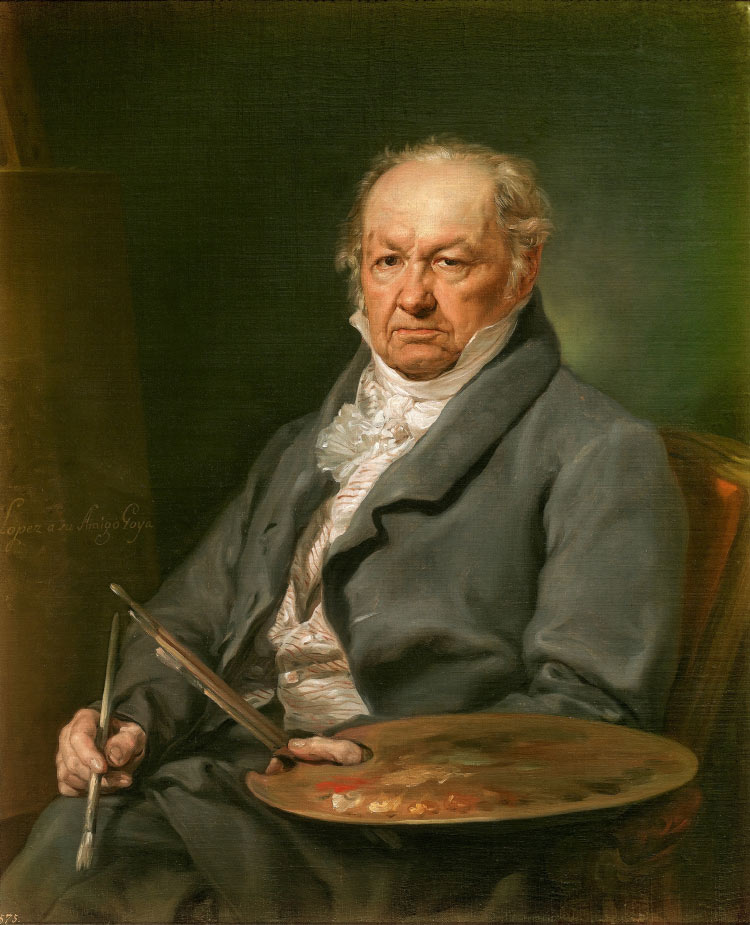
The Painter Francisco de Goya
Vicente López
1826. Oil on canvas.

1993, ‘Spanish Painting and Sculpture’. ‘The Painter Francisco de Goya’, made in 1826 by Vicente López, portraitist at the court of Ferdinand VII. Museo Nacional del Prado. Madrid. 33.4 x 21.6 cm.

Goya was eighty years old when Vicente López painted him. This picture, intended to hang in the Royal Painting Museum, as the Prado was known at the time, is the most famous likeness of the Aragonese artist and one of López’s finest portraits. He managed to give the old painter’s face an expressive of vibrant vitality, despite his solemn pose.

Room 63B. Proof ticket for draw 33/72, 5th series

Room 63B. Proof ticket for draw 33/72, 5th series
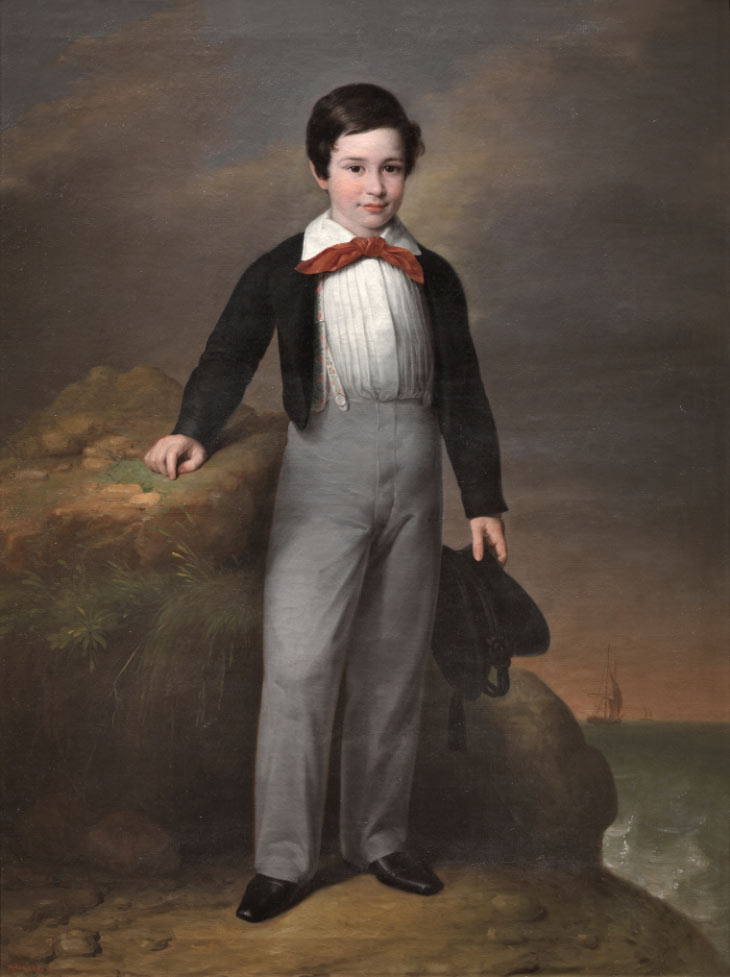
Manuel Flores Calderón 
Antonio María Esquivel
C.1842. Oil on canvas.

1972, ‘Children in Spanish Art’. Illustration: Esquivel. ‘Portrait of a Boy’ (copy). (Esquivel y Suárez de Urbina, Antonio María, ‘Manuel Flores Calderón’, Museo del Prado). 32.5 x 22 cm.

Esquivel combined the traditional Spanish palette of white, black, red and grey with the elegant refinement of English children’s portraiture to achieve a truly admirable result. Here he once again proved his mastery of the genre’s tricks and tools, bringing his impressive technical skill to bear on the description of the child’s attire—painstakingly capturing the decorative details of the braces and the gloss of the patent leather shoes—as well as on the modelling of his hands and the soft sheen of his fingernails.

Room 63B. Proof ticket for draw 5/1960, 2nd series

Room 63B. Proof ticket for draw 5/1960, 2nd series
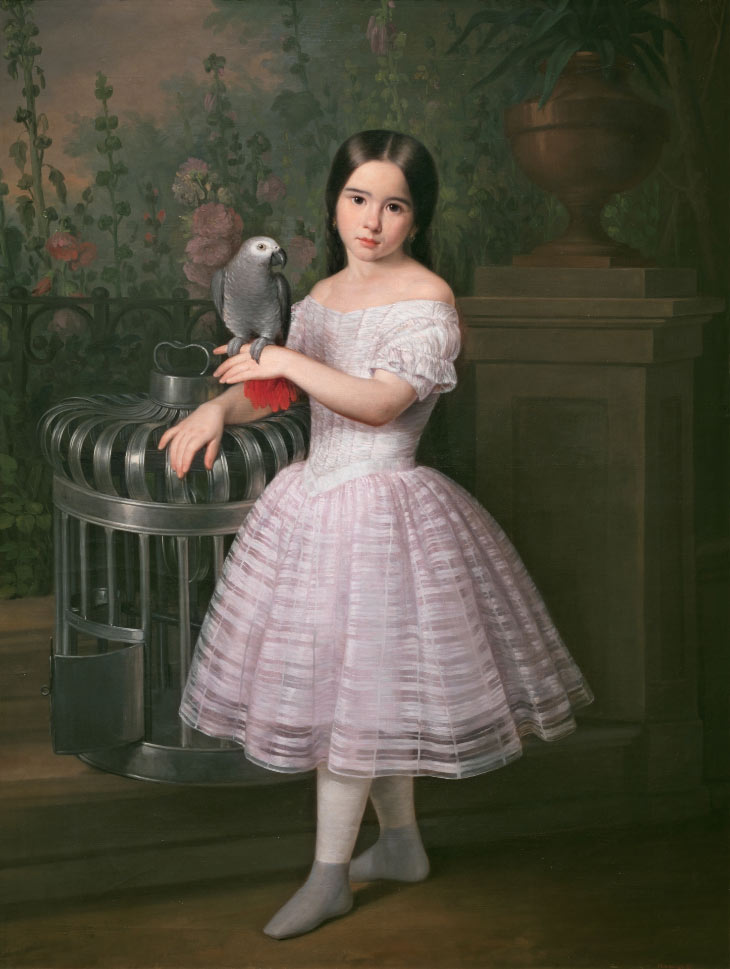
Rafaela Flores Calderón
Antonio María Esquivel 
C.1842. Oil on canvas

1960, ‘Women in Spanish Painting’. Illustration: ‘Girl with a Parrot’ (detail); A. Esquivel. (Esquivel y Suárez de Urbina, Antonio María, ‘Rafaela Flores Calderón’, Museo del Prado). 51x36 cm.

The pendant to the previous painting of Manuel Flores Calderón, this portrait of the family’s eldest daughter, Rafaela, denotes a more decorative intent, as was customary in female portraits, emphasised by the colourful details of the bird and garden flowers. In this case, Esquivel took special pains over the contouring of the girl’s arms, the subtle chiaroscuro on her neck and, above all, capturing the tactile qualities of the translucent frock (which allows us to see the underskirt), the gleam of metal and the parrot’s plumage, all depicted with the glossy, brilliant brushwork and incredibly meticulous attention to detail that characterised this artist at his finest.

Room 62B. Proof ticket for draw 11/1960, 1st series

Room 62B. Proof ticket for draw 11/1960, 1st series
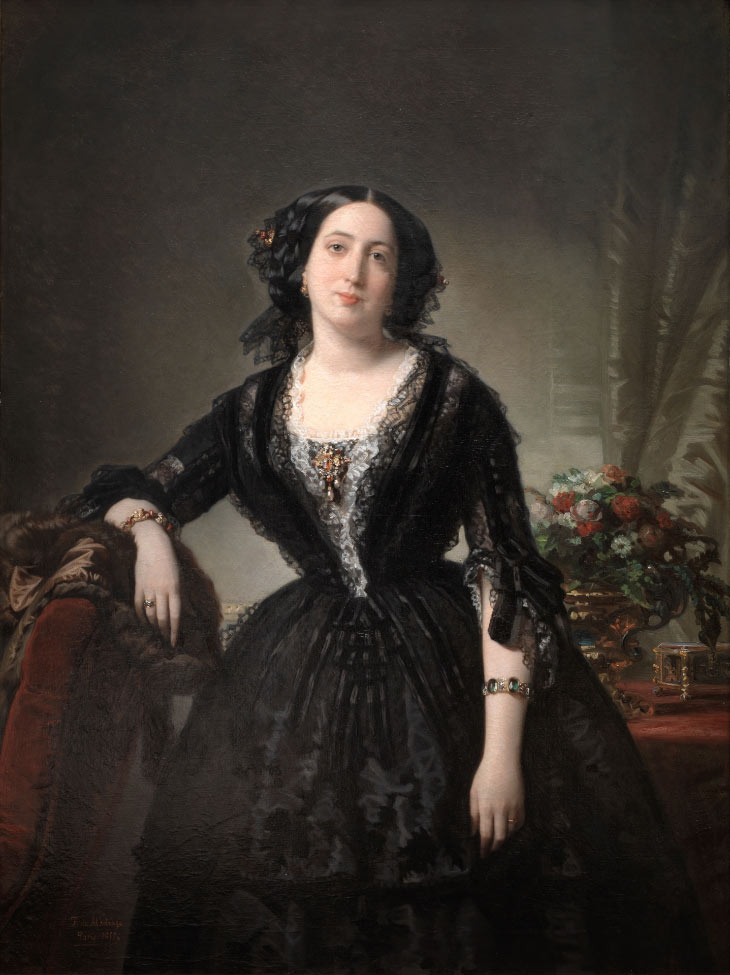
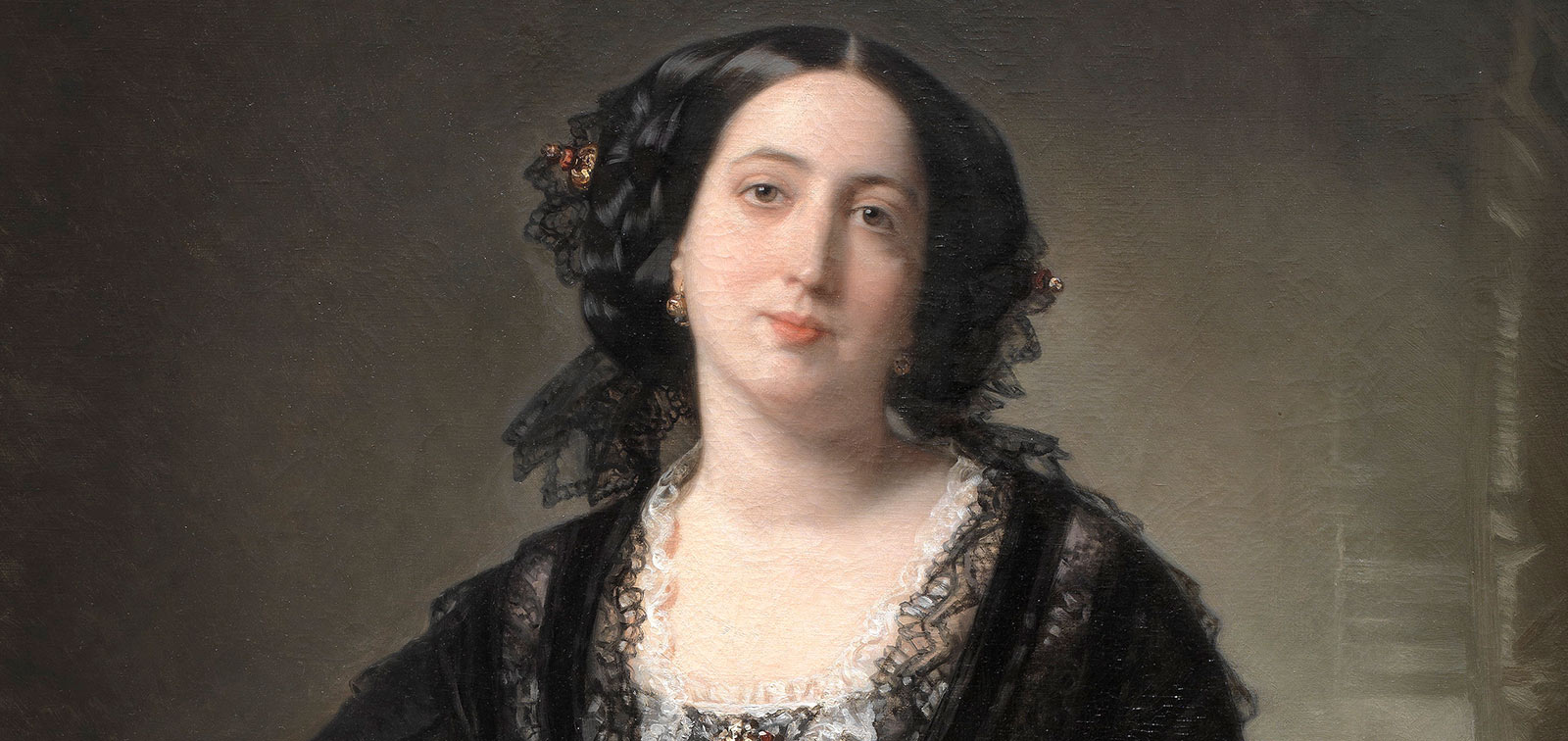
María Dolores de Aldama, Marchioness of Montelo
Federico de Madrazo
1855. Oil on canvas.

1960, ‘Women in Spanish Painting’. Illustration: ‘The Marchioness of Montelo.’ Federico Madrazo. (Madrazo y Kuntz, Federico de, ‘María Dolores Aldama, Marchioness of Montelo’, Museo del Prado). 51 x 36 cm.

The sitter, known for hosting intellectual gatherings at her home and her fondness for writing, is elegantly attired. The soft lighting accentuates the whiteness of her face and hands. Although it was painted in Paris, this portrait reveals the powerful influence that Velázquez and Goya had on Madrazo, particularly apparent in the elegance of the lady’s pose and the black tints of her gown.

Room 62B. Proof ticket for draw 94/93, 4th series

Room 62B. Proof ticket for draw 94/93, 4th series
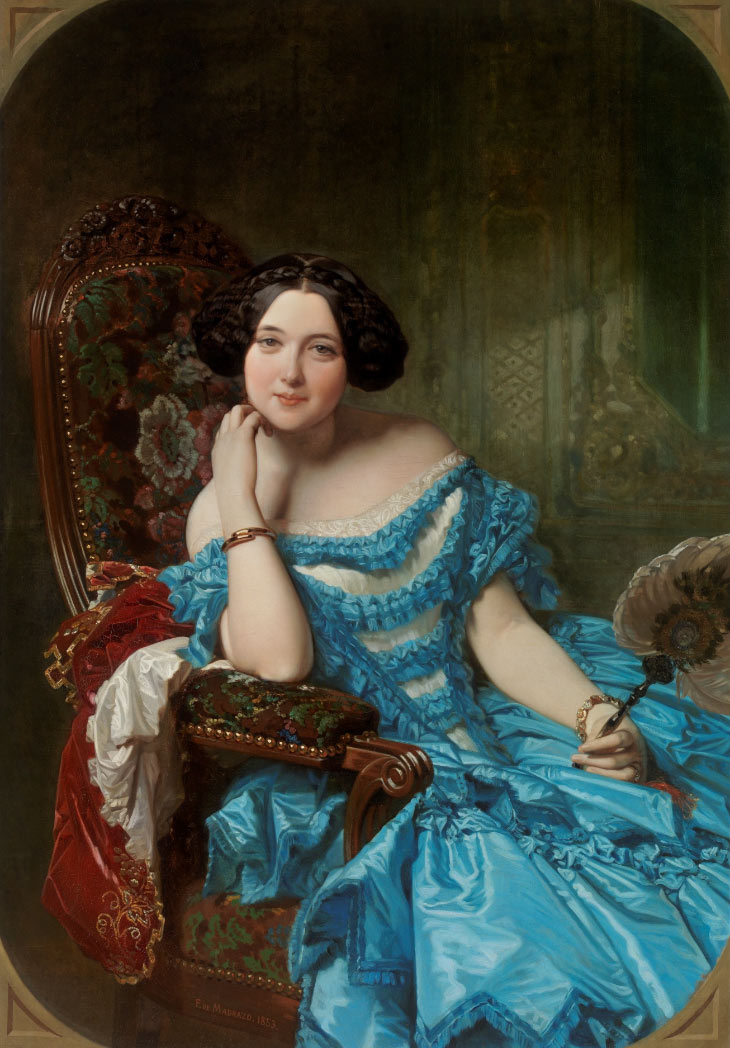
Amalia de Llano y Dotres, Countess of Vilches
Federico de Madrazo
1853. Oil on canvas.

1993, ‘Spanish Painting and Sculpture’. ‘Amalia de Llano y Dotres, Countess of Vilches’, painted in 1853 by Federico Madrazo y Kuntz. Museo Nacional del Prado. Casón del Buen Retiro. Madrid. 33.3 x 21.6 cm.

The subject, a monarchic writer, distinguished horsewoman and personal friend of the artist, stands out in the gloomy room as she poses in a striking armchair. This enormously attractive and alluring portrait, with its obvious French influence, recalls the aesthetic of Ingres’s style and is far removed from the sombre Spanish tradition. Madrazo deliberately emphasised the thirty-two-year-old lady’s beauty, youth, seductive gaze and porcelain-white skin. Her attire and attitude—head slightly tilted to one side and propped on her right hand—only heighten her sensuality.

Room 61B. Proof ticket for draw 60/93, 9th series, 7th fraction

Room 61B. Proof ticket for draw 60/93, 9th series, 7th fraction
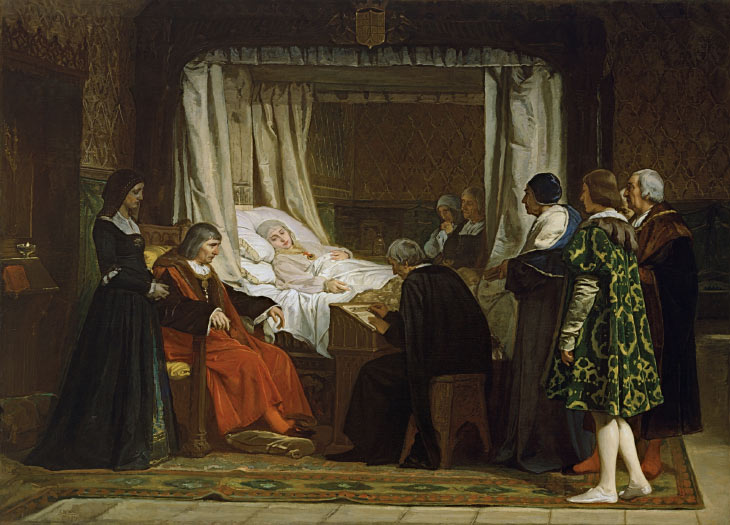
Queen Isabella the Catholic dictating her Will
Eduardo Rosales
1864. Oil on canvas

1993, ‘Spanish Painting and Sculpture’. ‘The Will of Isabella the Catholic’, made in 1864 by Madrid-born painter Eduardo Rosales. Museo Nacional del Prado. Casón del Buen Retiro. Madrid. 6.7 x 10.7 cm.

A few days before her death, Isabella the Catholic Queen dictated her last will and testament in the presence of her relatives and closest supporters. The painter even included prominent individuals from her reign who could not possibly have been present at that historic moment. Here Rosales demonstrated his interest in Velázquez’s painting and his mastery of draughtsmanship, composition and light, using the white bedclothes to focus the viewer’s attention on the queen. Produced during the artist’s time in Rome, this composition is the greatest exponent of nineteenth-century history painting and paved the way for modernity in Spanish painting through Velázquez.

Room 62A. Proof ticket for draw 27/72, 13th series

Room 62A. Proof ticket for draw 27/72, 13th series
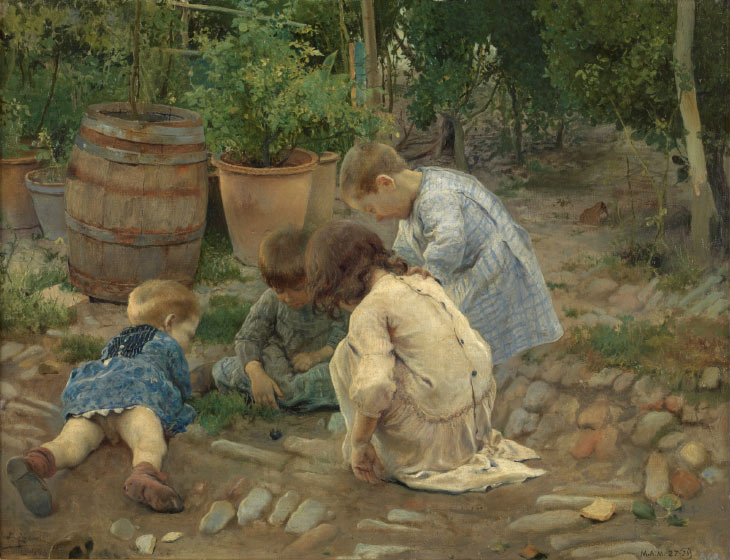
The Little Naturalists
José Jiménez Aranda
1893. Oil on canvas

1972, ‘Children in Spanish Art’. Illustration: J. Giménez Aranda. ‘Little Naturalists’ (copy). (Jiménez Aranda, José, ‘The Little Naturalists’, Museo del Prado). 32.5 x 22 cm.

After spending the 1880s in France, where he discovered the naturalism of Jules Bastien-Lepage (1848–1884), and a later period in Madrid, when his work influenced that of Joaquín Sorolla, the painter moved to Seville in 1893. It was there that he made this quietly delicate picture, which denotes a nuanced observation of reality, by means of meticulous drawing and very precise modelling.

Room 62A. Proof ticket for draw 66/93, 8th series

Room 62A. Proof ticket for draw 66/93, 8th series
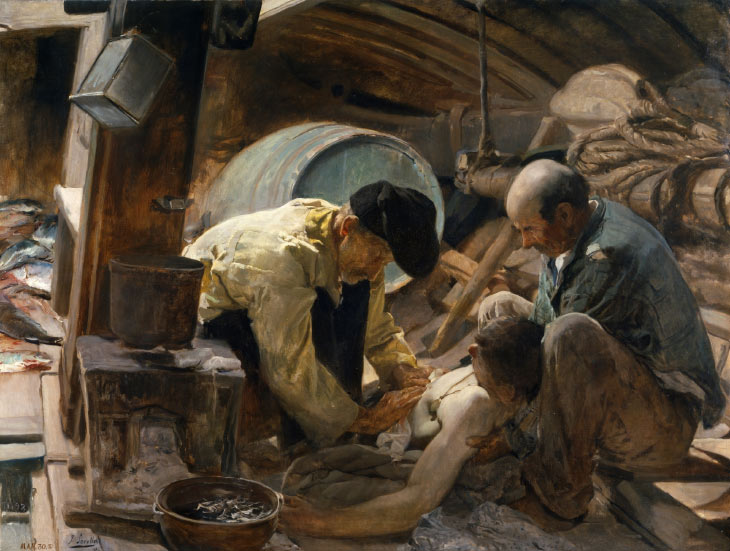
And They Still Say Fish Is Expensive!
Joaquín Sorolla
1894. Oil on canvas

1993, ‘Spanish Painting and Sculpture’. Detail of ‘And They Still Say Fish Is Expensive!’ (1894), work by the Valencian painter Joaquín Sorolla. Casón del Buen Retiro. Museo Nacional del Prado. Madrid. 33.3 x 21.5 cm.

Taken from the plot of Blasco Ibáñez’s novel Flor de mayo, this is one of the most moving scenes in Spanish social realist painting, where Sorolla denounced the injustices suffered by the lower classes. It shows the interior of a fishing boat’s cargo hold, where a young sailor, injured in an accident while working, is being tended to by two elderly seamen whose facial expressions convey concentration and resignation. The light entering through the hatch makes the volumes stand out and adds a dramatic tone to the composition.

Print on demand

Print artworks available in our catalogue in high quality and your preferred size and finish.

Image archive

Request artworks available in our catalogue in digital format.

Up