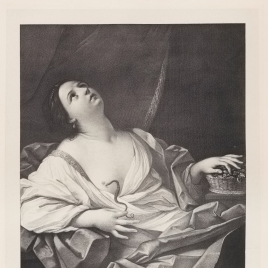
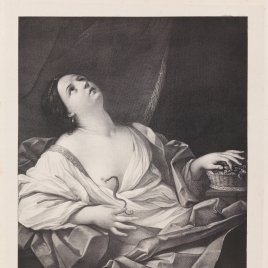
Cleopatra
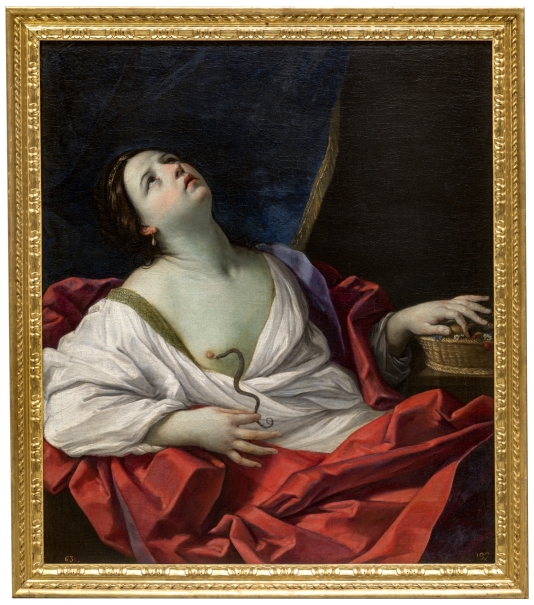
1621 - 1626. Oil on canvas.Not on display
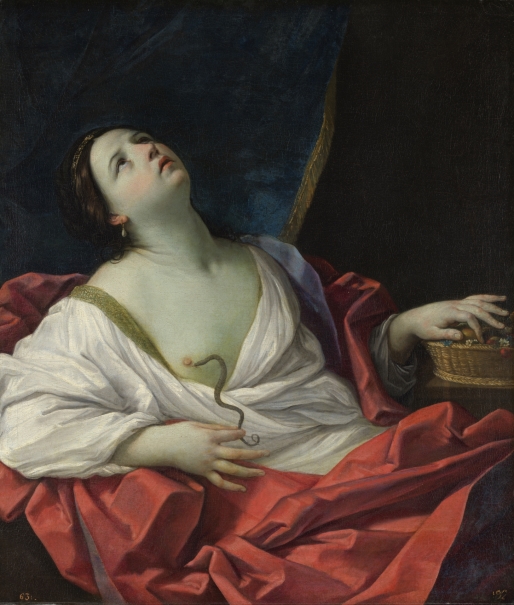
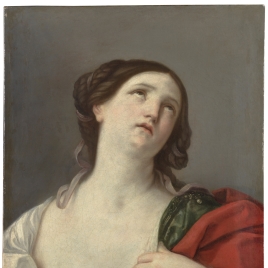
In his Maraviglie dell’arte (1648), the Venetian painter and biographer Carlo Ridolfi (1594–1658) describes a Cleopatra by Guido Reni in the collection of the Flemish painter Nicolas Régnier (1591–1667): “A life-size half-figure of Cleopatra who, wounded by a snake in the chest, fainting on account of the pain, seems to be expiring little by little”. In his 1663 edition of Francesco Sansovino’s Venezia città nobilissima, Giustiniano Martinioni singles out “the beautiful Cleopatra by Guido Reni” in Régnier’s house. Carlo Cesare Malvasia equally mentions the painting, providing us with the precise circumstances of its production. In his Felsina pittrice (1678), he reports that the Venetian painter Palma Giovane (c. 1548/50–1628) convinced Guido “to execute a Cleopatra in competition with three other half-figures, one by Palma himself, one by Régnier, salaried painter to the Venetian Republic, and one by Guercino, for a certain merchant Boselli”. The identity of this Boselli remains unknown. In recounting the episode, Malvasia remarks: “Guido later learned that the painting by Palma had been the most successful, since it was said that, even placed on top of Saint Mark’s bell tower, it would have had an effect, whereas his own would have been wholly lost to view”. With his usual witticism, Guido reportedly commented on this extravagant experiment: “Didn’t I tell you that in that place their Palma would have won the palm? Besides, I wasn’t told this Boselli used his campanile as a bedchamber, displaying the painting to the piazza from above”. Despite the criticism of the Venetians, Guido’s Cleopatra was cherished by Régnier, who had managed to purchase it, and who confessed to Malvasia (most probably during the latter’s trip to Venice in 1664) that he “lamented the disgrace suffered by that unrecognised divinity”, keeping the picture in his collection “like a diamond among other gems”. Guido’s Cleopatra is once again mentioned in the 1664 inventory of his paintings: “A Cleopatra who has her breast bitten by the viper, half-figure, seated, life-size, and thereby there is a small table with a little basket of fruits, high six and a half quarte, wide more than five and a half quarte, the most beautiful painting and one of his best, with its carved and gilded frame.” Guido’s Cleopatra thus measured 111 × 94 centimetres approximately (the quarta being a quarter of a Venetian braccio da lana, which corresponds to 68.3 centimetres). The connoisseur and collector Paolo del Sera (1617–1672) defined Guido’s Cleopatra as a copy when it sold in a public lottery held by Régnier on 4 December 1666. Soon afterward, the painting ended up in the hands of the Venetian art dealer Francesco Fontana. In an inventory of his paintings drawn up in 1675, Guido’s Cleopatra is described with almost the same words used in the Régnier inventory of 1664. Furthermore, the painting is listed there as a pendant to a Poetry by Guercino (1591–1666). Further documentation informs us that Fontana tried to sell Guido’s Cleopatra and Guercino’s Poetry to Cardinal Leopoldo de’ Medici (1617–1675). In an attempt to raise the price of Guido’s work, Fontana revealed to the prelate that the French ambassador in Venice, Jean-Antoine de Mesmes, Count d’Avaux (1640–1709), “had truly fell in love with Guido’s Cleopatra and its pendant by Guercino’, offering 200 doubloons (400 scudi) for the two paintings and “a portrait by Raphael”, which was also part of the deal. In his letter to Leopoldo de’ Medici, Fontana reports that he was in Paris in 1664 when a Magdalen by Guido, which “was neither larger nor more beautiful than this Cleopatra of mine”, sold for 800 scudi. The prelate declined the offer.
The commission of Guido’s Cleopatra in competition with paintings by Palma, Régnier, and Guercino, must have taken place between 1626 (when Régnier settled in Venice) and 1628 (the date of Palma’s death). Which subjects were depicted by Palma and Régnier in their half-figures remains unknown. Guercino’s Poetry is still to be traced. It might have resembled another Poetry he executed later, in 1640. In light of the description and measurements of the Régnier Cleopatra as recorded in the 1664 inventory, the painting could be identified either with Guido’s Cleopatra now in the English Royal Collection (114.2 × 95 centimetres) or with his painting of the same subject now in the Prado (110 × 94 centimetres). Regrettably, the provenance of both paintings is obscure. The Prado version is first mentioned in the Spanish royal collection in 1814–18. The version in England is first listed in Leicester House, London, in 1749, and must thus have been purchased by Frederick Louis, Prince of Wales (1707–1751). Unlike most of Guido’s paintings, the Prado Cleopatra is executed on Venetian canvas, as evidenced by its herringbone weave. But so, too, is apparently the English version (more detailed technical examination is needed to corroborate this). It is unknown whether Guido ever visited Venice, although this might have occurred during his youth perhaps at the suggestion of the Carracci, who acknowledged the importance of study trips (studioso corso) to the most prominent Italian artistic centres. Were it not for Malvasia’s testimony, Guido’s acquaintance with Palma Giovane would not be known – Malvasia evokes an epistolary correspondence between the two.
Given the obscurity of the historical context, it is impossible to ascertain how or why Guido used a Venetian canvas for his two versions of the Cleopatra. Equally unclear is Guido’s procedure in creating multiple versions of the same composition. If the two figures are superimposed, the left contour of the female heroine and most of the head can be said to coincide. It can therefore be assumed that Guido employed a cartoon (he might have traced the outlines with black chalk or oil pigment), or a lucido (an oiled paper or canvas that, on account of its transparency, was used for transfer), or, having the two canvases side by side, he might have reproduced the outlines from one to the other by relying on his confident draughtsmanship. It is noteworthy that modifications between these two versions are much more extensive than it was usual to Guido in creating replicas. Even if in these cases Guido revelled in giving free rein to stylistic improvisation, he rarely varied a composition to the point where both replicas present elements of remarkable originality.
In the Prado picture, Cleopatra’s left hand appears to pick a fruit (perhaps a fig) from a basket on a table nearby. As a result, her left shoulder recedes more into depth so that the contours of the upper right shoulder and neck are more distended. By changing the position of the left arm in the English painting, shifting the left hand to the foreground, and making it express acceptance and determination, Guido remedied the narrative anachronism present in the Prado version: there, the gesture of picking a fruit is absurdly synchronous with the biting of the serpent. The drapery in the Prado version is also more elaborate. The ruby mantle wrapped around the heroine’s torso and deftly deployed across the foreground as a red parapet is marked by an angularity, discontinuity, and complexity absent in the English painting. The Royal Collection Cleopatra can indeed be considered the product of stylistic and compositional distillation, with a considerable reduction of the chromatism to two predominant tonalities – white and pink – where only a few touches of dark brown and blue (in the curtain), with the aid of the black hair of the heroine, counteract the brightness of the overall composition. In this sense, the English version presents itself as a chromatic feat: the whiteness of the chemise competes in sheen with, but also texturally detaches itself from, the ivory-like fairness of the heroine’s flesh, while the white highlights of the pink mantle accentuate the luminosity of the painting, driving it into paroxysm. On the other hand, the Prado version better renders Cleopatra’s emotional dilemma and ordeal, the pallor of her soon-to-be bloodless chest exalted by the tortuous raggedness of her ruby mantle. Nothing is identical in these two versions: even the attitude and position of the hand that holds the snake, and the snake itself, differ in a perceptible measure. The increased whiteness and the recourse to thicker impasto characteristic of the English version better fits the style of works executed by Guido in 1627–28, such as the 1627 Immaculate Conception in the Metropolitan Museum of Art, New York. The chiaroscuro effect specific to the Prado version might instead relate to an earlier moment, between 1621 and 1626. In light of this, the English version is likely to be the one made for the Palma competition.
Pericolo, Lorenzo, 'Guido Reni. Cleopatra'. In: Guido Reni, Madrid, Museo Nacional del Prado, 2023, p.362-366 nº 79