formularioRDF
The itinerary <em>TITULORECORRIDO</em> has been successfully created. Now you can add in works from the Collection browser
<em>TITULOOBRA</em> added to <em>TITULORECORRIDO</em> itinerary

Close Continuar a ficha de la obra Continuar a ficha de la obra
02-06-2026
Francisco de Goya y Lucientes - Engraver
Fuendetodos, Zaragoza (Spain), 1746 - Bordeaux (France), 1828 - Engraver
Laureano Potenciano Pastor
Madrid, 1837 - ¿Madrid?, 1864
Real Academia de Bellas Artes de San Fernando

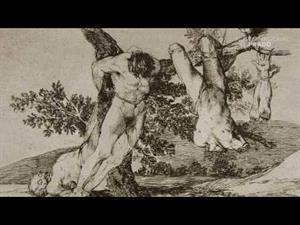
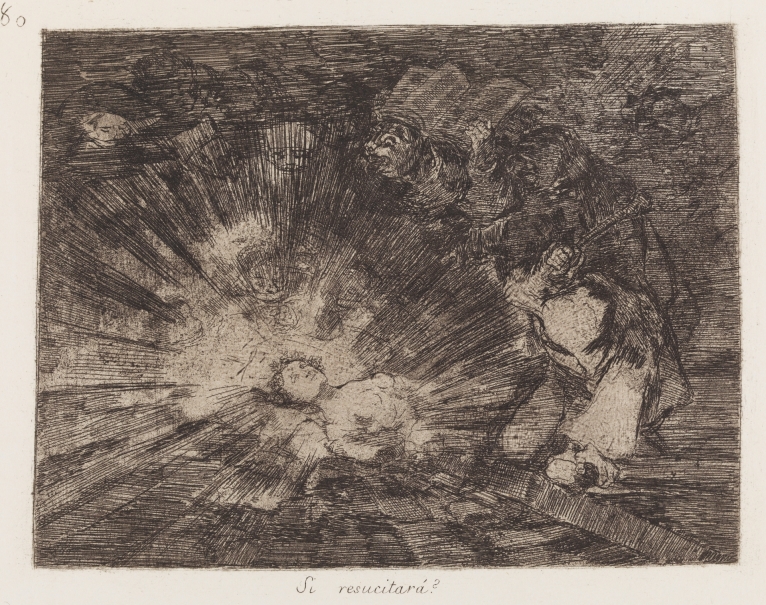
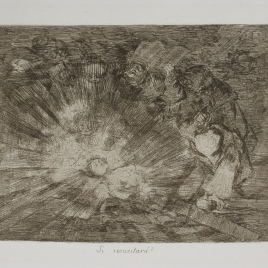
Will She Live Again?

1814 - 1815. Etching, Burnisher on wove paper.
Not on display

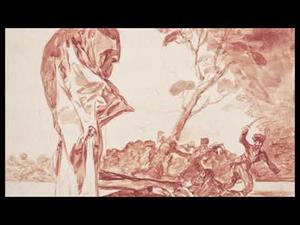
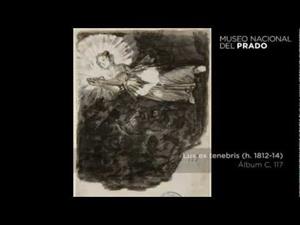
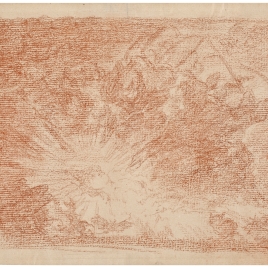
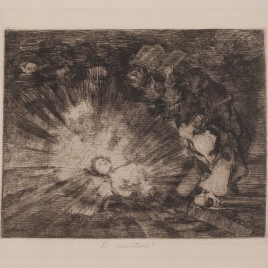
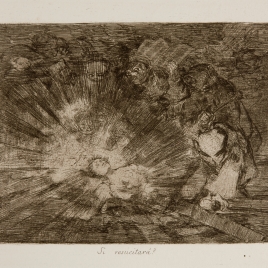
The volume of prints that the artist gave to Ceán with the title Fatal Consequences of Spain’s Bloody War with Bonaparte. And other Emphatic Caprices began with the premonitory image of a dejected man, defenseless before the terrible circumstances brought on by the approaching war. The end of the series shows just how accurate that premonition was, although Goya leaves room for some small bit of hope. Despite this series’ apparent disorder, it actually has an inner logic in its presentation of more-or-less grouped subjects, using titles to link the prints and presenting sequences in which the artist brings a narrative sense to his moral considerations about the perversity of war. The last three prints from the Emphatic Caprichos that constitute the series’ culmination maintain this allegorical character, although they eschew the previous use of fables. The sequence’s political content is clear. The Truth Has Died presents the body of a young woman lying bare-breasted on the ground and glowing with a light that allows us to see the people participating in her burial and their expressions. over the course of the Disasters, Goya employs the female body with a markedly sensual character to present the tragedy of war. He does so here as an allegory of Truth, which sheds light on all things, and again to her right, as an allegory of Justice, who wears similar garb and weeps at her loss. He also presents three male figures: a bishop wearing a miter, who seems to be blessing her body, and two monks with a hoe who seem content to dig her grave. Further back, numerous clergymen attend the event with more or less interest, including a blindfolded man leaning on a staff. The criticism of the Church is clear, and its political orientation probably refers to the restoration of its privileges following the Decree of May 4, 1814, which abolished the Constitution of 1812. Its link to the following print is determined by the question posed in its title: Will She Live Again? Given the ironic character of many of Goya’s titles, this one may be less hopeful than some authors think, as it could just as well be interpreted with the skepticism that characterizes many of his final works. And were Truth to return to life, the creatures of the night are still there to put an end to her with their laws and their power, thus maintaining men like the one barely visible behind her glowing light bound and gagged (Text drawn from Matilla, J. M.: "Desastre 79. Murió la verdad/ Desastre 80. Si resucitara?", in: Goya en Tiempos de Guerra, Madrid: Museo Nacional del Prado, 2008, pp. 346-348).
Multimedia

Technical data

Inventory number
G002080
Authors
Francisco de Goya y Lucientes -Engraver-; Laureano Potenciano Pastor; Real Academia de Bellas Artes de San Fernando
Title
Will She Live Again?
Date
1814 - 1815
Technique
Etching; Burnisher
Support
Wove paper
Dimension
Height: 225 mm; Height of the plate mark: 178 mm; Width of the plate mark: 220 mm; Width: 305 mm
Series
Desastres de la guerra [estampa], 80
Provenance
Bequest of Tomás Harris, 1964
Entry date
1964

Bibliography +

Brunet, M.G., Étude sur Francisco Goya sa vie et ses travaux, Aubry, Paris, 1865, pp. 59.
Yriarte, Charles, Goya: sa biographie, les fresques, les toiles, les tapisseries, les eaux-fortes et le catalogue de l' oeuvre, Henri Plon, Paris, 1867, pp. 40.

Viñaza, Cipriano Muñoz y Manzano Conde de la, Goya: su tiempo, su vida, sus obras, Tip. M.G.Hernández, Madrid, 1887, pp. 402.

Delteil, Loys, Francisco Goya, I, Chez L'Auteur, Paris, 1922.

Mayer, August L., Francisco de Goya, Labor, Barcelona, 1925, pp. 231.

Lafuente Ferrari, Enrique, Las Pruebas de Estado de 'Los Desastres de la Guerra' en la Biblioteca Nacional, II, Anabad, Madrid, 1934, pp. 389.

Lafuente Ferrari, Enrique, Goya: el dos de mayo y los fusilamientos de la Moncloa, Juventud, Barcelona, 1946, pp. 12.

Lafuente Ferrari, Enrique, Los desastres de la guerra de Goya y sus dibujos preparatorios, Instituto Amatller de Arte Hispánico, Barcelona, 1952, pp. 75, 190.

Harris, Tomas, Goya, engravings and lithographs, II, Bruno Cassirer, Oxford, 1964, pp. 292.

Gassier, Pierre y Wilson-Bareau, Juliet, Vie et oeuvre de Francisco de Goya: l' oeuvre complet illustré: peintures, dessins, gravures, Office du Livre, Fribourg, 1970.

Sayre, Eleanor, The Changing Image. Prints by Francisco Goya, Museum of Fine Arts, Boston, 1974, pp. 293.

Derozier, C., La Guerre D'Independance Espagnole a Travers L'Estampe (1808..., II, Universidad de Lille, Lille, 1976, pp. 966.

Sayre, Eleanor, Goya. España, Tiempo e Historia, Allegori over antagandet av 1812 ars spanska, Museo Nacional de Estocolmo, Estocolmo, 1980, pp. 44-45.

Pita Andrade J.M. y Alvarez Lopera J., Goya y la constitución de 1812, Ayuntamiento, Delegación de Cultura, Madrid, 1982, pp. 28.

Armstrong Roche M., Si resucitara ?, Goya y el espíritu de la Ilustración, Museo Nacional del Prado, Madrid, 1988, pp. 450.

Wolf, R., Onlooker, withness, and Judge in Goya's Disasters of War, Fatal Consequences: Callot, Goya and the Horrors of War, Dartmouth College, Hannover, 1990, pp. 44.

Vega, Jesusa, Fatales consecuencias de la guerra. Francisco de Goya, pintor, Francisco de Goya, grabador: instantáneas, Caser y Calcografía Nacional, Madrid, 1992, pp. 48.

Vega, Jesusa, Museo del Prado: catálogo de estampas, Museo del Prado, Madrid, 1992, pp. 99.

Adquisiciones del año 2000, Museo del Prado. Memoria de Actividades, Madrid, 2000, pp. 44.

Blas, Javier y Matilla, José Manuel, El libro de los desastres de la guerra: Francisco de Goya, Museo Nacional del Prado, Calcografía Nacional, Madrid, 2000, pp. 159-162.

Obras adscritas al Museo Nacional del Prado en el año 2000, Boletín del Museo del Prado, XIX, 2001, pp. 200.

Calvo Serraller, Francisco (dir.), Goya: la imagen de la mujer, Fundación Amigos del Museo del Prado, Madrid, 2001, pp. 319.

Nieto Alcaide, Víctor, La guerra y lo imaginario en la pintura de Goya, Barcelona, 2003, pp. 319-329.

Calcografía Nacional (España), Calcografía Nacional: catálogo general, II, Calcografía Nacional, Madrid, 2004, pp. 468.

Bozal, Valeriano, Francisco Goya: vida y obra, II, T.F., Alcobendas (Madrid), 2005, pp. 127.

Matilla, José Manuel, Estampas españolas de la Guerra de la Independencia: propaganda, conmemoración y testimonio, Universidad de Salamanca, 2008.

Matilla, J.M., Si resucitara ?, Goya: en tiempos de guerra, Museo Nacional del Prado, Madrid, 2008, pp. 346.

Bordes J., Matilla J.M. y Balsells S, Goya, cronista de todas las guerras: los "desastres" y la fotografía de guerra, Centro Atlántico de Arte Moderno y Real Academia de Bellas Artes de San Fernando, Las Palmas de Gran Canaria; Madrid, 2009, pp. 240.

Hofmann, Julius, Francisco de Goya: Katalog seines graphischen Werkes, Gesellschaft für vervielfältigende Kunst, Viena, 2014, pp. 91-145.

Pérez Francés, José Antonio, Aragón en los Desastres de la guerra de Francisco de Goya, Institución Fernando el Católico,, Zaragoza, 2025, pp. si resucitara?.

Filigree +

Motive: Venera e iniciales "J. G. O." (fragmento derecho)


25 x 33 mm
Principal
Yes
En el centro del margen superior
José García Oseñalde
Marca de agua en forma de venera e iniciales "J. G. O." característica del papel fabricado por José García Oseñalde, establecido en La Cabrera, Guadalajara. En esta localidad existió fábrica de papel desde por lo menos 1733, como así es recogido por Eugenio Larruga en sus "Memorias políticas y económicas sobre los frutos, comercio, fábricas y minas de España...", de ese año y de 1746. Esta antigua fábrica de papel blanco debió de ser la que José García Oseñalde compró en 1847, junto a un molino de harina llamado "Los Heros", colindante entre las localidades de La Cabrera y Aragosa. La fábrica también debió conocerse con el nombre del molino de harinas, pues así consta en 1886, cuando la fábrica de papel sellado "Los Heros" era propiedad de Pedro García Oseñalde (véase: "El obispado de Sigüenza, ó sea Nomenclátor descriptivo, Geográfico y Estadístico de todos los pueblos del mismo, por un sacerdote de la diócesis", Zaragoza, 1886, p. 21 [Aragosa])

La primera edición de los "Desastres de la Guerra" de Goya se imprimió en papel con esta filigrana, en 1863.

Bibliography
Biblioteca Nacional de España, Catálogo de las estampas de Goya en la Biblioteca Nacional, Biblioteca Nacional, Sociedad Estatal Goya 96 y Lunwerg, Madrid, 1996, pp. 280, fil. 22.
Fundación Lázaro Galdiano, Goya en la Fundación Lázaro Galdiano, Fundación Lázaro Galdiano, Madrid:, 1999, pp. 386-387, fil. 14-15.

Inscriptions +

80 // Goya [invertido] // Si resucitará?
Lettered in the plate. Front

TH [monograma en un círculo. Lugt, n. 4922] // Thomas Harris. [Lugt, n. 4921]
Brown ink stamp. Back, lower central area

Update date: 02-06-2026 | Registry created on 22-07-2016

Visor 360

Drag with the cursor to rotate the piece

Other works by Francisco de Goya y Lucientes; Laureano Potenciano Pastor; Real Academia de Bellas Artes de San Fernando

Print on demand

Print artworks available in our catalogue in high quality and your preferred size and finish.

Image archive

Request artworks available in our catalogue in digital format.

Up