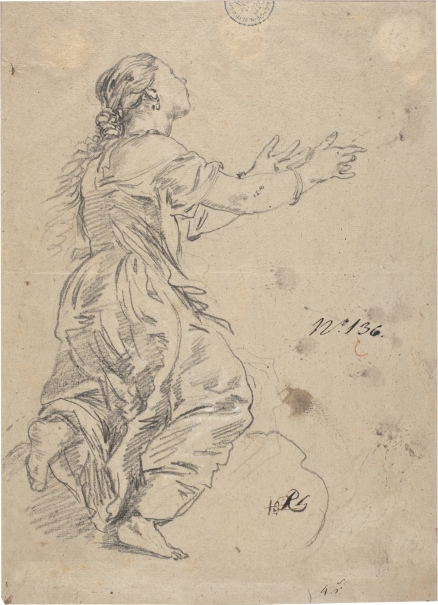
Female Figure kneeling on Clouds
1685 - 1690. White lead, Black chalk on laid paper.Not on display
This drawing depicts a female figure in profile, kneeling on a cloud with both arms extended at shoulder height and with her head raised. Details including the dress typical of the period, which leaves the right shoulder uncovered, the type of hairstyle (gathered at the nape of the neck), and the clearly visible earring, leave no doubt that this work was drawn from life. The subject was probably the painter’s own daughter, María Ignacia Teresa, who was born in February 1677. The similarities with the figure of Maximilla – who heads the group of women in The Martyrdom of Saint Andrew (Casarrubios in Toledo) – is evident in details of the dress, the earrings and the positioning of the arms. From her attitude, imploring or in ecstasy, it could be deduced that this is a study for a saint or angelic figure in a more complex composition. Regarding the technique, the speed and confidence with which the artist traces the figures and the attention given to the line – in detriment to the more painterly effects that characterise Carreño’s drawings or those of Claudio Coello – are particularly noteworthy. The characteristic shading based on parallel strokes, converted in this work into long and rapid zigzags, and even the use of black pencil with touches of chalk on coloured paper, typical of the painter’s oeuvre, appear to support his authorship. Some examples, including the preparatory studies for the painting in Casarrubios, suggest that in his final years the painter preferred the more Italianate combination of sanguine and black pencil to black pencil on its own. For this reason, this drawing could be placed at a not very late date of around 1685–90.
Zapata Fernández de la Hoz, Teresa, Francisco Ignacio Ruiz de la Iglesia (1649-1703) en el Museo del Prado: revisión y nuevas atribuciones. Boletín del Museo del Prado, Museo del Prado, 2013, p.82-95 [90 f.18]