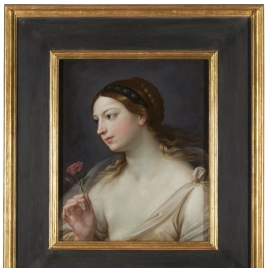
Girl with a Rose
1636 - 1637. Oil on canvas.Not on display
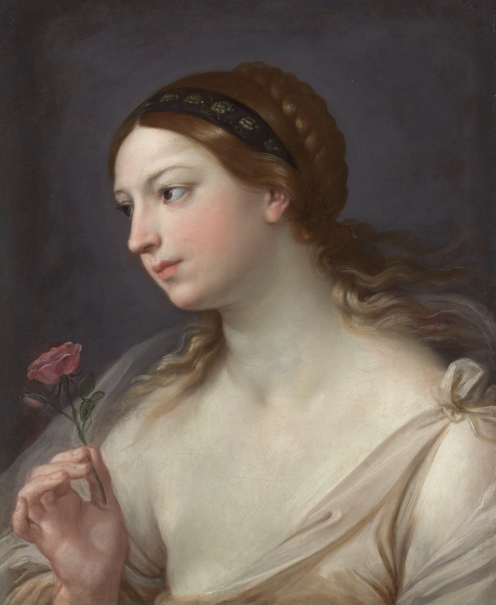
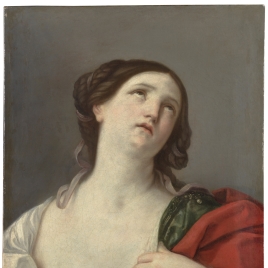
Reni based this beautiful bust on a tracing of the Helen of Troy he had painted years earlier for his Abduction of Helen, now in the Louvre. Here, he used a mirror image of the tracing, to which he added the hand holding the rose. The girl’s romantic, love-struck expression hints more at an idealised vision than at a particular portrait. The loose style and sketchy handling are characteristic of Reni’s late works.
Recent technical examination carried out by the Museo del Prado has established that the original canvas on which Girl with a Rose was executed measured 67.5 × 53 centimetres, although the surface originally painted by Guido Reni was only 62.5 × 50 centimetres, with the remaining used as borders for the easel. This is confirmed by the first mention of the painting in the 1666 inventory of the Madrid Alcázar: ‘Another painting three-quarters of a vara high and half a vara wide of a head by Guido from Bologna with a rose in the hand [prized] fifty ducats’. According to this listing, Girl with a Rose thus measured 62.5 × 41.8 centimetres (a vara being 83.59 centimetres approximately). Prior to 1734, the canvas of the painting was restretched, relined, and enlarged through additions, as documented by the measurements recorded in the 1734 inventory of the Madrid Alcázar, ‘una vara de alto y tres quartas de ancho’, which corresponds to its current size. In its original format, the outermost lower left corner tightly framed the hand holding the rose – the foreshortened arm, adjacent drape, and the parapet being absent.
It is unknown when and how the painting reached the Spanish royal collection. Because it was not recorded in the 1636 inventory of the Madrid Alcázar, it is certain that King Philip IV (1605–1665) received it after that date. He had it placed in his summer office, the ‘despacho de verano’, and it can be assumed that his choice of paintings for this space was consistent with his own taste. Since 1645, Diego Velázquez (1599–1660) had been tasked with refurbishing the king’s summer quarters in the Alcázar. In 1658–59, Philip IV ordered the Bolognese quadrature painters Agostino Mitelli (1609–1660) and Angelo Michele Colonna (1604–1687) to decorate the vault of his summer office with a depiction of the Fall of Phaethon. In his Felsina pittrice (1678), Carlo Cesare Malvasia describes Philip IV’s satisfaction with Mitelli and Colonna’s work in the Alcázar, adding, however, in connection with the decoration of the Salón de Espejos (Hall of Mirrors) in the same palace: ‘They were to paint a Pandora in the centre [of the ceiling] and had produced a fine drawing of it, which, because it was disliked by Diego Velázquez, all the more so could not be to the liking of His Majesty, who trusted everything to him’. Despite his reliance on Velázquez, the king was personally involved in the decoration of his summer quarters. In a letter of 6 February 1658 from Madrid, Cardinal Camillo Massimo (1620–1677), then the apostolic nuncio to the Spanish court, reported that the king had fallen sick ‘for having spent a long time the previous day in his summer quarters to see some pictures be arranged’. That the king was keen on the decoration of his summer office is above all suggested by the presence there of Velázquez’s famous Las Meninas (1656), which hung not far from a pair of allegories recently donated by Cardinal Massimo: Guido’s Cupid with a Bow and Guercino’s (1591–1666) Cupid spurning Riches, both now at the Prado. It is possible that Girl with a Rose served as a pendant to Domenico Tintoretto’s (1560–1635) Venetian Girl, also listed in the summer office, although at the time the two paintings had differing sizes. While the decoration of the summer office was characterised by a variety of pictorial genres and themes, the Massimo pair of Cupids along with the two female portraits by Guido and Tintoretto were clearly meant to introduce an amorous, gallant note, apparently dear to the king.
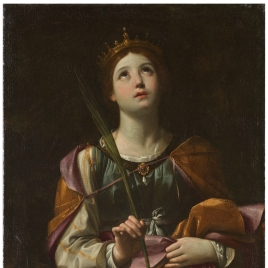
It bears remarking that the head of Girl with a Rose is substantially the reverse of the head of Helen in Guido’s renowned Abduction of Helen at the Louvre, which was originally destined for Philip IV but ended up in the hands of Marie de’ Medici, French queen regent (1575–1642). This becomes evident by comparing Girl with a Rose with an untraced drawing by Guido of the Head of Helen. Malvasia reports that the King of Spain, ‘knowing full well what had happened with the Abduction of Helen, after complaining about it with his ambassadors’, ordered from Guido a Latona, which remained unfinished upon the master’s death in 1642. Bearing this in mind, it is not completely unlikely that Girl with a Rose was purchased or obtained for Philip IV as a ‘reminder’ of the lost Abduction of Helen, perhaps simultaneously to the Latona commission. In spite of its simplicity, Girl with a Rose epitomizes Guido’s exceptional dexterity in evoking female beauty with a palette restricted to a few pigments, the flesh tones almost imperceptibly different from the cream hues of the drooping chemise, the touch of pale red of the rose rhyming with the vermilion of the lips and the ruddiness of the cheeks. Similar chromatic effects are to be found in works executed in 1636–37, such as Guido’s Sibyl at the Pinacoteca Nazionale di Bologna and Circe at the Birmingham City Art Gallery.
Pericolo, Lorenzo, 'Guido Reni. Girl with a rose'. In: Guido Reni, Madrid, Museo Nacional del Prado, 2023, p.342-344 nº72