formularioRDF
The itinerary <em>TITULORECORRIDO</em> has been successfully created. Now you can add in works from the Collection browser
<em>TITULOOBRA</em> added to <em>TITULORECORRIDO</em> itinerary

Close Continuar a ficha de la obra Continuar a ficha de la obra
02-06-2026
Francisco de Goya y Lucientes - Engraver
Fuendetodos, Zaragoza (Spain), 1746 - Bordeaux (France), 1828 - Engraver
Laureano Potenciano Pastor
Madrid, 1837 - ¿Madrid?, 1864
Real Academia de Bellas Artes de San Fernando

He gets something out of it

1814 - 1815. Etching, Drypoint, Burin on wove paper.
Not on display
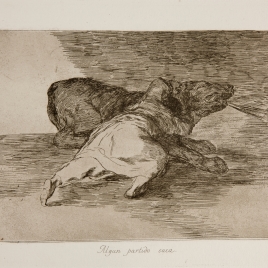
Situated at the midpoint of the series, this print is, because of its allegorical nature, similar to those that make up the last section called Caprichos enfáticos (Emphatic caprichos). In fact, Algún partido saca has traditionally been related to plate 81, entitled Fiero monstruo! (Fierce monster!), which represents a fabulously large animal regurgitating the naked bodies of dead men. Both the meaning of the print and the significance of its placement in the series have been a subject of debate since its publication in 1863. None of the various interpretations offered, however, are completely convincing, owing to the lack of clear references, the cryptic nature of Goya's compositions and the ambiguity of his titles.
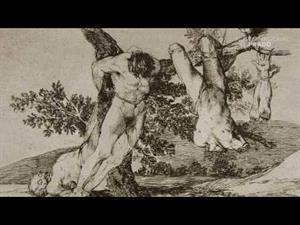
Placed immediately following the bloodiest scenes, in which savagely mutilated bodies of executed combatants are immodestly exhibited, this etching marks the beginning of the group of prints that show the suffering of the civilian population, which was the indirect consequence of the war, the refugees from the cities, the absence of solidarity among the clergy (but also their own suffering) and, above all, the famine and its tragic effects.
We are moved to ponder the meaning of the print in part by its ambiguous title: Algún partido saca, sometimes translated into English as There is something to be gained, although more literally it would be She (or he) gets something out of it.
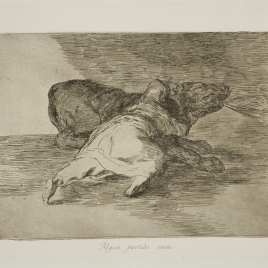
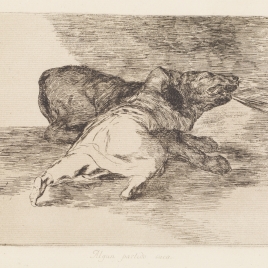
The identity of the two figures is unclear, as is the nature of the action depicted. We may intuit that the human figure is female, owing to the skirts it wears. She strongly grasps the neck of an animal that is difficult to identify, though its monstrous nature is apparent in its front claws and prominent fangs. Lying on the ground with its eyes half-open, the beast is breathing its last breath, as a result of the stab wound to its jaw; its open mouth allows us to see the tip of the protruding knife.
Scholars and critics have always recognised the difficulty in interpreting this scene. Some have imagined the beast is an image of the defeated afrancesado, or French sympathiser. Others suggest the scene represents the bravery of the Spanish nation, wielding humble arms like the knife, here, yet capable of defeating the ferocious army of Napoleon. Others argue that the scene is an allegorical representation of the brutality and inequality of war itself. Whatever the case may be, Goya uses his customary devices in the series to direct our attention to what he wishes us to notice. Thus, the heroine of the composition is highlighted by the use of white space to represent the tensed lower portion of her body, which is contrasted with the heavy etching of her upper body and the animal to which she is clinging. Goya's skill at suggesting ideas through simple compositional elements is evident in the way he has treated her feet: her left foot, lightly supported on her big toe, denotes the tension running along her body diagonally up to the monster's snout, while her right foot is planted firmly on the ground, revealing the force she is exerting with her whole body, in contrast to the laxness of the animal's forepaws (Matilla, J. M.: Portrait of Spain. Masterpieces from the Prado, Queensland Art Gallery-Art Exhibitions Australia, 2012, p. 224).
Multimedia

Technical data

Inventory number
G000700
Authors
Francisco de Goya y Lucientes -Engraver-; Laureano Potenciano Pastor; Real Academia de Bellas Artes de San Fernando
Title
He gets something out of it
Date
1814 - 1815
Technique
Etching; Drypoint; Burin
Support
Wove paper
Dimension
Width of the plate mark: 221 mm; Height: 226 mm; Height of the plate mark: 177 mm; Width: 305 mm
Series
Desastres de la guerra [estampa], 40
Provenance
Bequest of Tomás Harris, 1964
Entry date
1964

Bibliography +

Brunet, M.G., Étude sur Francisco Goya sa vie et ses travaux, Aubry, libraire-éditeur, Paris, 1865, pp. 54.
Viñaza, Cipriano Muñoz y Manzano Conde de la, Goya: su tiempo, su vida, sus obras, Tip. M.G. Hernández, Madrid, 1887, pp. 382.

Delteil, Loys, Francisco Goya, I, Chez L'Auteur, Paris, 1922.

Mayer, August L., Francisco de Goya, Labor, Barcelona, 1925.

Lafuente Ferrari, Enrique, Las Pruebas de Estado de 'Los Desastres de la Guerra' en la Biblioteca Nacional, II, Anabad, Madrid, 1934, pp. 387.

Lafuente Ferrari, Enrique, Los desastres de la guerra de Goya y sus dibujos preparatorios, Instituto Amatller de Arte Hispánico, Barcelona, 1952, pp. 64.

Harris, Tomas, Goya, engravings and lithographs, II, Bruno Cassirer, Oxford, 1964, pp. 238.

Gassier, Pierre y Wilson-Bareau, Juliet, Vie et oeuvre de Francisco de Goya: l' oeuvre complet illustré: peintures, dessins, gravures, Office du Livre, Fribourg, 1970.

Derozier, C., La Guerre D'Independance Espagnole a Travers L'Estampe (1808..., II, Universidad de Lille, Lille, 1976, pp. 902.

Vega, Jesusa, Fatales consecuencias de la guerra. Francisco de Goya, pintor, Francisco de Goya, grabador: instantáneas, Caser y Calcografía Nacional, Madrid, 1992, pp. 39.

Vega, Jesusa, Museo del Prado: catálogo de estampas, Museo del Prado, Madrid, 1992, pp. 92.

Cuenca M. L., Docampo J. y Vinatea P., Catálogo de las estampas de Goya en la Biblioteca Nacional, Biblioteca Nacional y Lunwerg, Madrid, 1996, pp. 158.

Blas J., Matilla J.M. y Aguilar I, El libro de los desastres de la guerra: Francisco de Goya, I, Museo Nacional del Prado y Calcografía Nacional, Madrid, 2000, pp. 173.

Obras adscritas al Museo Nacional del Prado en el año 2000, Boletín del Museo del Prado, XIX, 2001, pp. 200.

Nieto Alcaide, Víctor, La guerra y lo imaginario en la pintura de Goya, Barcelona, 2003, pp. 319-329.

Calcografía Nacional (España), Calcografía Nacional: catálogo general, II, Calcografía Nacional, Madrid, 2004, pp. 463.

Matilla, José Manuel, Estampas españolas de la Guerra de la Independencia: propaganda, conmemoración y testimonio, Universidad de Salamanca, 2008.

Bordes J., Matilla J.M. y Balsells S, Goya, cronista de todas las guerras: los "desastres" y la fotografía de guerra, Centro Atlántico de Arte Moderno y Real Academia de Bellas Artes de San Fernando, Las Palmas de Gran Canaria; Madrid, 2009, pp. 160.

Hofmann, Julius, Francisco de Goya: Katalog seines graphischen Werkes, Gesellschaft für vervielfältigende Kunst, Viena, 2014, pp. 91-145.

Pérez Francés, José Antonio, Aragón en los Desastres de la guerra de Francisco de Goya, Institución Fernando el Católico,, Zaragoza, 2025, pp. 39-62 [313-314,355-362].

Inscriptions +

40 // Algun partido saca.
Lettered in the plate. Front

TH [monograma en un círculo. Lugt, n. 4922] // Thomas Harris. [Lugt, n. 4921]
Brown ink stamp. Back, lower left area

Exhibitions +

Farideh Lashai, Cuando cuento estás solo tú... pero cuando miro hay solo una sombra
Madrid
30.05.2017 - 10.09.2017

Update date: 02-06-2026 | Registry created on 31-05-2025

Visor 360

Drag with the cursor to rotate the piece

Other works by Francisco de Goya y Lucientes; Laureano Potenciano Pastor; Real Academia de Bellas Artes de San Fernando

Print on demand

Print artworks available in our catalogue in high quality and your preferred size and finish.

Image archive

Request artworks available in our catalogue in digital format.

Up