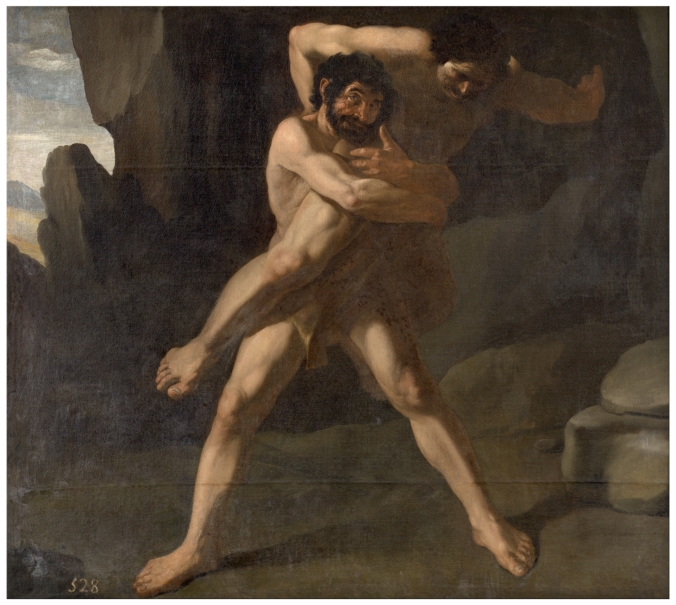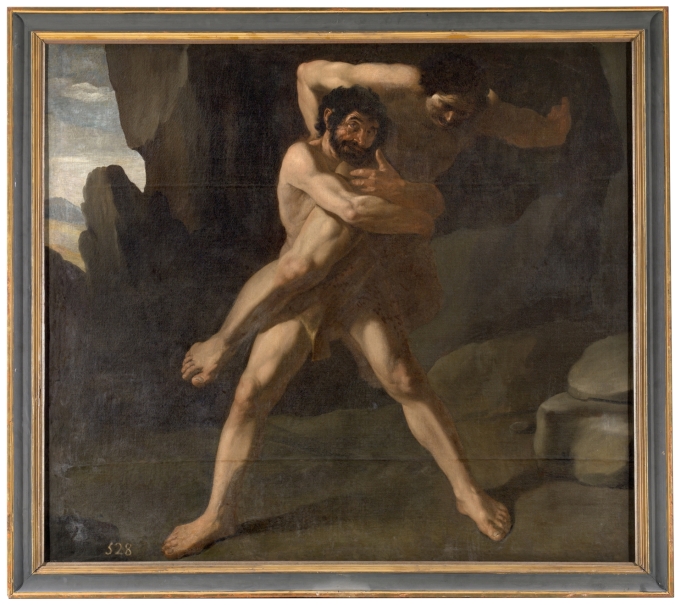
Hercules fighting with Antaeus
1634. Oil on canvas.Room 009A
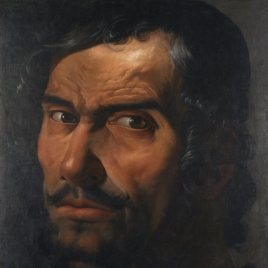
Hercules puts the North-African giant to death in yet another demonstration of his capacity to combine cleverness and strength. The creature’s mother was Gaea, goddess of the Earth, who doubled his strength every time he was knocked down, requiring Hercules to break his contact with the ground in order to kill him. Juan Pérez de Moya wrote: Noticing Anthaeus’s trickery, Hercules lifted him in the air and squeezed him so powerfully between his arms that he died. Such was Hercules’s victory in this fight. And he added a moral that could explain its inclusion in the series: Hercules signifies the virtuous man who seeks to overcome his carnal desires, with which he engages in mighty combat on a daily basis. Covetousness or carnal desire is said to be born of the earth, and thus embodied by Anthaeus, because, as the Apostle said, such greed is not born of the mind but rather, of the flesh. This statement is consistent with the Marquis of Villena’s observation a century earlier that Anthaeus represents man’s fondness for carnal vice, which is therefore against God. Hercules and those who, like him, put an end to this carnal desire free themselves of such tyrannical and vicious servitude that robs its subjects of body and mind, reason and zeal, by not allowing virtuous customs. This episode has more recently been related to Philip IV’s virtues as a strong and astute ruler who managed to put an end to all his enemies, no matter how powerful. In his conception of this canvas, the painter drew on a print on the same subject by Hans Sebald Beham, which includes the same rocky landscape. In the painting, however, Beham’s brightly lit background becomes a dark cavern, much like the backgrounds of all the other works in this group. This is generally considered one of the least successful paintings from this series, and it has been suggested that Zurbarán’s workshop participated in it, although the master most certainly painted Hercules’s head, which has the same physiognomy and ironic, skeptical expression as in the episode where he shifts the course of the Alpheus River (P1248). There are certainly some problems in the conception of Anthaeus, although they would have been partially corrected by its location in the Hall of Realms, some three meters about the ground. We should keep in mind, however, that the placement of the figures posed some problems to the artist, as the subject imposes a vertical presentation of the two giants, while the series’ overall conception is horizontal, with the hero’s figure in the foreground, and always at the same scale. This left little room for Athaeus, crowding him into the upper part of the canvas, and that almost certainly kept Zurbarán from concluding his arm and left hand.
Ruiz Gómez, Leticia, El Palacio del Rey Planeta, Úbeda de los Cobos, A. (ed), Madrid, Museo Nacional del Prado, 2005, p.161