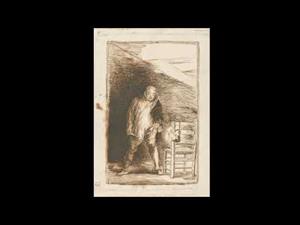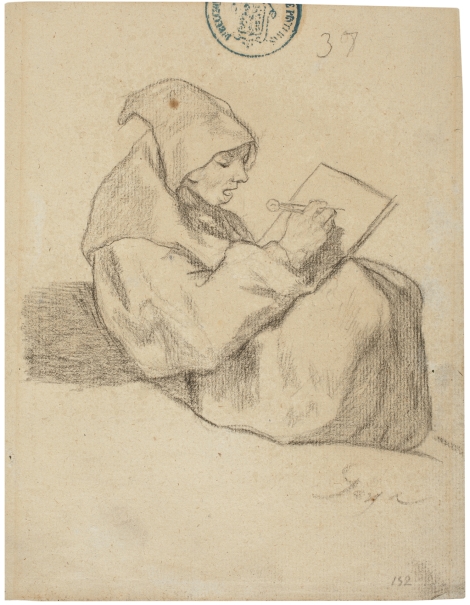
Monk drawing with a compass
1824 - 1828. Pencil on laid paper.Not on display
This drawing has rarely been exhibited and studied, but it is, nevertheless, one of the most beautiful due to its monumental and synthetic feel. Using only sharp crayon strokes, Goya defines the contours of the figure the friar, nestled in an indeterminate space while drawing with a compass. His face shows a degree of concentration perhaps excessive for the task he is performing. A smooth shading confers the nuances necessary to suggest volume and space.
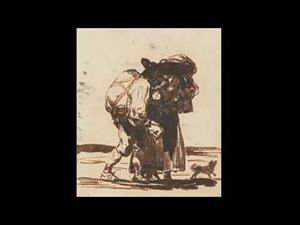
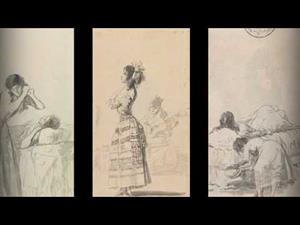
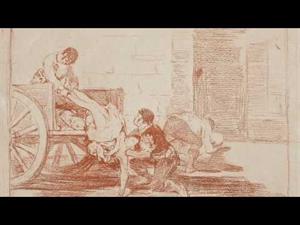
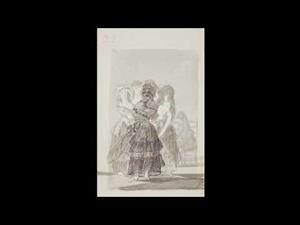
Albums G and H were produced in Bordeaux, probably simultaneously or very close to one another in time, as evidenced by their formal, stylistic and technical similarity. In them, Goya gave free rein to his capacity for invention based on specific events he had experienced, such as the popular characters seen on the streets of Paris and Bordeaux, and to his pure imagination. Goya depicts the most significant issues presented over the course of his career, but in this case the changes the tone from satirical to grotesque: the falsehood of humanity, inequality, poverty, irrationality and the violence of individuals and of society. Goya introduced the use of crayon in these albums. This occurs in coincidence to his interest in lithography and his practice of that procedure in Bordeaux.
Matilla Rodríguez, José Manuel, Ligereza y atrevimiento. Dibujos de Goya, Santander, Fundación Botín, 2017, p.131 n.79; 200-201 n.79