Oval rock crystal salver
1600 - 1610. Silver gilt, Rock crystal / Hyaline quartz.Room 079B
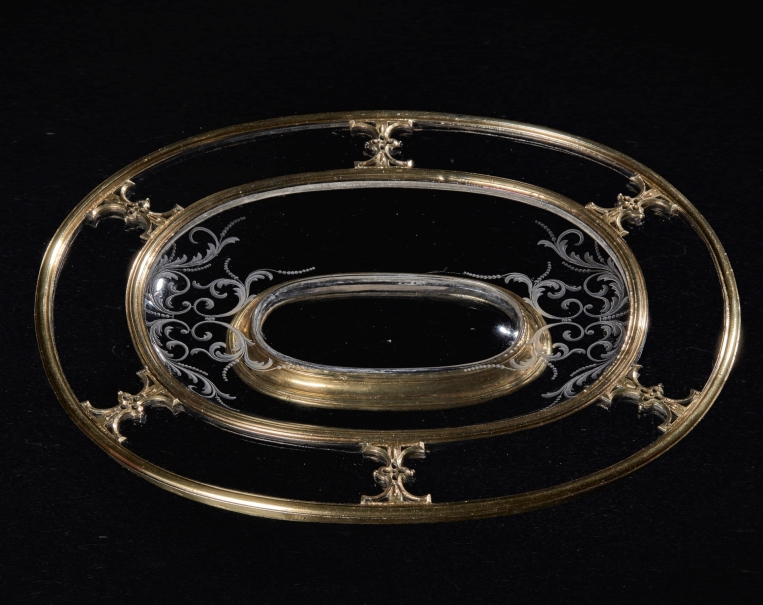
A salver made up of seven pieces of rock crystal held in an oval silver gilt structure. The central piece is oval, with a decoration at the ends of simple vegetable whorls and seeds engraved with a sure hand. All around this is a grooved moulding joined to another larger one by counterposed double C-shaped pieces linked by screws with flower-shaped heads. Fitted between these are the six pieces of crystal that form the brim of the salver. It rests upon a silver oval foot. The protagonist of this piece is the rock crystal itself, of extraordinary quality. It is so limpid that the optical illusion is created of a structure mounted in thin air.
The openwork pieces that join the plaques of rock crystal are similar to those on the heliotrope platter of the Dauphin’s Treasure, O26. Fleurettes are found on the mounts of both pieces, and these parallels were sufficient to persuade Arbeteta to attribute them to the Miseroni workshop. Another platter dating from about 1615 at the Schatzkammer der Residenz in Munich, inv. no. D. 59, has similar joints on the brim, richly decorated in this case, and its crystal plaques, according to Distelberger, were made at the Milanese workshop of the Miseroni. This raises the possibility that both platters, together with the tray, O106, at the Museo del Prado, might have come from the same workshop. Given the form of the object, the pieces must have been delivered ready assembled, either with a provisional mount of the type of the present one, in virtually unadorned silver gilt, to be replaced later by another, or else richly ornamented by the silversmiths of the workshop.
The structure is similar to that of salver O103 of the Dauphin’s Treasure, probably from the same workshop, which has richer decoration though with a design of poorer quality and crystal of less purity.
Original state: Juan Laurent y Minier, “Plateau ovale, cristal de roche gravé, montures d’argent doré, XVIe siècle, règne de Charles IX ou Henri III”, c. 1879. Museo del Prado, HF0835/41.