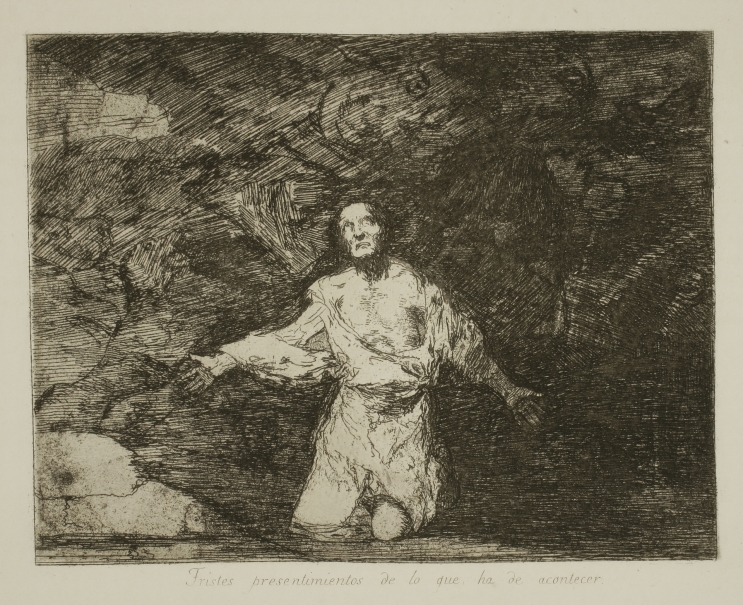
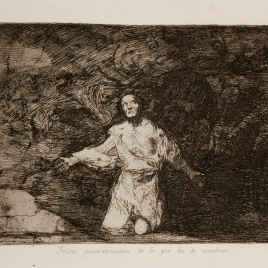
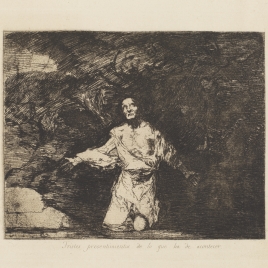
Sad forebodings of what is to happen
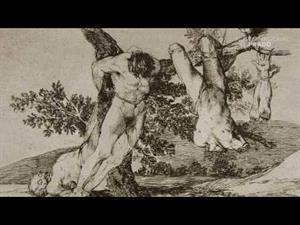
1814 - 1815. Etching, Drypoint, Burnisher, Burin on wove paper.Not on display
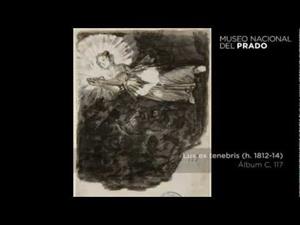
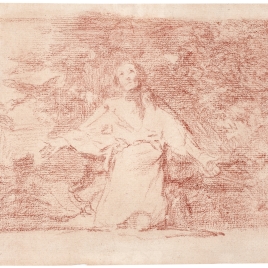
Goya did not publish The Disasters of War during his lifetime. Several motives have been adduced to explain this decision; the most likely would seem to be that it was politically inconvenient. Who would be willing to acquire, following the painful years of the Peninsular War, a series of images in which, from the first to the last print, the viewer is subjected to an uninterrupted sequence of calamities, each worse than the one before it? The reactionary government of Ferdinand VII would have been displeased by these prints that -in contrast to the commemorative spirit guiding the period´s artistic production- offer a critical vision of everything related to the war and its consequences, both material and political. It is no surprise that Goya stored away the copper plates in a box in his residence, the Quinta del Sordo, where there they remained until, years after his death, the Royal Academy of Fine Arts of San Fernando published them in 1863.Although Goya did not prepare an edition of the series while he was alive, we know he presented a bound album containing a complete set of working proofs to his friend Juan Agustín Ceán Bermúdez, which is now housed in the British Museum. On the manuscript´s title page, Goya wrote an eloquent text explaining his intentions, which begins: The terrible consequences of the bloody war in Spain against Bonaparte. With other emphatic caprichos...These terrible consequences have their prologue in this first etching, which functions as a kind of frontispiece or declaration of intent for what the viewer will see in the remaining 81 images. Unlike the commemorative cycles published after the war´s conclusion, which presented the conflict´s immediate political antecedents that led to the popular uprising in Madrid, Goya broke radically with that propagandistic narrative approach. In this image, he focused instead on the feeling of helpless abandonment that overwhelms the central figure, alone and on his knees, in the face of the impending dark tragedy that would demolish the humanistic concept of life.The changes Goya introduced in the print, compared with the preparatory drawing, which are especially apparent in the expression of suffering on the man´s face, help us clarify the role of this print as a prologue to the series, symbolising the physical and mental destruction of humanity as a result of war. To express this concept, Goya has secularised the iconography of Christ´s Agony in the Garden, situating it in a context that offers no redemption. It is evident that Goya himself felt similarly hopeless, and might also be seen as represented allegorically in this print. In 1814, Goya was nearly 70, deaf, recently widowed and deprived of many friends who had fled into exile or were persecuted by the State; the man, here, makes one think of Goya, demanding to know the meaning of life, suffering and death. The answer to this question may be found in Disaster 69, which presents the corpse of a man who has suffered the baneful effects of war and whose final act was to scratch with a pen on a sheet of paper the word Nada (nothing), expressing all the emptiness and barrenness that comes from war (Matilla, J. M.: Portrait of Spain. Masterpieces from the Prado, Queensland Art Gallery-Art Exhibitions Australia, 2012, p. 214).