Saint James the Greater
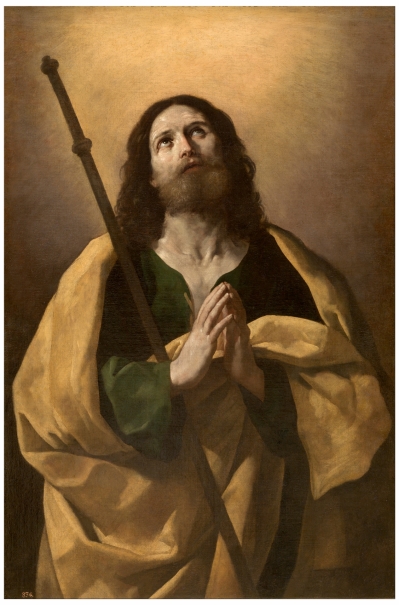
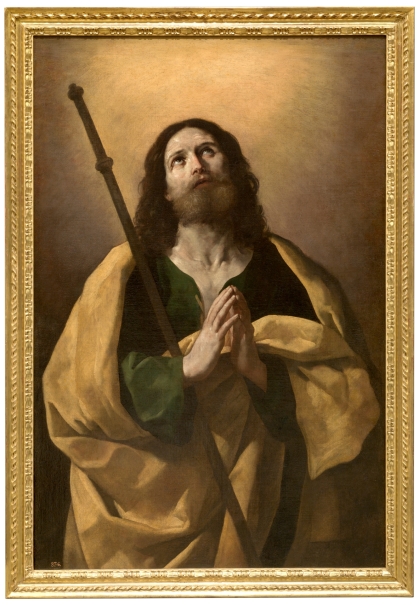
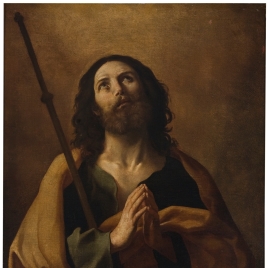
Ca. 1626. Oil on canvas.Not on display
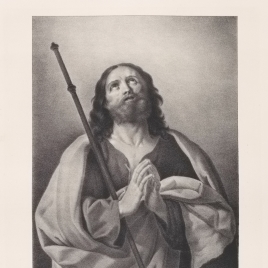
James the Greater, a senior apostle and one of Jesus’ closest disciples, had strong ties with Spain. He is said to have travelled to the peninsula after the events at Pentecost in order to preach the gospel. According to tradition, his remains were interred in Santiago de Compostela, where from the Middle Ages onwards his shrine became a popular place of pilgrimage, as a result of which he was named patron saint of Spain. He is also deemed to have played a central role in several miracles associated with battles against the Moors. Accordingly, he was held in special esteem by the Spanish monarchy, in whose territories the image of this saint, in its various iconographies, soon spread. In this half-length frontal representation, the brilliant rendering of colour against a neutral background combines with the chosen perspective to endow the figure with a sculptural presence. James is portrayed here as a pilgrim, with the staff as his only attribute, pinned diagonally against his body by his right arm, and his hands folded in prayer. His head is slightly tilted backwards, emphasising his upward gaze. Above him, the golden heavens open in a dramatic gesture underlining his role as God’s intercessor.
For this version, Guido Reni turned to a model first used around 1617 in a canvas that was more demanding in terms of composition: the Assumption of the Virgin in the church of Gesù e dei Santi Ambrogio e Andrea in Genoa, in which the position of one of the apostles in the lower left, gazing up at Mary, is identical to that of Saint James in this painting. Guido had earlier made successful use of this pose – and this setting – for similar figures, for example in the frescoes of Saint Francis in Ecstasy of about 1611 for the Cappella Paolina in Santa Maria Maggiore, Rome, and in the Glory of Saint Dominic for the apse of the Cappella dell’Arca, in the church of San Domenico, Bologna, of around 1613.
The first mention of this canvas in an inventory of the Spanish royal collection appears in 1746, when it is listed among Queen Isabella Farnese’s paintings at the palace of La Granja de San Ildefonso. It was later transferred to Aranjuez, together with several other works by Reni, including a Saint Catherine and a Saint Sebastian, beside which it was placed in the oratory. The painting was subsequently moved to the Royal Palace in Madrid, where it hung in the ‘first room’, and more specifically in the Infante Francisco’s quarters, and kept the same inventory number. It was taken to the Museo del Prado in 1834. In the twentieth century, Bernard Berenson and Hermann Voss agreed that this was an original work by Reni, a view officially adopted in 1955 in a book by Cesare Gnudi and Giancarlo Cavalli.
This composition achieved considerable success in the seventeenth century. The presence of copies in several major Spanish religious buildings, including the cathedrals of Granada and Zamora, led some to believe they were based on the Prado canvas, which must therefore have been in Spain before it entered the royal collection. However, it is now known that the model for these copies was another autograph version that formed part of an Apostles series commissioned in Rome around 1625 by Fernando Afán Enríquez de Ribera, 3rd Duke of Alcalá de los Gazules (1583–1637), for the family pantheon at the monastery of La Cartuja in Seville. This canvas, now in the Museum of Fine Arts, Houston, displays several subtle traits that also appear in the reproductions to be found in Spain but not in the Prado version, confirming that the Houston work was the painting in the duke’s collection. X-radiography of the Madrid painting, carried out at the Museo del Prado, has revealed neither pentimenti nor substantial changes in composition, both of which have been detected in the Houston canvas, suggesting that the Prado version was produced later, with greater ease and technical assurance.
The Prado register of copyists shows that between the nineteenth and twentieth centuries fifteen applications were received to copy this canvas, making it the third most copied Reni work in the Prado. Prominent copyists included Natalio Hualde (1873–1951) – a Navarre painter who made a copy in December 1890, at the age of only seventeen – and the Granada sculptor Pablo de Loyzaga (1872–1951), who produced a copy in 1943.
Japón, Rafael, 'Guido Reni. Saint James the Greater'. In: Guido Reni, Madrid, Museo Nacional del Prado, 2023, p.248-249 nº 38