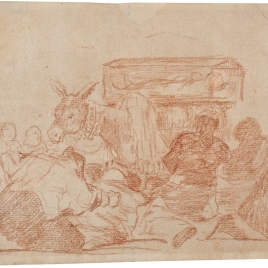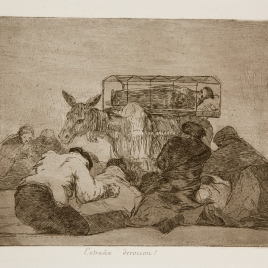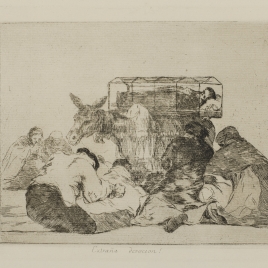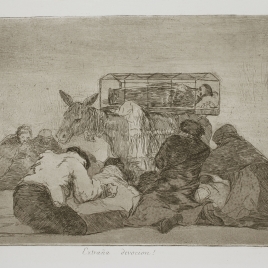
Strange Devotion!
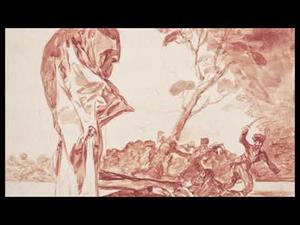
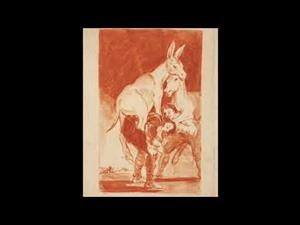
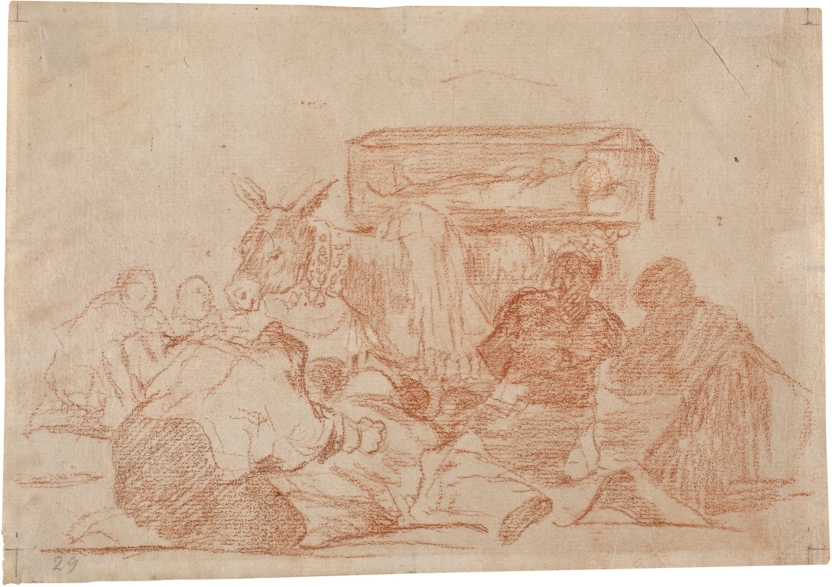
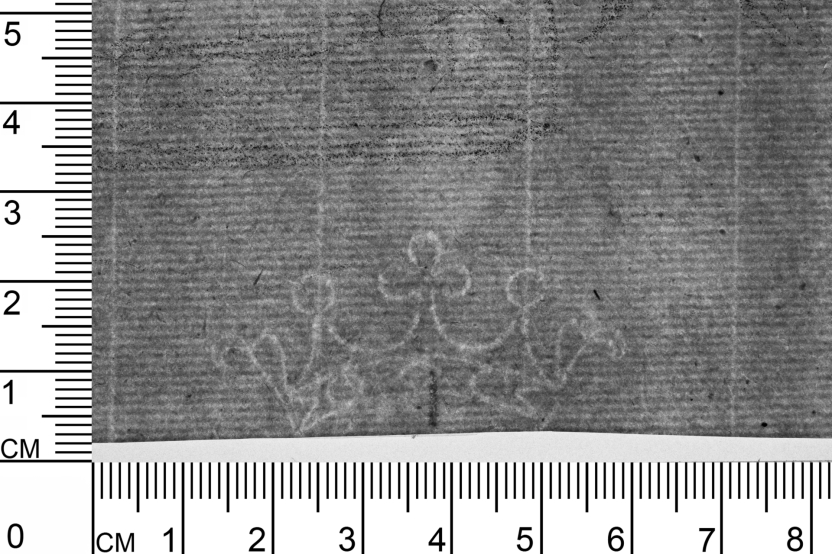
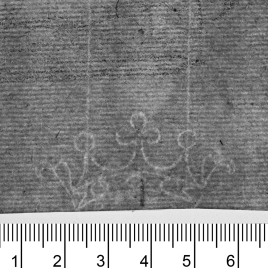
1814 - 1815. Red chalk on laid paper.Not on display
A preparatory drawing for Disasters of War, 66, Strange Devotion! In his novel, Rinconete and Cortadillo (1613), Miguel de Cervantes has his character, Monipodio, say the following about two old men in his band of criminals, who, despite being thieves, “were man of considerable truth and very honorable, with good lives and reputations. God-fearing and conscientious, they attended mass every day with strange devotion.” The adjective that qualifies their devotion can be interpreted with a variety of nuances, as “strange” can mean singular, rare, surprising or even extravagant, in short, not in keeping with their condition. Thus, “strange devotion” acquires an unquestionably satirical tone as a result of the clash between substance and form. That same clash appears in Goya’s homonymous drawing and print, and it persists, both verbally and visually, in the following scene, This is not the least. In both, the artist targets that devotion or form of religiosity that, in the present drawing, leads a group of people to venerate a relic, or rather, a sacred mummy, that is being transported in a urn carried by a donkey with bells on his harness. In the second work, a group of old men in outdated suits carry various effigies of the Virgin Mary on their backs in a wobbling manner. The ridiculousness of both scenes leaves no doubt about Goya’s critical and sarcastic view of the religious irrationality associated with the worship of relics, processions, offerings and ex-votos, the latter of which appear in Disasters 60, What Madness! These works belong to the final part of the series, which is also known as Emphatic Caprices and comprises prints number 65 through 80. These must have been made immediately after the war, between 1814 and 1815, as their overall interpretation targets different aspects of the repression and absolutism that coincided with Ferdinand VII’s return to Spain. The idea that they were made at that time is also supported by formal and ideological similarities between these two prints and the panels at the Academy of San Fernando, which date from around 1815. Given Goya’s tendency to return to subjects by reusing formal aspects employed in different media, it is clear that the two groups coincide in both age and ideological outlook. And the latter is precisely what has most been debated with regard to both prints, as their interpretation has involved a search for the sources Goya may have drawn upon when making them. The variety of proposed sources clearly reflects the different approaches to the study of his work. With regard, especially, to the Emphatic Caprices, Nigel Glendinning (1962) made an innovative proposal, suggesting that these engravings could be related to La Fontaine’s fable of The Ass Carrying Relics, which Goya probably knew through contemporaneous Spanish versions by Samaniego and Ibáñez de la Rentería. Glendinning offers an explanation for both Disasters. In the first, he describes the presumptuousness of a burro carrying relics before whom a devout crowd has kneeled. This is the first part of the Fable, and as is generally appreciable in Goya’s drawings and prints, it begins with a reality known from various historical and literary sources only to transform it into a personal version marked by a ferocious criticism of human behavior in which, rather than illustrating concrete events, the images become general referents. More recent studies (Roche en Madrid-Boston-Nueva York 1988-89, pp.432-34, no 154; Vega 1992, p.44) have found contemporaneous mentions of processions with religious images that were the object of considerable popular devotion in Madrid. Thus, the cadaver of the nun Mariana de Jesús -a Barefoot Sister of Mercy- could be the starting point for Disaster 66, while images of Our Lady of Solitude, to which the monarch’s health was entrusted, and the Virgin of Atocha, in whose hands King Ferdinand VII placed Spain in 1808, would be the religious effigies carried on the old men’s backs in Disaster 67. Goya begins with those events, reinterpreting them in the context of moralizing literary sources well known to the public -here, the fables mentioned above- to turn them into satirical scenes emphasized by mismatching images and contents. It is hardly coincidence that he chooses a donkey to carry the relics when it is practically impossible to maintain the stability of an urn on such an animal’s back, and the same can be said for the religious effigies of the Virgin Mary, wobbling on the backs of old men. Thus, Goya unfolds his criticism of unreasoning popular religiosity rooted in outdated practices and directed by a social class whose outdated clothing indicates that their ideas are equally obsolete (Text drawn from Matilla, J. M.: Extraña devoción!, in: Goya en tiempos de Guerra, Madrid: Museo Nacional del Prado, 2008, pp. 334-335).