formularioRDF
The itinerary <em>TITULORECORRIDO</em> has been successfully created. Now you can add in works from the Collection browser
<em>TITULOOBRA</em> added to <em>TITULORECORRIDO</em> itinerary

Close Continuar a ficha de la obra Continuar a ficha de la obra
02-06-2026
Francisco de Goya y Lucientes - Engraver
Fuendetodos, Zaragoza (Spain), 1746 - Bordeaux (France), 1828 - Engraver
Laureano Potenciano Pastor
Madrid, 1837 - ¿Madrid?, 1864
Real Academia de Bellas Artes de San Fernando

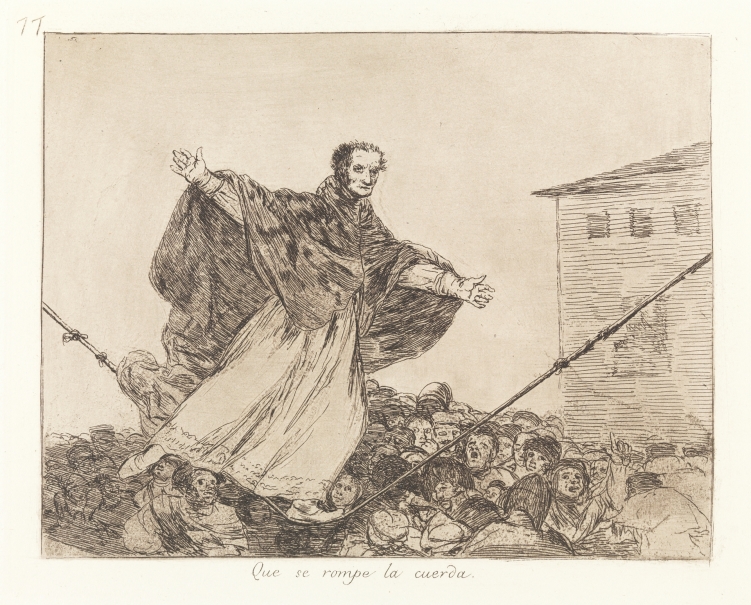
The Rope is Breaking

1814 - 1815. Wash, Drypoint, Etching, Burnished wash on wove paper.
Not on display

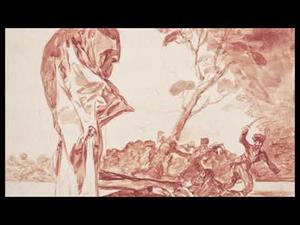
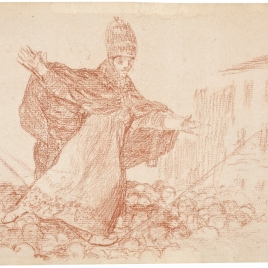
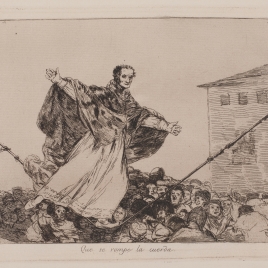
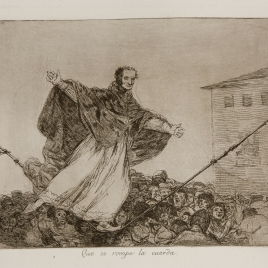
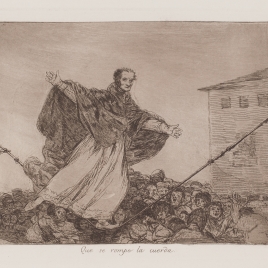
The title that appears on this print recalls the Spanish saying: “the rope always breaks at the weakest point.” Careful comparison of the drawing and the print reveals a series of differences that affect the meanings of both. In the drawing, the rope mentioned in the title could be called a “slack rope,” as its lines suggest a lateral movement that produces instability rather that possible breaking. On the print, however, the rope has a series of knots to the right, with frayed and weaker parts to the right. These convey a sensation of instability, but the rope’s obvious fragility adds a sense of risk that is clearly justified by the title. The second important difference has to do with the protagonist’s clothing, and thus, with his identification. In the drawing, he wears the tiara, white cassock and dark, presumably red cape associated with a pope. In the print, the tiara has been eliminated. Finally, in the move from drawing to engraving, the faces and expressions of the crowd have been more precisely defined. In an urban setting, they boisterously observe the clergyman’s plight -especially a woman who watches him from the corner of her eye, pointing to the weakest part of the rope and opening her mouth as if to say “the rope is breaking.” The key to understanding this work thus lies in the ropewalker’s identity. In the drawing, his clothing clearly identifies him as a pope, but in the print, in what some have called self-censorship, Goya removes his main identifying trait. Religious figures appear frequently in the Emphatic Caprichos. In Disaster 73, Feline Pantomime, a cardinal approvingly contemplates the coronation of the animals of the night, and in Disaster 74, This is the Worst, a monk bows to a wolf. In Disaster 75, Troup of Charlatans, what could be a cardinal with a bird’s head bows to a motley group of animals, and in Disaster 76, The Carnivorous Buzzard, a clergyman in the background blesses the bird’s expulsion. Finally, in Disaster 79, The Truth has Died, a bishop blesses its cadaver. None of these works presents a positive assessment of the Church’s attitude to the return of King Ferdinand VII, and that is how they should be interpreted. Moreover, one of the most debated aspects of the Emphatic Caprichos is their dating. While we defend the idea that they were engraved in 1814-1815, it has been suggested that the last ones were engraved between 1820 and 1823 and should thus be interpreted as symbols of the Church’s precarious position and its loss of prestige on the eve of the return of the constitution during the Liberal Triennium. The papal attributes and a certain physical resemblance have led the protagonist to be identified as Pope Pius VII, whose position was rather delicate during the Napoleonic Empire. Still, it is rather surprising that in a fundamentally allegorical context, Goya would have made the effort to depict a specific person, especially when he had not done so at any time before that in this series. It is true, however, that he was working on his Tauromaquia at that time, and there, numerous works precisely define some of their protagonists. Given his approach, it seems more logical to conclude that Goya used papal attributes to allegorically refer to the Church’s role, or possibly to the figure of Cardinal Luis María de Bourbon, president of the Regency. At war’s end, it was he who had to choose between following the guidelines set out by the Cádiz Cortes that obliged King Ferdinand VII to pledge allegance to the Constitution, or instead, to directly accept royal authority, which he in fact did, on April 16, 1814, near Valencia. The rope would thus break at its weakest point, where those liberals were forced to withdraw in the face of returning absolutism (Text drawn from Matilla, J. M.: "Que se rompe la cuerda", en: Goya en tiempos de Guerra, Madrid: Museo Nacional del Prado, 2008, pp. 344-346).
Multimedia

Technical data

Inventory number
G000758
Authors
Francisco de Goya y Lucientes -Engraver-; Laureano Potenciano Pastor; Real Academia de Bellas Artes de San Fernando
Title
The Rope is Breaking
Date
1814 - 1815
Technique
Wash; Drypoint; Etching; Burnished wash
Support
Wove paper
Dimension
Height: 225 mm; Width of the plate mark: 221 mm; Height of the plate mark: 178 mm; Width: 305 mm
Series
Desastres de la guerra [estampa], 77 [17]
Provenance
Bequest of Tomás Harris, 1964
Entry date
1964

Bibliography +

Brunet, M.G., Étude sur Francisco Goya sa vie et ses travaux, Aubry, Paris, 1865, pp. 58.
Yriarte, Charles, Goya: sa biographie, les fresques, les toiles, les tapisseries, les eaux-fortes et le catalogue de l' oeuvre, Henri Plon, Paris, 1867, pp. 117.

Viñaza, Cipriano Muñoz y Manzano Conde de la, Goya: su tiempo, su vida, sus obras, Tip.M.G.Hernández, Madrid, 1887, pp. 400.

Delteil, Loys, Francisco Goya, I, Chez L'Auteur, Paris, 1922.

Mayer, August L., Francisco de Goya, Labor, Barcelona, 1925, pp. 231.

Velasco y Aguirre, Miguel, Grabados y litografías de Goya, Espasa Calpe, Madrid, 1928, pp. 11.

Lafuente Ferrari, Enrique, Las Pruebas de Estado de 'Los Desastres de la Guerra' en la Biblioteca Nacional, II, Anabad, Madrid, 1934, pp. 387.

Lafuente Ferrari, Enrique, Los desastres de la guerra de Goya y sus dibujos preparatorios, Instituto Amatller de Arte Hispánico, Barcelona, 1952, pp. 75, 188.

Harris, Tomas, Goya, engravings and lithographs, II, Bruno Cassirer, Oxford, 1964, pp. 288.

Gassier, Pierre y Wilson-Bareau, Juliet, Vie et oeuvre de Francisco de Goya: l' oeuvre complet illustré: peintures, dessins, gravures, Office du Livre, Fribourg, 1970.

Sayre, Eleanor, The Changing Image. Prints by Francisco Goya, Museum of Fine Arts, Boston, 1974, pp. 287.

Derozier, C., La Guerre D'Independance Espagnole a Travers L'Estampe (1808..., II, Universidad de Lille, Lille, 1976, pp. 958.

Pita Andrade, J.M. y Alvarez Lopera J., Goya y la constitución de 1812, Ayuntamiento, Delegación de Cultura, Madrid, 1982, pp. 68.

Armstrong Roche M., Que se rompe la cuerda, Goya y el espíritu de la Ilustración, Museo Nacional del Prado, Madrid, 1988, pp. 443.

Vega, Jesusa, Fatales consecuencias de la guerra. Francisco de Goya, pintor, Francisco de Goya, grabador: instantáneas, Caser y Calcografía Nacional, Madrid, 1992, pp. 47.

Vega, Jesusa, Museo del Prado: catálogo de estampas, Museo del Prado, Madrid, 1992, pp. 99.

Biblioteca NacionalEspaña, "Ydioma Universal": Goya en la Biblioteca Nacional, Biblioteca NacionalLunwerg, Madrid, 1996, pp. 218.

Cuenca M. L., Docampo J. y Vinatea P., Catálogo de las estampas de Goya en la Biblioteca Nacional, Biblioteca Nacional y Lunwerg, Madrid, 1996, pp. 185.

Blas, Javier y Matilla, José Manuel, El libro de los desastres de la guerra: Francisco de Goya, Museo Nacional del Prado, Calcografía Nacional, Madrid, 2000, pp. 152-154.

Obras adscritas al Museo Nacional del Prado en el año 2000, Boletín del Museo del Prado, XIX, 2001, pp. 200.

Nieto Alcaide, Víctor, La guerra y lo imaginario en la pintura de Goya, Barcelona, 2003, pp. 319-329.

Calcografía Nacional (España), Calcografía Nacional: catálogo general, II, Calcografía Nacional, Madrid, 2004, pp. 467.

Bozal, Valeriano, Francisco Goya: vida y obra, II, T.F., Alcobendas (Madrid), 2005, pp. 127.

Matilla J.M., Que se rompe la cuerda, Goya: en tiempos de guerra, Museo Nacional del Prado, Madrid, 2008, pp. 344.

Matilla, José Manuel, Estampas españolas de la Guerra de la Independencia: propaganda, conmemoración y testimonio, Universidad de Salamanca, 2008.

Bordes J., Matilla J.M. y Balsells S, Goya, cronista de todas las guerras: los "desastres" y la fotografía de guerra, Centro Atlántico de Arte Moderno y Real Academia de Bellas Artes de San Fernando, Las Palmas de Gran Canaria; Madrid, 2009, pp. 234.

Hofmann, Julius, Francisco de Goya: Katalog seines graphischen Werkes, Gesellschaft für vervielfältigende Kunst, Viena, 2014, pp. 91-145.

Pérez Francés, José Antonio, Aragón en los Desastres de la guerra de Francisco de Goya, Institución Fernando el Católico,, Zaragoza, 2025, pp. 39-62 [313-325].

Inscriptions +

77 // Que se rompe la cuerda
Lettered in the plate. Front

TH [monograma en un círculo. Lugt, n. 4922] // Thomas Harris. [Lugt, n. 4921]
Brown ink stamp. Back, lower central area

Exhibitions +

Colaboración con el Museo Nacional Centro de Arte Reina Sofía
Madrid
28.05.2009 - 20.10.2009

Update date: 02-06-2026 | Registry created on 22-07-2016

Visor 360

Drag with the cursor to rotate the piece

Other works by Francisco de Goya y Lucientes; Laureano Potenciano Pastor; Real Academia de Bellas Artes de San Fernando

Print on demand

Print artworks available in our catalogue in high quality and your preferred size and finish.

Image archive

Request artworks available in our catalogue in digital format.

Up