formularioRDF
The itinerary <em>TITULORECORRIDO</em> has been successfully created. Now you can add in works from the Collection browser
<em>TITULOOBRA</em> added to <em>TITULORECORRIDO</em> itinerary

Metabuscador

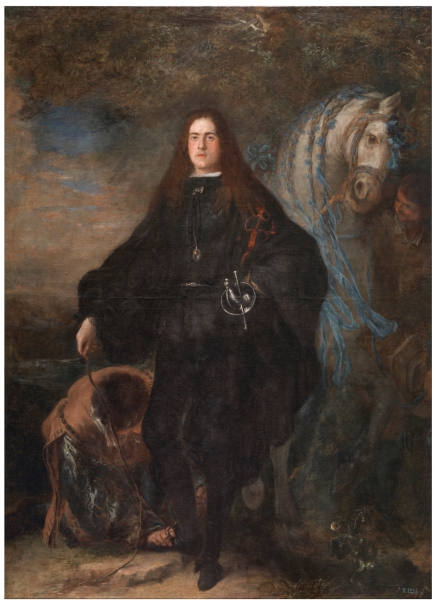
The Duke of Pastrana
Oil on canvas. Ca. 1679
Here we are presented with a young man, elegantly dressed in black, standing within a landscape beside a horse whose mane is richly adorned with blue ribbons and bows. The man wears his hair very long, as was popular during the reign of Charles II, and carries a sword at his side. Hanging on his chest is a pendant with the cross of the Order of Saint James, which also appears prominently on his cape. In his right hand he holds a rod for breaking-in horses, an equestrian reference that is complet
ARTWORK
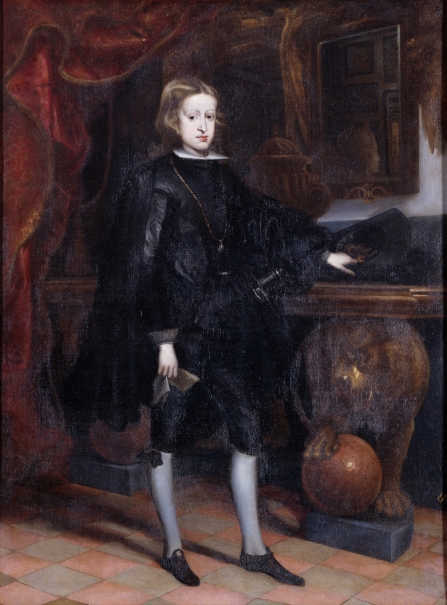
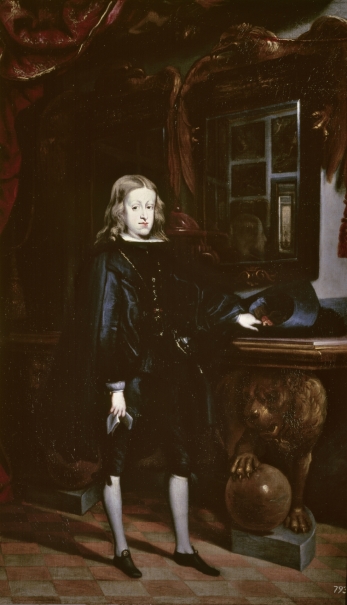
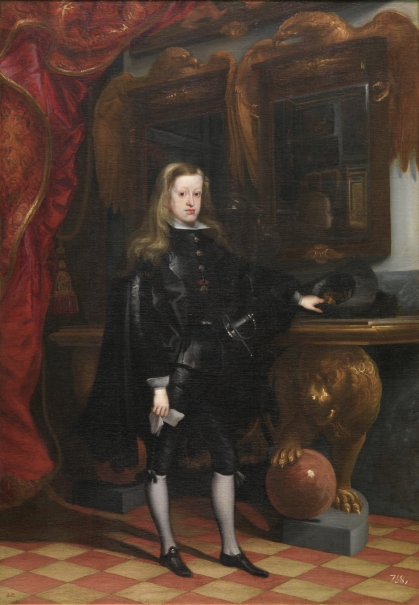
Charles II as a child
Oil on canvas. Ca. 1675
Charles II stands in the Alcázar Palace’s Hall of Mirrors alongside a porphyry table held up by two of Mateo Bonuccelli’s gilded bronze lions. The monarch is dressed in black silk, as was customary in royal portraits of the Spanish branch of the Habsburg dynasty since the time of Philip II. He wears the Golden Fleece on a necklace and has a sword on his belt. He holds a folded report in his right hand, and his left, which grasps a hat with black plumes, rests on a buffet. He has a traditi
ARTWORK
Juan Carreño de Miranda – (Attributed to)
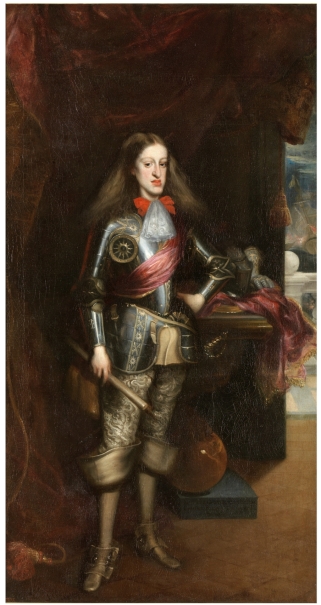
Charles II in armour
Oil on canvas. 1681
Charles II was born in 1661, the only son of Philip IV and his second wife (and niece), Mariana of Austria, to survive to adulthood. Charles succeeded his father in 1665 and died without an heir in 1700 at the age of 39, thus bringing to an end the Spanish Habsburg dynasty. According to the date on this portrait, the king would have been 20 years old at the time. His long hair is worn in a similar style to his earlier portraits, although here, for the first time, he is depicted in military dress
ARTWORK
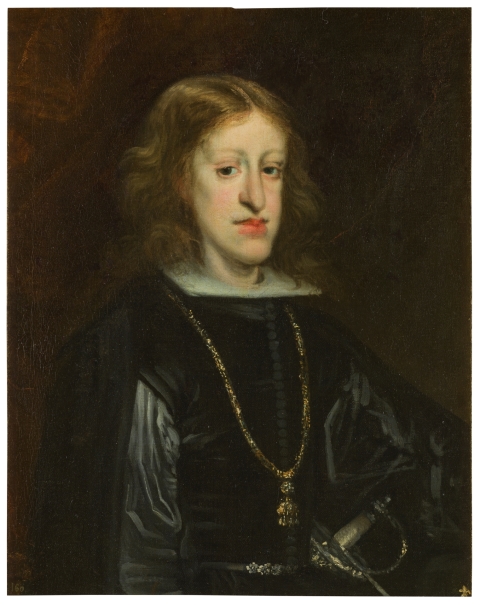
Charles II
Oil on canvas. Ca. 1680
The most characteristic depiction of Felipe IV towards the end of his life is a half-length one, wearing dark clothes with the emblem of the Order of the Golden Fleece around his neck and standing out against a similarly dark background. More than twenty copies of this model devised by Velázquez are known. While portraits of Carlos II are generally full-length and include a more complex setting, there are also examples that look back to those late portraits of his father. The most importa
ARTWORK
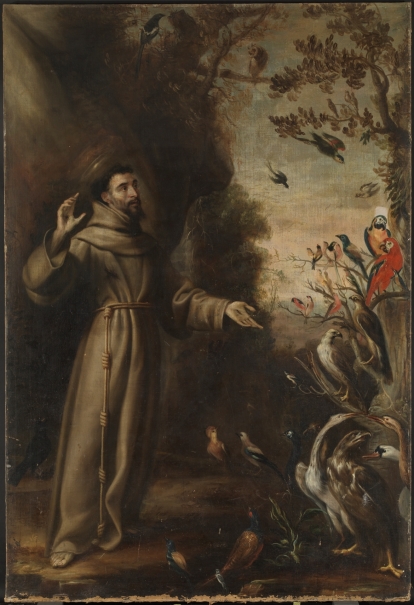
Saint Francis Preaching to the Birds
Oil on canvas. Ca. 1646
In 1724, Antonio Palomino, who had been Juan Carreño de Miranda’s disciple, included his teacher’s biography in his Parnaso español pintoresco y laureado. Their close relationship makes that text a highly informative source of first-hand information. Palomino wrote: Two other works by his hand (though early) are the paintings on the facing side walls of the church of El Caballero de Gracia, which are of Saint Francis and Saint Anthony, one preaching to the birds, and the other, to
ARTWORK
Charles II
Oil on canvas. 1673
Charles II stands in the Alcázar Palace’s Hall of Mirrors, alongside a porphyry table held up by two of Mateo Bonuccelli’s gilded bronze lions. The monarch is dressed in black silk, as was cutomary in royal portraits of the Spanish branch of the Habsburg dynasty since the time of Philip II. He wears the Golden Fleece on a necklace and has a sword on his belt. He holds a folded report in his right hand, and his left, which grasps a hat with black plumes, rests on a buffet. He has a traditi
ARTWORK
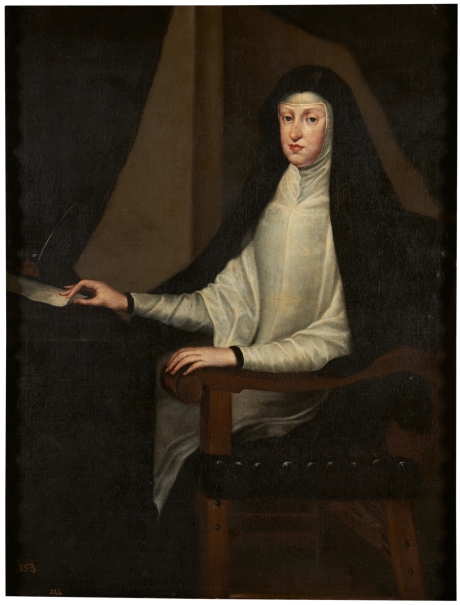
Mariana of Austria, Queen Regent
Oil on canvas. Last third of the XVII century
This painting entered the Museo del Prado from the Lodgings of the Monastery of El Escorial, where it hung in 1847. At that time, José de Madrazo petitioned the religious order to have it “transferred to this Royal Museum so that it can be included in the chronological series of our Monarchs and Royal persons.” It was accompanied by another portrait of Marianne of Austria dressed as a nun (P644).
ARTWORK
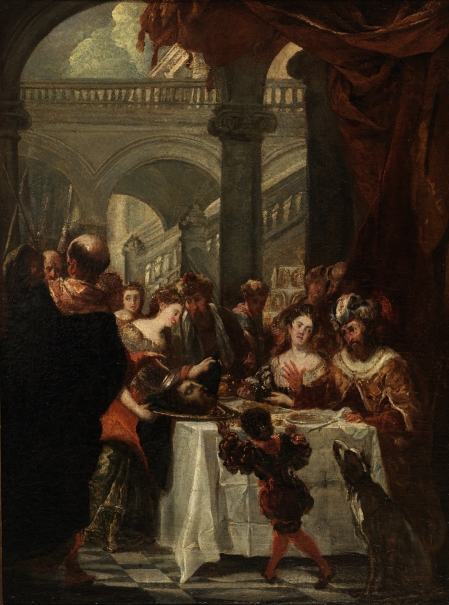
Herod’s Feast (sketch)
Oil on canvas. XVII century
Herod and Herodias appear at the right of the composition. Sitting at a table painted in foreshortened perspective, they look on—the king with a stupefied expression—as Salome presents them with the payment for her dance: John the Baptist’s head on a platter(Mark, 6 21-29). The skillfully lit architectural background clearly recalls Venice. The other figures in the scene are standing, which contributes to its sense of verticality. In the foreground, lit from behind, are a male figure and a young
ARTWORK
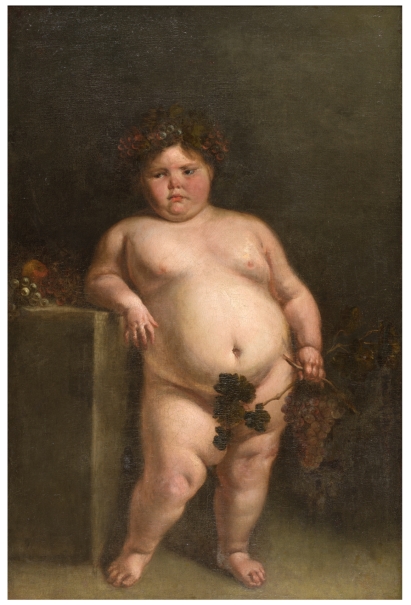
Eugenia Martínez Vallejo, Naked
Oil on canvas. Ca. 1680
After the death of Velázquez, Carreño showed himself to be the artist most worthy of continuing the depiction of jesters that inhabited the Spanish court. Inventories show that the Alcázar possessed a large number of portraits of this kind by Carreño, among which are the two of Eugenia Martínez, as well as others that have unfortunately disappeared. The few that have come down to our own day show, at any rate, that Carreño approached these individuals as
ARTWORK
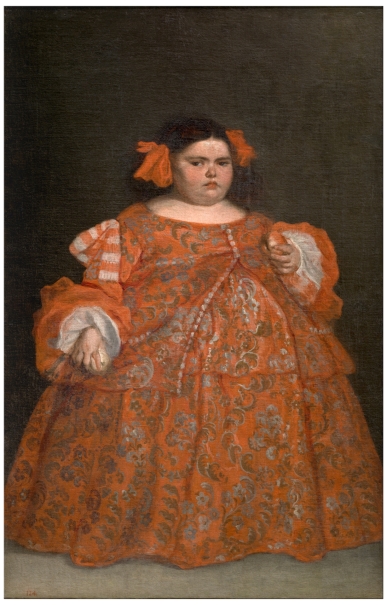
Eugenia Martínez Vallejo, Clothed
Oil on canvas. Ca. 1680
In the courts of Spain´s nobility, the sixteenthcentury para-scientific interest of the nature persisted into the seventeenth and was manifested in, among other things, in portraits of court jesters. Such people were employed for the entertainment of the powerful and were also frequently represented in paintings. Inventories of aristocratic art collections occasionally contain references to this type of work, as, for instance, in the Count of Monterrey´s collection inventory (1653), which record
ARTWORK
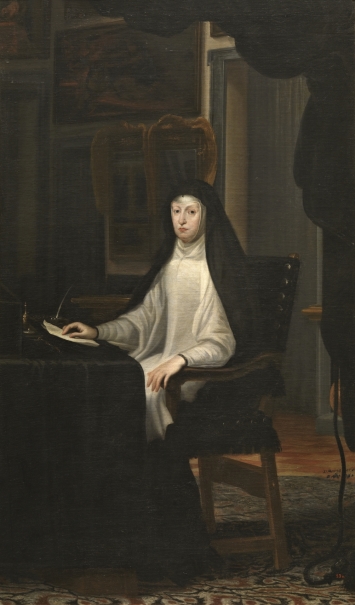
Mariana of Austria, Queen Regent
Oil on canvas. Ca. 1670
After the death of Philip IV in 1665, his widow Mariana (1634-1696) became regent. She is depicted here as both widow and regent in the Hall of Mirrors in the Alcázar in Madrid. The writing implements on the desk allude to her responsibilities as ruler. The overt inclusion of the royal palace into the royal portrait is one of the features that characterises the court portrait after Velázquez. Among its starting points is Las Meninas (P1174), which is also the source for the use of
ARTWORK
Charles II
Oil on canvas. Ca. 1675
The son of Felipe IV (1605-1665) and Mariana of Austria (1634-1696), Carlos II (1661-1700) was the last King of the Hapsburg Dynasty in Spain. He appears dressed in black, with the chain of the Golden Fleece around his neck. This order from Burgundy, to which he belonged, was first brought to Spain by Felipe el Hermoso (1578-1506). The young monarch (1661-1700) is depicted in the Hall of Mirrors, one of the principal rooms in the Alcázar, or old royal palace, in Madrid. He wears a sword a
ARTWORK
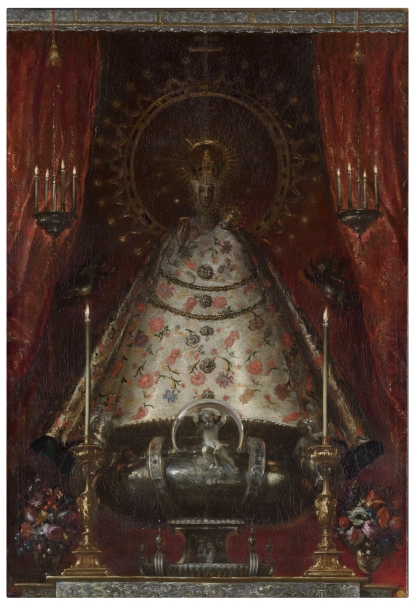
The Virgin of Atocha
Oil on canvas. Ca. 1680
This surprising canvas presents the image of the Virgin of Atocha, just as she was worshipped on her altar at the Dominican convent dedicated to her on the outskirts of Madrid. This type of votive image with luxurious rigid clothing that gives the figure a conical silhouette—hence their popular characterization as “funnel” images—is very characteristic of the 17th century and quite frequently reproduced in engravings and sometimes paintings, where they created a sort of divine trompe l’oeil in w
ARTWORK
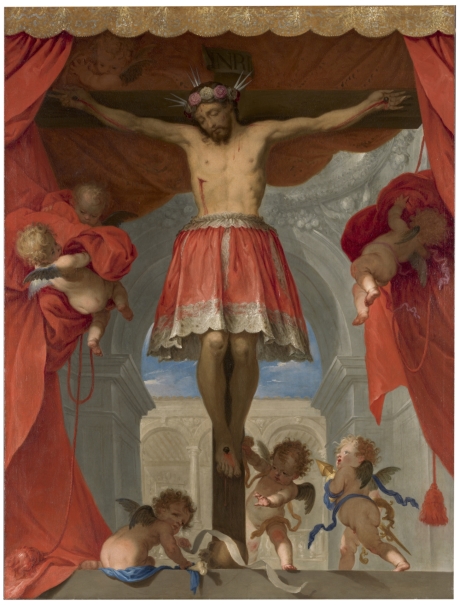
Christ Crucified
Oil on canvas. 1660 - 1670
Along with the Virgin of Atocha (P5536), this is one of the most interesting examples of religious paintings known as divine trompe l’oeil works, in which a famous votive sculpture is replaced with its own “true portrait.” Such likenesses so closely imitated the original that the faithful might actually think they were in its presence. We do not know what concrete image is presented in this depiction of a real chamber, with its sumptuous adornments and a magnificently rendered trompe l’oeil arch
ARTWORK
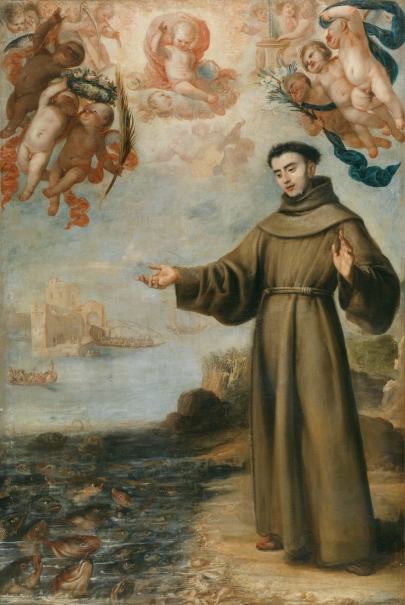
Saint Anthony Preaching to the Fish
Oil on canvas. 1646
This is the earliest surviving work signed and dated by Carreño, and its style is still closely linked to masters from the first half of the century. Palomino, who knew and had contact with Carreño mentions this painting as being, by his hand, but more at the beginning, probably as a reference to what his contemporaries clearly recognized: that the composition was rather archaic. Especially the child angels, with their rather forced foreshortening and excessively turgid forms, are
ARTWORK
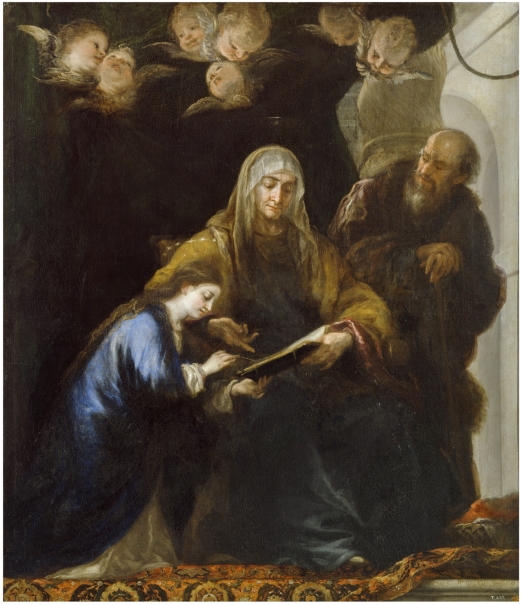
Saint Anne teaching the Virgin to read
Oil on canvas. 1674
The scene takes place on a set of richly carpeted steps. A dark curtain in the background opens on the right to show a Solomonic column and some sketchy architectural elements that suggest an indoor setting. The subject was quite common in Counterreformation iconography, and was painted by Rubens, Roelas and even Murillo, among others. It presents the moment when Saint Anne teaches the young Virgin Mary to read. The child kneels at her feet as Saint Joachim looks on. The composition is triangula
ARTWORK
Loading...

Loading...

Up