Saint Paul
1633 - 1634. Oil on satin.Room 004
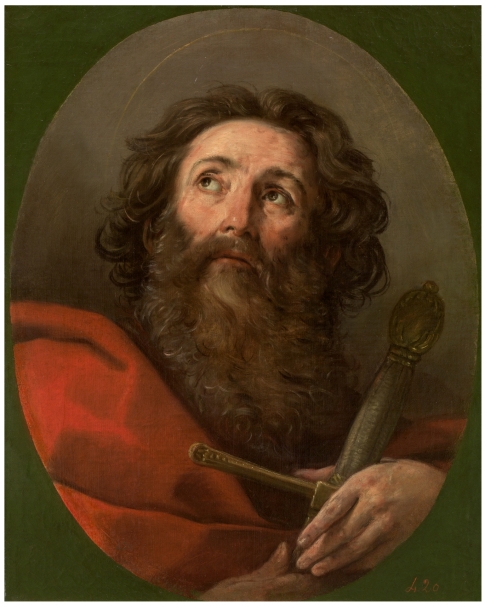
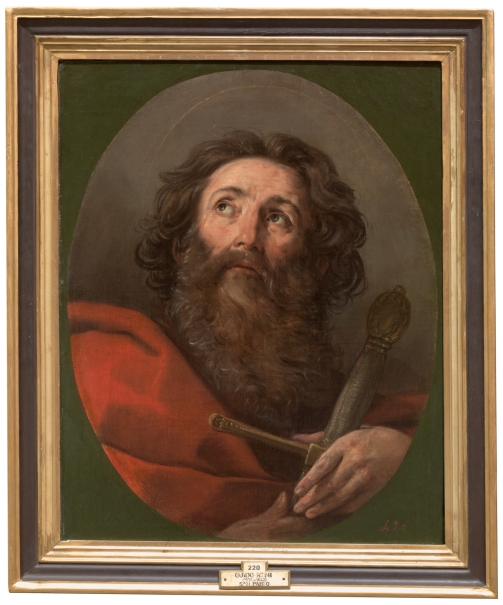
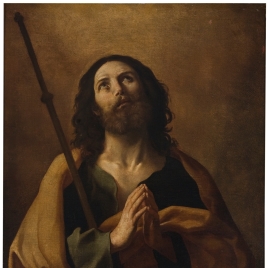
This Saint Paul shares with its pendant – the Saint Peter also in the Museo del Prado – a number of technical characteristics which indicate that they were produced by Guido Reni at the same time, around 1633–34. Chief among these is his masterly construction of volume using swift brushstrokes that allow the picture layer beneath to show through, creating a vibrant effect. This is particularly apparent in the saint’s left hand, which assumes great prominence on account of its position in the foreground grasping the sword, one of Paul’s attributes. His fingers are rendered in patches of colour employing a very limited palette and using fragile glazes that make precise contours unnecessary. This testifies to the vast technical knowledge of an artist at the height of his career, whose paintings during this period are notable both for their speed of execution and for an economy of resources which – contrary to what one might imagine – never undermines the quality of his work.
This piece contains several compositional elements that contrast with those of Saint Peter, probably in order to convey different, though complementary, Counter-Reformation values. Here, the Apostle to the Gentiles is depicted in early middle age, his maturity hinted at only by a few grey hairs, executed with fine brushstrokes against his dark locks. Though the two saints are facing in opposite directions, both raise their eyes towards heaven, but Paul’s gaze bespeaks a wholly different intention; his firm, haughty expression and his grip on the sword underline his commitment to the defence of Christianity. The colour of their garments is also in keeping with their attitudes: while Peter wears an ochre robe that stresses his grief, Paul’s bright red cloak stands out against the green background, heightening the sense of movement conveyed by the turning of his head. In terms of composition and use of colour, the picture strongly resembles the Saint Paul designed by Fra Bartolomeo (1472–1517) and completed by Raphael (1483–1520) for the church of San Silvestro al Quirinale in Rome, now hanging – alongside a Saint Peter by the same artists – in the Musei Vaticani. Reni employed an identical combination of clothing in other portrayals of the two apostles, making excellent use of all the technical resources at his disposal to create two very different but interrelated works that were part of a shared programme.
While Paul of Tarsus was not among the twelve apostles who had personally known Jesus, he was a key figure both as a missionary and as the author of the epistles, which were to achieve canonical status. The sword, usually intended as a reference to his martyrdom, reflects a phrase from one of his letters, ‘the sword of the Spirit, which is the word of God’, alluding to the power of the divine message as a defensive spiritual weapon, but also as an offensive one to be used in spreading the gospel. For that reason, following the Council of Trent the image of Paul came to symbolise militant Catholicism, complementing the figure of Saint Peter as founder of the early Church. Reni also depicted the two apostles together in a single scene, engaged in theological discussion. Although according to Carlo Cesare Malvasia that canvas was produced early in the artist’s career for the Sampieri family in Bologna, the saints physically resemble their counterparts in the Prado paintings, albeit in a register much more reminiscent of Caravaggio, typical of Guido’s first sojourn in Rome. Malvasia notes that, while in Rome, the artist produced a complete Apostles series, pointing to an early specialization in this kind of devotional image.
This painting together with its pendant were placed in the prior’s chapter room at El Escorial, perhaps as part of the redecoration programme undertaken by Diego Velázquez (1599–1660); they were hung beneath a Virgin and Child with the Infant Saint John by Paolo Veronese (1528–1588), now unidentified. During the Peninsular War, both pieces were taken to the friary of Nuestra Señora del Rosario for safe keeping, remaining there until 1813, when they entered the Real Academia de Bellas Artes de San Fernando, from where they were transferred to the Museo del Prado. Recent technical analysis has revealed an identical change of format in both works, and has established that they may have been painted on a silk fabric support, a procedure not uncommon in Reni’s oeuvre. In addition to the copies made by Antonio Ponz (1725–1792), now in El Escorial, Alfonso E. Pérez Sánchez identified further copies painted in the eighteenth century by Luis Planes (1772–1799) in storage at the Museo de Bellas Artes in Valencia. The Prado register of copyists shows that in the late nineteenth century at least three applications were received to copy Saint Paul, while only one was made to copy its companion piece. The interest of other painters in these pictures appears to date back to their creation; it has been suggested that Jusepe de Ribera (1591–1652) may have been inspired by them.
Japón, Rafael, 'Guido Reni. Saint Paul'. In: Guido Reni, Madrid, Museo Nacional del Prado, 2023, p.237-240 nº 34