Saint Peter
1633 - 1634. Oil on satin.Room 004
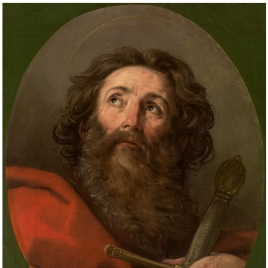
This painting and its pendant – the Saint Paul also in the Museo del Prado – formed part of the Spanish royal collection as early as the seventeenth century, when Father Francisco de los Santos described them as hanging in the Chapter Rooms at the royal monastery of San Lorenzo de El Escorial in 1667. Both were placed in the Prior’s Chapter Room, where this Saint Peter hung below a depiction of the Adulterous Woman from the workshop of Paolo Veronese (1528–1588) and near another celebrated painting by Guido Reni, the Virgin of the Chair. They had previously belonged to García de Haro Sotomayor y Guzmán, 2nd Count of Castrillo (1585–1670), who – among other appointments – held the post of Viceroy of Naples from 1653 to 1659. Both were listed in an inventory of his possessions, drawn up in Naples two years before his return to Spain, which records two octagonal paintings portraying the two apostles.
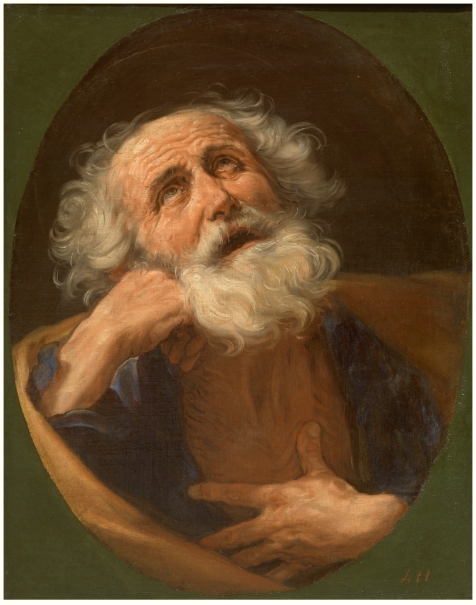
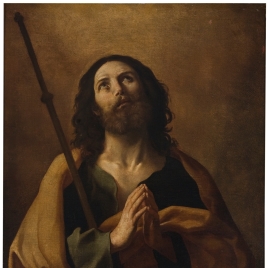
Father Santos praised this Saint Peter, describing it as admirable and ‘superior in Art’, and drawing attention to the distress conveyed by Peter’s realistic gestures. In this bust-length depiction within an oval frame, Peter gazes heavenward, his head resting on his right hand and his mouth half open. The pathos is heightened by Reni’s rendering of the signs of old age in the saint’s face, the deep wrinkles serving as channels for the tears that fall from his weary eyes, as well as the grey hair and the unkempt beard. His left hand presses against his chest with such strength that it makes furrows in the skin, following the line of his fingers.
All these elements suggest that the theme was in fact the socalled ‘tears of Saint Peter’, the moment when the apostle implores Christ’s forgiveness after denying him three times. The subject became popular within the Catholic Church during the Counter-Reformation since it conveyed several of the values espoused by the Council of Trent, such as repentance and the ensuing sacrament of penance. Guido was among the artists who best succeeded in adapting their painterly approach to the new Catholic ideology, developing a compositional formula ideally suited to the production of profoundly devotional images. Like this portrait, Reni’s holy figures aroused the empathy of the faithful by reflecting a range of emotions drawn from their own reality. The painting thus became a means of teaching the principles debated by theologians; here, the penitent Saint Peter embodies human weakness and illustrates the mercy shown by the Church in forgiving it.
The skilled handling of compositional resources evident in this picture – a hallmark of Reni’s treatment of holy figures – together with certain technical features, including the loose yet accurate brushstrokes, suggest that it was painted fairly late in his career. Notwithstanding, Alfonso E. Pérez Sánchez dated it to the mid-1610s, noting similarities with the physical models in the lower part of the Assumption at the church of Gesù e dei Santi Ambrogio e Andrea in Genoa, painted around 1616. However, critics now agree that it was painted in 1633–34 in view of certain anatomical features; the masterly use of the pictorial mass to shape the neck, for example, hints at a certain abstraction far removed from the perfect outlines of his earlier work. It has been suggested that Guido may have taken as his model a classical sculpture of the Death of Seneca, which he could have seen in the Villa Borghese, where it had stood since at least 1613. According to Carlo Cesare Malvasia, Reni had a copy of this marble, which he could also have used as a model for the figure of Saint Peter in the Genoa Assumption mentioned above. By placing the bust in an oval frame, against whose dark background only the figure and the halo stand out, Guido succeeded in creating a sense of depth, thus demonstrating his awareness of the particular effects that can be achieved with different formats.
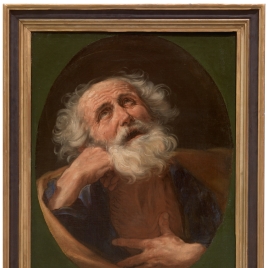
Recent technical examination carried out at the Museo del Prado has revealed that the support is silk, cut to a circular shape and relined on a rectangular fabric, with the joins modified and the space at the corners painted green. Although it is impossible to determine exactly when these changes were made, the inventory of the 2nd Count of Castrillo alludes specifically to the unusual octagonal format of the pictures, but neither Father Santos nor Antonio Ponz (1725–1792) – who saw them in the late eighteenth century – make any reference to it. While this does not in itself confirm a later modification, the two copies made by Ponz himself – now in the minor cloisters at the monastery of El Escorial – are rectangular in format, and the figures have been extended into the lower section. This suggests that the canvases may have undergone two changes in format, the first probably in the seventeenth century, after entering the Spanish royal collection, and the second in the nineteenth or twentieth century.
Japón, Rafael, 'Guido Reni. Saint Peter'. In: Guido Reni, Madrid, Museo Nacional del Prado, 2023, p.236-237 nº 33