Not on display
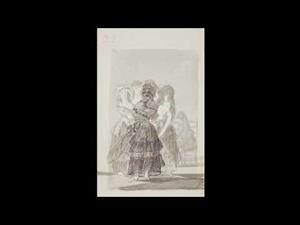
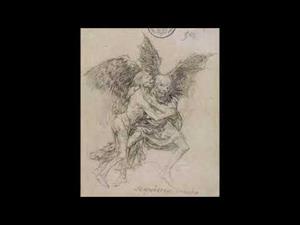
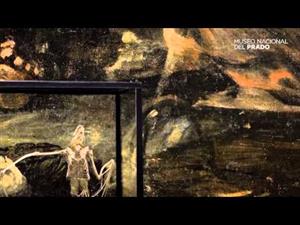
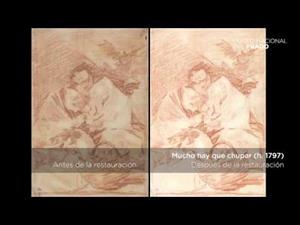
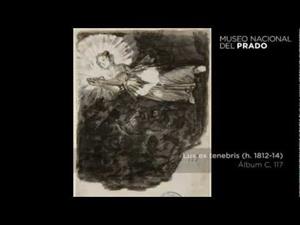
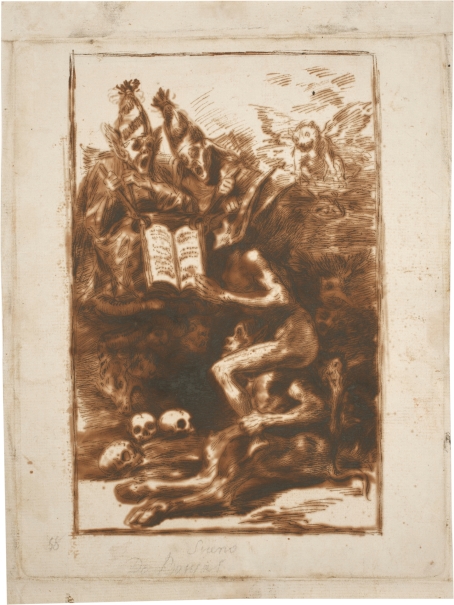
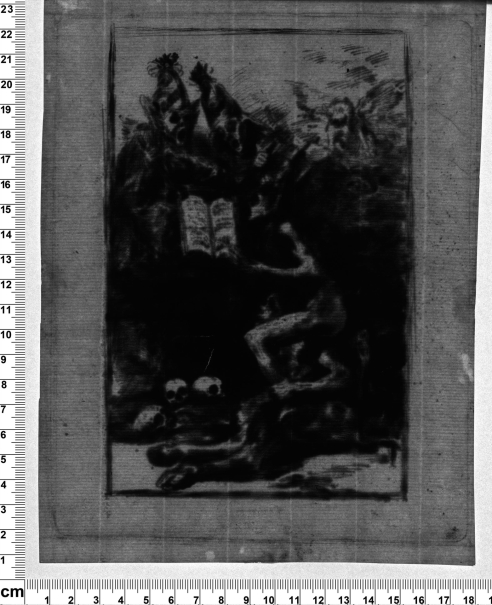
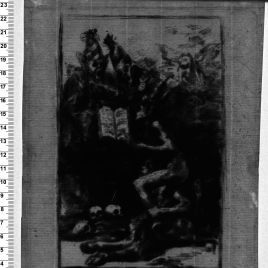
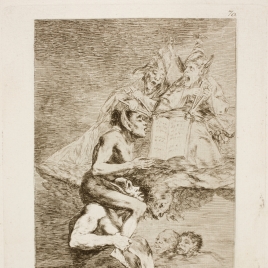
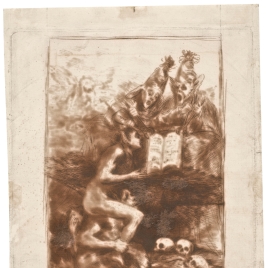
This preparatory drawing for Caprichos, 70, Devout profession is in two parts. The image on the front of the paper is called Dream of a beginner witch while the rear one, which appears with the title, Dream of witches, has been traced from the previous one with some variants that reflect ideas from Witches in flight, a drawing in Album B or the Madrid Album. Flying was a skill that had always been popularly associated with witches. The harsh criticism set out by the artist in these images and in the definitive etching, which he ironically titled Devout profession (G02158/G00739) to openly reveal the scene’s meaning, is directed against ignorant and hypocritical clergymen, metaphorically represented here by witchcraft. The three images transform the Catholic mass and reading of the Gospels into a satanic ritual. Goya casts witchcraft in the same terms as devout images of angels and airborne saints presenting the mysteries of the Catholic religion to the faithful. And in that sense, this drawing has been compared to Saint Pascal Baylon praying before the Eucharist, which Giandomenico Tiepolo painted for the main altarpiece at the church of the Franciscan monastery of Saint Pascal in Aranjuez (1769). It is quite likely that Goya admired both the original painting and the etching of the same image. Witches had been accused of employing Christian rites in their depraved activities since the Middle Ages. Here, the witches on the lower part display a customary metamorphosis into animal forms. The one sitting on the ground personifies lechery as a satyr, while the one on her shoulders has a wolf’s head—this is clear in the drawing from Album B—because that animal was associated with sly and violent behavior. Both figures are devoutly pouring over the book held by two warlocks dressed as bishops, whose animal-like features are enveloped in ample pontifical capes. Goya has replace their miters with dunce caps decorated with flames of the sort that the Inquisition placed on the heads of those condemned to death. They are sitting on an altar that varies in each drawing and has demon heads on the front. In the final print, the artist placed them on the spread wings of an imperial eagle that holds the book in his claws. This bird accompanied Saint John the Evangelist and its presence here indicates that the magnificently illuminated book may be one of the Gospels, which the Inquisition’s torturers used to break their victims. However, like the rest of the Bible, the Gospels were not published in Spanish until 1792-93, as the faithful, unlike the ministers of the Church, were not allowed to read or interpret them. Goya thus implies that the Gospels were in the hands of ignoramuses, hypocrites and lechers (presented as animals with donkey, goat or wolf ears), whom he accuses here of having perverted the words of Jesus Christ either by leading the faithful to believe erroneous doctrines or by accusing them of heresy. The skull resting at the foot of the altar in the first drawing from Album B symbolizes death, and its importance in this composition is manifest in the changes that appear in the two drawings for the Dreams, where Goya scatters tibias on the ground and adds three brightly lit skulls whose empty eye sockets direct their gaze at the warlocks, accusing them of their deaths. This image’s terrible criticism must have struck Goya as too excessive or dangerous to be printed, so the skulls were replace by two brutish creatures up to their necks in water, and thus about to drown in a broad surface that seems to represent the sea. This may be yet another reference to Saint John, whose iconography when he is depicted writing the revelations of the Apocalypse on the shores of the isle of Patmos matches both this composition and the capital importance assigned to that book. The devout expressions of the two creatures indicate that they are fervently listening to the incomprehensible (Latin) canticles of the warlock-bishops and their acolytes, who will lead them to their deaths. Along with the works at the Museo del Prado (G02158, G00739 and G01944), these images are related to a preliminary India-ink drawing known as Album B, 56 (1794-1795) at the National Gallery of Art in Washington D.C., numbered 1991.182.10b (DR), which is the source of the idea for the witches on the back drawing; and a steel-plated copper engraving place that corresponds to Caprichos, 70 at Madrid’s Calcografía Nacional, numbered 3496. The present preparatory study (D04392) also appears in Gassier’s 1975 catalog of Goya’s drawings (front, no. II 41, back, no. II 42). (Text from: Mena Marqués, M. Sueño 3. Sueño de bruja principianta, in Matilla, J. M., Mena Marqués, M. (dir.): Goya: Luces y Sombras, Barcelona, Fundación La Caixa-Madrid, Museo Nacional del Prado, 2012, p. 250).