formularioRDF
The itinerary <em>TITULORECORRIDO</em> has been successfully created. Now you can add in works from the Collection browser
<em>TITULOOBRA</em> added to <em>TITULORECORRIDO</em> itinerary

Close Continuar a ficha de la obra Continuar a ficha de la obra
02-06-2026
Francisco de Goya y Lucientes - Engraver
Fuendetodos, Zaragoza (Spain), 1746 - Bordeaux (France), 1828 - Engraver
Laureano Potenciano Pastor
Madrid, 1837 - ¿Madrid?, 1864
Real Academia de Bellas Artes de San Fernando

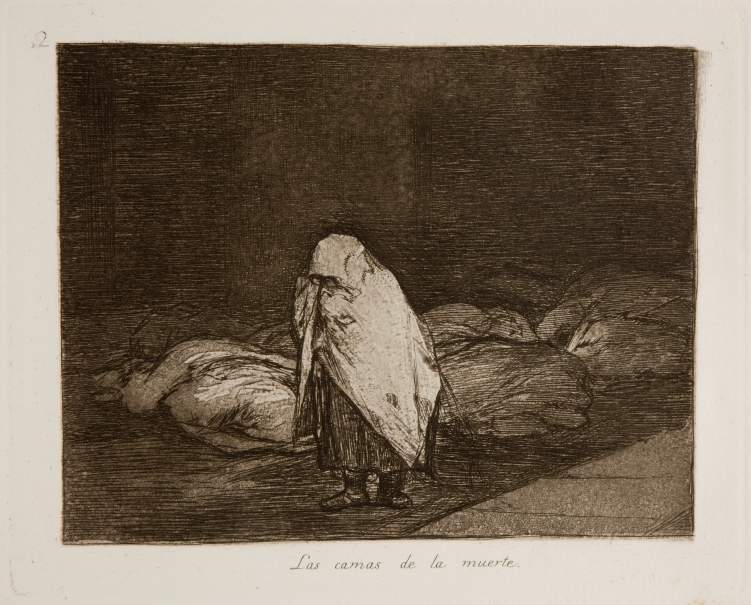
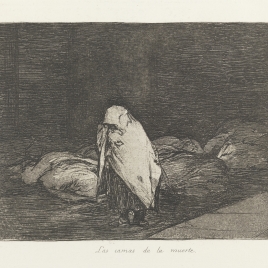
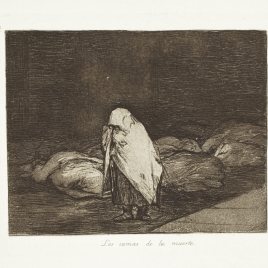
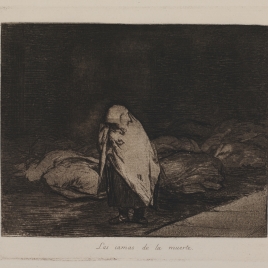
The beds of death

1812 - 1814. Wash, Burin, Burnisher, Drypoint, Etching on wove paper.
Not on display

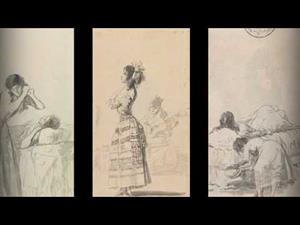
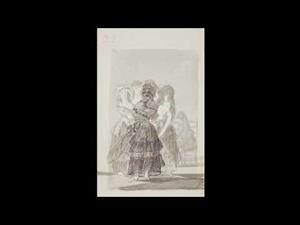
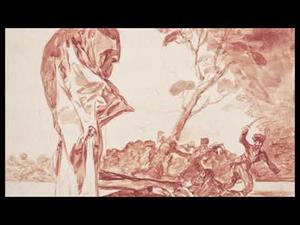
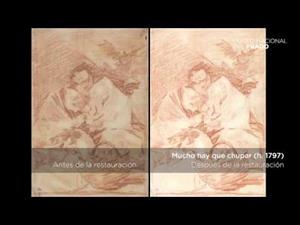
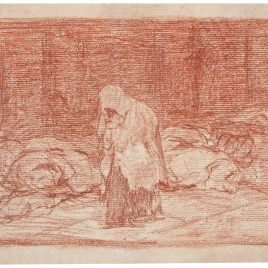
If death has been explicit and omnipresent over the course of the numerous Hunger prints, its name has not appeared in their titles until now. This work may be one of the most expressive of all, as well as one of the most meditative. Goya’s ideas for this composition were clear from the beginning, and the scant differences between the preparatory drawing and the final print are due almost exclusively to the fact that they employ different graphic techniques: red chalk, for the former, and etching for the latter. The subject was not clear to the work’s earliest critics. In 1918, Beruete was the first to grasp the emotional content of this image, which he called an “impressive and tragic scene, admirably rendered, straightforward and steeped in emotion, which recalls those decisive moments of silence in which not a word is uttered, but everything is said” (Beruete 1916-18, III, p. 91). This scene has been related to the large number of bodies that built up in hospitals during the famine that struck the capital. There were not enough beds, so they lay on the hallway floors, covered with little more than blankets, awaiting their inevitable deaths. Here, Goya presents a woman almost entirely covered by a blanket that stops just above the bottom of her skirt. She covers her face to avoid the sight and smell of such a horrendous situation. It matters very little whether the bodies lined up behind her are alive or not, as death is omnipresent. It has hovered around the previous prints, and will do so around the following ones, as well, and the title of this one makes that clear. Still, this image’s protagonist is alive and is trying to walk around the row of deathbeds, and to avoid their beckoning fate. The sense of transit is suggested by the slight diagonal established by the horizontally aligned bodies, and this marks the woman’s movement towards the foreground. Compositionally, Goya accentuates her solitude by darkening the background that emphasizes her verticality. Once again, Goya presents an image this is more than simply something he may have witnessed in Madrid in those years. By stripping it of any concrete reference to a specific location, he imbues it with a more transcendent significance, making it a universal image of man’s aloneness and anguish in the face of death. (Text from: Matilla, J.M.: Las Camas de la muerte, in: Goya en tiempos de Guerra, Madrid, Museo Nacional del Prado, 2008, p. 332)
Multimedia

Technical data

Related artworks

The beds of death
Red chalk on laid paper, 1812 - 1814
Francisco de Goya y Lucientes
Inventory number
G002392
Authors
Francisco de Goya y Lucientes -Engraver-; Laureano Potenciano Pastor; Real Academia de Bellas Artes de San Fernando
Title
The beds of death
Date
1812 - 1814
Technique
Wash; Burin; Burnisher; Drypoint; Etching
Support
Wove paper
Dimension
Height: 248 mm; Width: 345 mm; Width of the plate mark: 221 mm; Height of the plate mark: 177 mm
Series
Desastres de la guerra [estampa], 62
Provenance
Real Academia de Bellas Artes de San Fernando, Madrid; Eduardo Luis Moreda Fernández; Museo del Prado, 2000
Entry date
2000

Bibliography +

Brunet, M.G., Étude sur Francisco Goya sa vie et ses travaux, Aubry, Paris, 1865, pp. 56.

Viñaza, Cipriano Muñoz y Manzano Conde de la, Goya: su tiempo, su vida, sus obras, Tip. M.G. Hernández, Madrid, 1887, pp. 393.

Delteil, Loys, Francisco Goya, I, Chez L'Auteur, Paris, 1922.

Mayer, August L., Francisco de Goya, Labor, Barcelona, 1925, pp. 231.

Lafuente Ferrari, Enrique, Goya: el dos de mayo y los fusilamientos de la Moncloa, Juventud, Barcelona, 1946, pp. 20.

Lafuente Ferrari, Enrique, Los desastres de la guerra de Goya y sus dibujos preparatorios, Instituto Amatller de Arte Hispánico, Barcelona, 1952, pp. 26, 69, 177.

Harris, Tomas, Goya, engravings and lithographs, II, Bruno Cassirer, Oxford, 1964, pp. 268.

Gassier, Pierre y Wilson-Bareau, Juliet, Vie et oeuvre de Francisco de Goya: l' oeuvre complet illustré: peintures, dessins, gravures, Office du Livre, Fribourg, 1970.

Sayre, Eleanor, The Changing Image. Prints by Francisco Goya, Museum of Fine Arts, Boston, 1974, pp. 194.

Derozier, C., La Guerre D'Independance Espagnole a Travers L'Estampe (1808..., II, Universidad de Lille, Lille, 1976, pp. 931.

Vega, Jesusa, Fatales consecuencias de la guerra.Francisco de Goya, pintor, Francisco de Goya, grabador: instantáneas, Caser y Calcografía Nacional, Madrid, 1992.

Vega, Jesusa, Museo del Prado: catálogo de estampas, Museo del Prado, Madrid, 1992, pp. 96.

Blas, J. y Matilla, J.M., El libro de los desastres de la guerra : Francisco de Goya, Museo Nacional del Prado,Calcografía Nacional, Madrid, 2000, pp. 117-118.

Obras adscritas al Museo Nacional del Prado en el año 2000, Boletín del Museo del Prado, XIX, 2001, pp. 200.

Nieto Alcaide, Víctor, La guerra y lo imaginario en la pintura de Goya, Barcelona, 2003, pp. 319-329.

Calcografía Nacional (España), Calcografía Nacional: catálogo general, II, Calcografía Nacional, Madrid, 2004, pp. 466.

Matilla J.M., Goya: en tiempos de guerra, Museo Nacional del Prado, Madrid, 2008, pp. 332.

Matilla, José Manuel, Estampas españolas de la Guerra de la Independencia: propaganda, conmemoración y testimonio, Universidad de Salamanca, 2008.

Bordes J., Matilla J.M. y Balsells S, Goya, cronista de todas las guerras: los "desastres" y la fotografía de guerra, Centro Atlántico de Arte Moderno y Real Academia de Bellas Artes de San Fernando, Las Palmas de Gran Canaria; Madrid, 2009, pp. 204.

Hofmann, Julius, Francisco de Goya: Katalog seines graphischen Werkes, Gesellschaft für vervielfältigende Kunst, Viena, 2014, pp. 91-145.

Pérez Francés, José Antonio, Aragón en los Desastres de la guerra de Francisco de Goya, Institución Fernando el Católico,, Zaragoza, 2025, pp. 39-62 [270-303].

Other inventories +

Inv. Nuevas Adquisiciones (iniciado en 1856). Núm. 2564.

Inscriptions +

62 // Las camas de la muerte.
Lettered in the plate. Front

Exhibitions +

The invited work: Farideh Lashai
Madrid
30.05.2017 - 10.09.2017

Update date: 02-06-2026 | Registry created on 26-11-2015

Visor 360

Drag with the cursor to rotate the piece

Other works by Francisco de Goya y Lucientes; Laureano Potenciano Pastor; Real Academia de Bellas Artes de San Fernando

Print on demand

Print artworks available in our catalogue in high quality and your preferred size and finish.

Image archive

Request artworks available in our catalogue in digital format.

Up