formularioRDF
The itinerary <em>TITULORECORRIDO</em> has been successfully created. Now you can add in works from the Collection browser
<em>TITULOOBRA</em> added to <em>TITULORECORRIDO</em> itinerary

Close Continuar a ficha de la obra Continuar a ficha de la obra
02-06-2026
Francisco de Goya y Lucientes

Fuendetodos, Zaragoza (Spain), 1746 - Bordeaux (France), 1828

Francisco de Goya y Lucientes See author's file

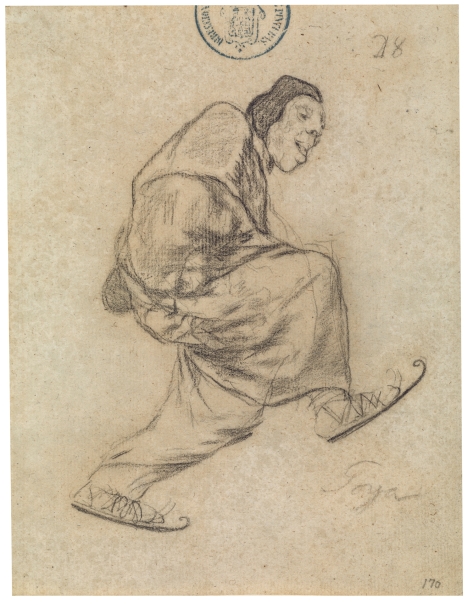
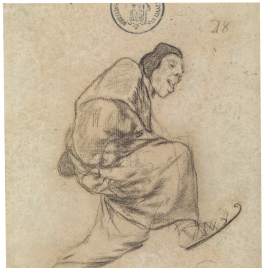
The Lay Brother on Skates

1824 - 1828. Pencil on laid paper.
Not on display

This drawing of a monk skating is number “28” of the album known as Bordeaux II or Album H, which contains the second series of drawings that Goya made in Bordeaux. As in the previous drawing, Goya harshly criticizes the clergy, whose influence had again increased under Ferdinand VII—especially following the end of the Liberal Triennial in 1823. Skating was a popular pastime in 16th-century Holland, and it was frequently depicted in Dutch painting from that period, including works by both the elder and younger Brueghel. In the 17th and 18th centuries, it became very popular in other northern European countries. There is no documentation at all, however, of it being practiced in Spain during Goya’s lifetime, although skates were imported from England for sale in Madrid in the years following the Peninsular War (Diario de Madrid, December 19, 1818, p. 7), and their use was described in various Spanish newspapers and magazines. Those descriptions, however, were based on narrations of travel to northern countries. Skating was also included in a book by French author Jean Augustin Amar du Rivier, which was published in Madrid in 1807 as Gymnastics or the School of Youth: An elementary treatise on games and exercises considered in terms of their physical and moral adequacy. That publication included a dedication to the General Director of the Royal Seminary of Noblemen in Madrid and it presented skating in the section titled “Balance and tumbling,” praising it as one “of the finest gymnastic exercises” due to “the purity of the air, the intensity of the cold, the steely circulation of the humors and blood, the tension of the muscles, the circular movements carried out by skaters and the pleasure that enlivens them—in a word, everything must necessarily influence not only man’s physical nature, but also his moral one” (Amar du Rivier, 1807, p. 236). Here, however, Goya presents this popular pastime in a grotesque setting: a skater wearing a monk’s habit over long trousers, with a cap on his head and, hanging from his belt, a bag of coins or other valuables of the sort described in a satire of the clergy that appeared in issue no. 23 of El Zurriago, a liberal magazine published between 1820 and 1823. The protagonist’s hands are covered by his robes, which further complicates his efforts to keep his balance on skates whose blades have been considerably elongated by Goya. This character’s exaggerated movements and unstable posture, along with the obtuse and content expression conveyed by facial features that are practically a caricature unto themselves, emphasize the absurdity of his dedication to one of the activities considered favorable to physical and moral wellbeing. Here, however, Goya is not entirely successful in his effort to convey the ethics of the Enlightenment or of modern society, which were considered incompatible with the clergy’s rigorous rejection of any form of progress. With ingenious humor, Goya places his signature directly beneath the monk’s raised foot, suggesting that the skater could squash him unless he were to fall down first. This latter possibility seems most likely, as Goya is in a more liberal country. This subtle provocation also recalls the unsuccessful accusation brought against the artist following the publication of his Caprichos in 1799 but neutralized when the copper plates from that series were acquired in 1803 by Goya’s protector, no less than the King of Spain, who may even have commissioned them (Yriarte 1867, p 43) (G. Maurer, "El lego de los patines", in J. M. Matilla, M. B. Mena Marqués (dir.), Goya: Luces y Sombras, Barcelona: Fundación "la Caixa", Barcelona: Obra Social "la Caixa"-Madrid: Museo Nacional del Prado, 2012, p. 290, no. 85) .
Multimedia

Technical data

Imagen del carrusel
Imagen del carrusel
Inventory number
D004117
Author
Francisco de Goya y Lucientes
Title
The Lay Brother on Skates
Date
1824 - 1828
Technique
Pencil
Support
Laid paper
Dimension
Height: 192 mm; Width: 147 mm
Series
Cuaderno de Burdeos II o Cuaderno H, 28
Provenance
Javier Goya, Madrid, 1828; Mariano Goya, Madrid, 1854; Federico de Madrazo / Román Garreta, Madrid, c. 1855-1860; Museo de la Trinidad, Madrid, 5-4-1866; Museo del Prado, 1872.
Entry date
1872

Bibliography +

Sánchez Cantón, Francisco Javier, Sala de los dibujos de Goya, II, Museo del Prado, Madrid, 1928, pp. 50, n.379.

Gassier, Pierre y Wilson-Bareau, Juliet, Vie et oeuvre de Francisco de Goya: l' oeuvre complet illustré: peintures, dessins, gravures, Office du Livre, Fribourg, 1970, pp. nº 1790.

Salas, Xavier de, El Arte de Goya, Ministerio de Auntos Exteriores, Tokio, 1971, pp. nº 144.

Gassier, Pierre, Dibujos de Goya. Los álbumes, 1, Noguer, Barcelona, 1973, pp. 639-640.

Goya e il mondo moderno, Skira, Milán, 2010.

Goya: luces y sombras. Obras maestras del Museo del Prado, The Yomiuri Shimbun, Tokyo, 2011, pp. 288-289.

Matilla, J.M. Mena M.B., Goya: dibujos. Solo la voluntad me sobra, Museo Nacional del Prado, Madrid, 2019, pp. 271 nº 181.

Matilla, J.M; Mena, M.B, Goya: Drawings. Only My Strength of Will Remains, Museo Nacional del Prado, Madrid, 2019, pp. 271 nº.181.

Mano, Jose Manuel de la, Javier Goya's Legacy: The albums of his father's drawings / El legado de Javier Goya. Los álbumes de dibujos de su padre, De la Mano, Madrid, 2021.

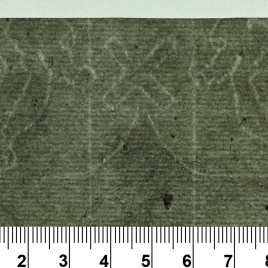
Filigree +

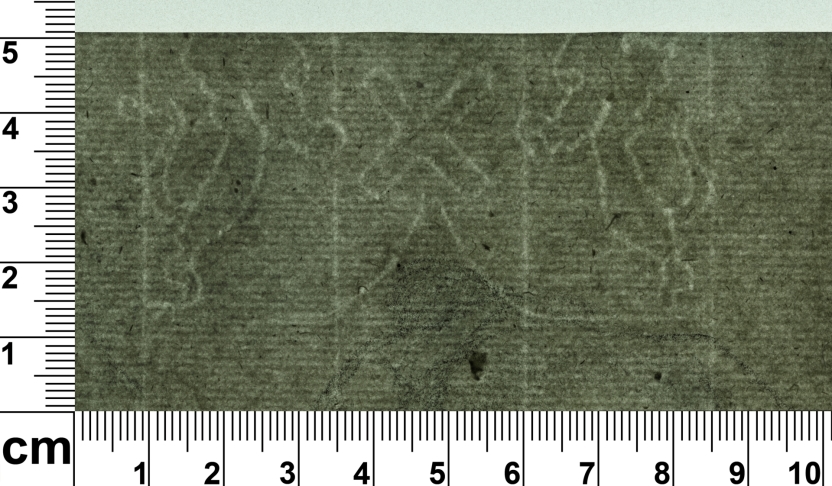
Motive: Corazón con un trébol y variante del escudo de Ámsterdam con una cruz de san Andrés (mitad inferior)


38 x 83 mm
Principal
Yes
Horizontales
26 mm.
Centro del margen izquierdo
Corazón y escudo de Ámsterdam
Varios fabricantes franceses emplearon la filigrana del escudo de Ámsterdam en su variante con una cruz de San Andrés. Entre ellos, los papeleros de la dinastía Jardiel, de la comarca del Périgord, o los Bouygar, de Burdeos, cuya filigrana tenía además un gran corazón sobre el escudo.

Imagen de la bibliografia

Bibliography
Churchill, William Algernon, Watermarks in paper, in Holland, England, France, etc., in the XVII and XVIII centuries and their interconnection, B. De Graaf, Nieuwkoop, 1985, pp. n. 72 [D. Jardel, año 1780].

Other inventories +

Inv. provisional de libros que existen en el Archivo del Museo Nacional de Pintura y Escultura, 1896. Núm. 152.
Una carpeta marcada con la letra “H” que contiene según está inscrita en la misma “todos los dibujos que gravó Goya” = Nota Esta carpeta se recogio en el Ministerio de Fomento sin que haya mediado documento alguno al efecto Autor Goya [Nota al margen izquierdo] Nota 27 de estos dibujos están colocados en el facistol de la Sala de dibujos

Colección Dibujos Goya (Numeración Sánchez Catón). Núm. 379.

Catálogo Goya, Pierre Gassier y Juliet Wilson. Núm. 1790.

Catálogo Gassier, 1975. Núm. I 444.

Inscriptions +

Dirección del Museo Nacional de Pinturas (Museo de la Trinidad)
Ink stamp. Front

170
Front, lower right corner

Goya
Inscribed with black pencil. Front, Lower right area

28
Front, upper right corner

379
Front, Secondary support

Exhibitions +

Goya Beyeler
Basilea
10.10.2021 - 23.01.2022

Goya. Drawings. "Only my Strength of Will Remains"
Madrid
20.11.2019 - 16.02.2020

Goya. Light and Shade
Barcelona
16.03.2012 - 24.06.2012

Goya: luces y sombras. Obras maestras del Museo del Prado / Goya: Lights and Shadows. Masterpieces of the Museo del Prado
Tokio
22.10.2011 - 29.01.2012

Goya. Light and Shade
Tokio
22.10.2011 - 29.01.2012

Goya y el mundo moderno. Milán
Milán
15.03.2010 - 27.06.2010

Update date: 02-06-2026 | Registry created on 28-04-2015

Visor 360

Drag with the cursor to rotate the piece

Other works by Francisco de Goya y Lucientes

Print on demand

Print artworks available in our catalogue in high quality and your preferred size and finish.

Image archive

Request artworks available in our catalogue in digital format.

Up