formularioRDF
The itinerary <em>TITULORECORRIDO</em> has been successfully created. Now you can add in works from the Collection browser
<em>TITULOOBRA</em> added to <em>TITULORECORRIDO</em> itinerary

Close Continuar a ficha de la obra Continuar a ficha de la obra
02-06-2026
Francisco de Goya y Lucientes - Engraver
Fuendetodos, Zaragoza (Spain), 1746 - Bordeaux (France), 1828 - Engraver
Laureano Potenciano Pastor
Madrid, 1837 - ¿Madrid?, 1864
Real Academia de Bellas Artes de San Fernando

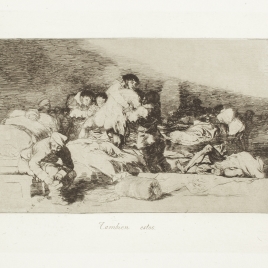
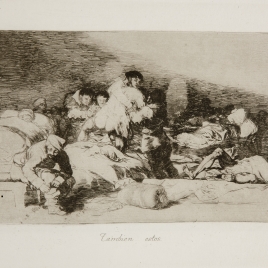
These, too

1810 - 1814. Etching, Drypoint, Burin on wove paper.
Not on display
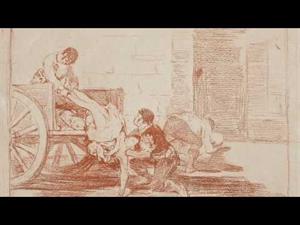
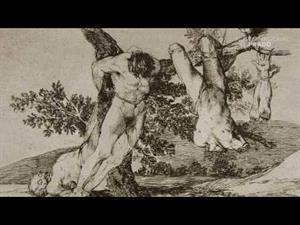
Very few prints from The Disasters of War show direct confrontations between the French and Spanish since the majority of the etchings portray the abuses and terrible consequences of war. Among these are images of the wounded, to whom Goya devoted three etchings, two of which are closely related in terms of their sequential placement as well as their titles. They apparently represent the gathering of the wounded from battles and skirmishes, and their conveyance by townsfolk to hospitals, a manifest example of charity and patriotism. Were it not for the titles, this might well be the explanation for the images.
However, Goya displays a bitter irony here. In plate 20, Curarlos, y a otra (Get them well, and on to the next), Goya expresses criticism of charity borne from self-interest, suggesting it leads to people being taken advantage of, which Enrique Mélida recognised when he wrote: This egotistical objective is not what must have moved our forefathers to gather and cure the wounded. No: it must have been the sense of charity so manifest in those who exposed their lives to danger in the defence of the fatherland. But Goya was little concerned with such matters.
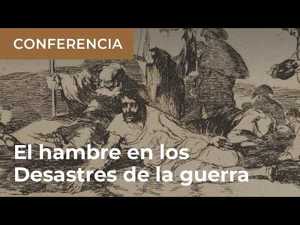
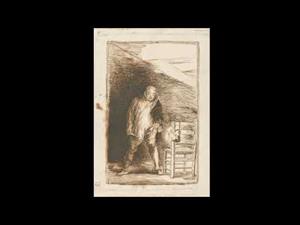
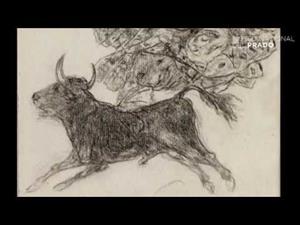
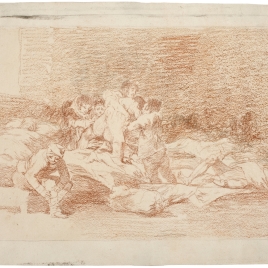
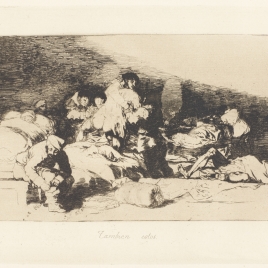
The juxtaposition of Aun podrán servir (They can still be of use, plate 24) with this, the following print, makes manifest the sequential connection between images and titles that reinforces, through repetition, the expressive charge that Goya seeks to transmit. In Aun podrán servir, a group of civilians comes to the aid of several soldiers, recognisable from their uniforms. The tragedy they have suffered is suggested by their fallen arms, scattered on the ground, an unambiguous sign of defeat, and a device Goya would repeat years later in the painting The second of May 1808, Madrid 1814 (P748). Subsequently, in También estos, at first glance the soldiers appear to be recuperating from their wounds. A more careful examination reveals, however, that appearances are deceptive, for the convalescing soldiers are merely a group of almost useless bodies. Some are even prostrate on the floor, inert like the sack lying in the foreground. The differences between this print and Goya's preparatory drawing indicate that he made the etching more precise, with more details in the characterisation of faces, gestures and clothes. The faces, like the shadows in which the scene unfolds, contribute to an overall atmosphere of gloom - we can hardly imagine anything but the wailing of the wounded, some of whom are obliged to tend to themselves, such as the one in the foreground looking after his injured leg; or the concern of those who, somewhat awkwardly, fashion a tourniquet for a half-naked man, whose backside is exposed to us in an explicit image of humiliation and pathos (Matilla, J. M.: Portrait of Spain. Masterpieces from the Prado, Queensland Art Gallery-Art Exhibitions Australia, 2012, p. 217).
Multimedia

Technical data

Related artworks

These, too
Red chalk on wove paper, 1810 - 1814
Francisco de Goya y Lucientes
Inventory number
G000695
Authors
Francisco de Goya y Lucientes -Engraver-; Laureano Potenciano Pastor; Real Academia de Bellas Artes de San Fernando
Title
These, too
Date
1810 - 1814
Technique
Etching; Drypoint; Burin
Support
Wove paper
Dimension
Height: 225 mm; Height of the plate mark: 165 mm; Width: 306 mm; Width of the plate mark: 236 mm
Series
Desastres de la guerra [estampa], 25 (13)
Provenance
Bequest of Tomás Harris, 1964
Entry date
1964

Bibliography +

Brunet, M.G., Étude sur Francisco Goya sa vie et ses travaux, Aubry, Paris, 1865, pp. 52.
Viñaza, Cipriano Muñoz y Manzano Conde de la, Goya: su tiempo, su vida, sus obras, Tip. M. G. Hernández, Madrid, 1887, pp. 374.

Delteil, Loys, Francisco Goya, I, Chez L'Auteur, Paris, 1922.

Mayer, August L., Francisco de Goya, Labor, Barcelona, 1925, pp. 231.

Lafuente Ferrari, Enrique, Las Pruebas de Estado de 'Los Desastres de la Guerra' en la Biblioteca Nacional, II, Anabad, Madrid, 1934, pp. 387.

Lafuente Ferrari, Enrique, Los desastres de la guerra de Goya y sus dibujos preparatorios, Instituto Amatller de Arte Hispánico, Barcelona, 1952, pp. 61.

Harris, Tomas, Goya, engravings and lithographs, II, Bruno Cassirer, Oxford, 1964, pp. 215.

Gassier, Pierre y Wilson-Bareau, Juliet, Vie et oeuvre de Francisco de Goya: l' oeuvre complet illustré: peintures, dessins, gravures, Office du Livre, Fribourg, 1970.

Derozier, C., La Guerre D'Independance Espagnole a Travers L'Estampe (1808..., II, Universidad de Lille, Lille, 1976, pp. 879.

Tomlinson, Janis, Graphic Evolutions. The Print Series of Francisco Goya, Columbia University Press, New York, 1989, pp. 27-28.

Vega, Jesusa, Museo del Prado: catálogo de estampas, Museo del Prado, Madrid, 1992, pp. 90.

Vega, Jesusa, Fatales consecuencias de la guerra. Francisco de Goya, pintor, Francisco de Goya, grabador: instantáneas, Caser y Calcografía Nacional, Madrid, 1992, pp. 27.

Cuenca M. L., Docampo J. y Vinatea P., Catálogo de las estampas de Goya en la Biblioteca Nacional, Biblioteca Nacional y Lunwerg, Madrid, 1996, pp. 148.

Blas J., Matilla J.M. y Aguilar I, El libro de los desastres de la guerra: Francisco de Goya, I, Museo Nacional del Prado y Calcografía Nacional, Madrid, 2000, pp. 138.

Obras adscritas al Museo Nacional del Prado en el año 2000, Boletín del Museo del Prado, XIX, 2001, pp. 200.

Nieto Alcaide, Víctor, La guerra y lo imaginario en la pintura de Goya, Barcelona, 2003, pp. 319-329.

Calcografía Nacional (España), Calcografía Nacional: catálogo general, II, Calcografía Nacional, Madrid, 2004, pp. 462.

Matilla, José Manuel, Goya: en tiempos de guerra, Museo Nacional del Prado, Madrid, 2008, pp. 288.

Wilson- Bareau [et alt.], Catalogue, Goya graveur, Chaudun y Paris musées, Paris, 2008, pp. 241.

Matilla, José Manuel, Estampas españolas de la Guerra de la Independencia: propaganda, conmemoración y testimonio, Universidad de Salamanca, 2008.

Bordes J., Matilla J.M. y Balsells S, Goya, cronista de todas las guerras: los "desastres" y la fotografía de guerra, Centro Atlántico de Arte Moderno y Real Academia de Bellas Artes de San Fernando, Las Palmas de Gran Canaria; Madrid, 2009, pp. 130.

Hofmann, Julius, Francisco de Goya: Katalog seines graphischen Werkes, Gesellschaft für vervielfältigende Kunst, Viena, 2014, pp. 91-145.

Pérez Francés, José Antonio, Aragón en los Desastres de la guerra de Francisco de Goya, Institución Fernando el Católico,, Zaragoza, 2025, pp. 39-62 [205-215].

Filigree +

Motive: Venera y J. G. O. (sección de venera)


5 x 17 mm
En el centro del margen inferior
José García Oseñalde
Marca de agua en forma de venera e iniciales "J. G. O." característica del papel fabricado por José García Oseñalde, establecido en La Cabrera, Guadalajara. En esta localidad existió fábrica de papel desde por lo menos 1733, como así es recogido por Eugenio Larruga en sus "Memorias políticas y económicas sobre los frutos, comercio, fábricas y minas de España...", de ese año y de 1746. Esta antigua fábrica de papel blanco debió de ser la que José García Oseñalde compró en 1847, junto a un molino de harina llamado "Los Heros", colindante entre las localidades de La Cabrera y Aragosa. La fábrica también debió conocerse con el nombre del molino de harinas, pues así consta en 1886, cuando la fábrica de papel sellado "Los Heros" era propiedad de Pedro García Oseñalde (véase: "El obispado de Sigüenza, ó sea Nomenclátor descriptivo, Geográfico y Estadístico de todos los pueblos del mismo, por un sacerdote de la diócesis", Zaragoza, 1886, p. 21 [Aragosa])

La primera edición de los "Desastres de la Guerra" de Goya se imprimió en papel con esta filigrana, en 1863.

Bibliography
Biblioteca Nacional de España, Catálogo de las estampas de Goya en la Biblioteca Nacional, Biblioteca Nacional, Sociedad Estatal Goya 96 y Lunwerg, Madrid, 1996, pp. 280, fil. 22.
Fundación Lázaro Galdiano, Goya en la Fundación Lázaro Galdiano, Fundación Lázaro Galdiano, Madrid:, 1999, pp. 386-387, fil. 14-15.

Inscriptions +

25 // Goya // Tambien estos. // 13
Lettered in the plate. Front

TH [monograma en un círculo. Lugt, n. 4922] // Thomas Harris. [Lugt, n. 4921]
Brown ink stamp. Back, left side

Exhibitions +

Portrait of Spain. Masterpieces from the Prado
Houston TX
15.12.2012 - 31.03.2013

Portrait of Spain. Masterpieces from the Prado
Brisbane
22.07.2012 - 04.11.2012

Update date: 02-06-2026 | Registry created on 31-05-2025

Visor 360

Drag with the cursor to rotate the piece

Other works by Francisco de Goya y Lucientes; Laureano Potenciano Pastor; Real Academia de Bellas Artes de San Fernando

Print on demand

Print artworks available in our catalogue in high quality and your preferred size and finish.

Image archive

Request artworks available in our catalogue in digital format.

Up