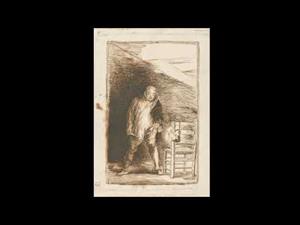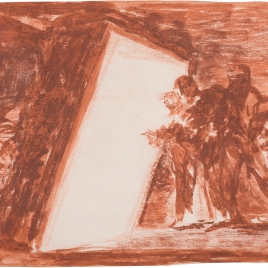
Two people looking into a luminous room
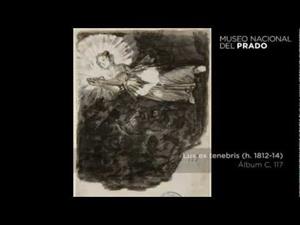
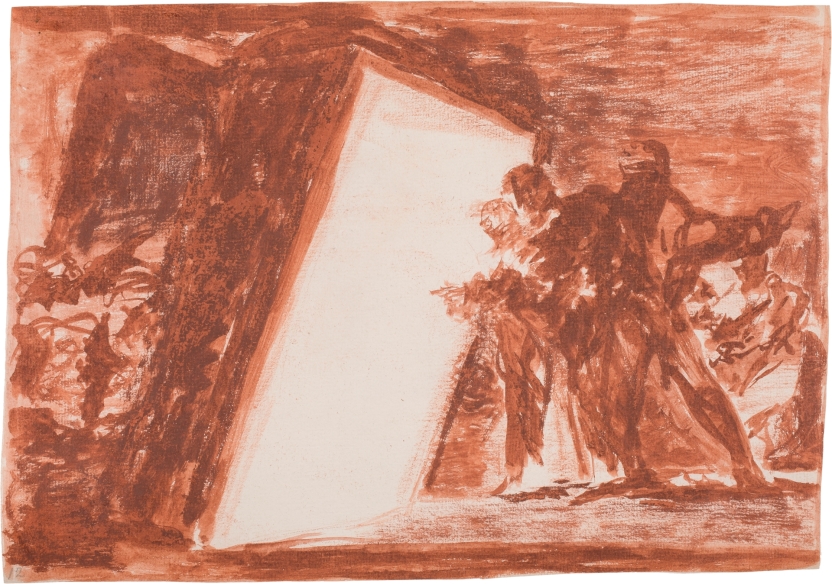
1816 - 1819. Red wash, Red chalk on laid paper.Not on display
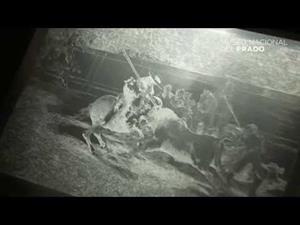
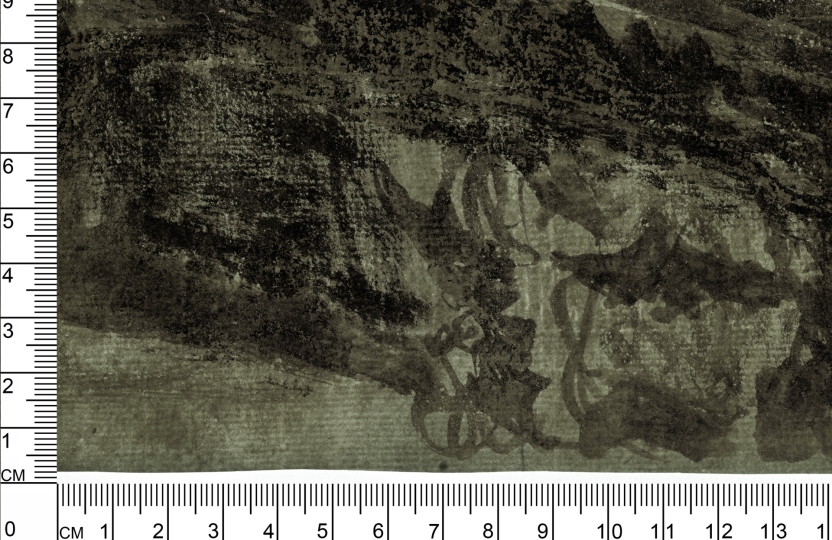
This drawing’s composition, its relaxed and summary technique and the paper on which it was drawn are all related to the preparatory drawings for the Disparates, although there is no known engraved version of it. It presents a night scene with a neutral red-chalk and dry-brush background that allows the eye to capture the white of the paper and the different spatial planes. In the center, three standing figures are grouped in front of the luminous opening of a large crate that stands on one end with its bottom sunk into the ground and its open side angled towards them. Goya creates the light that emerges from the crate by leaving the paper bare, rather than covering it with wash, and its glare foreshortens the heads and one hand of the two figures that lean into the opening, one of whom appears to be wearing a cassock. The contours of the third figure are not easily distinguished from those of the one at his side. He holds out his hand, but it is not clear whether he is looking out at the viewer and raising his animal-featured face to the heavens with closed eyes, or has instead turned his back to the viewer in order to face the figures on the right. The scene appears to bear all the characteristics of a witches’ coven in which the protagonists, one of whom may be a priest, are accompanied by symbols of absurdity in their celebration of a spectacular vision of the afterlife. This had been a matter of certain concern since the French Revolution, and here, it is reflected in images critical of such lugubrious beliefs, which appear in several of Goya’s prints from the Disparates. The small figures that appear to be sitting on the ground to the right are arranged in a manner that recalls the witches surrounding a ram in the Witches’ Coven scene at the Fundación Lázaro Galdiano in Madrid—one of the images of witches painted by Goya in 1797-98—as well as the Witches’ Coven from the Black Paintings at the Museo Nacional del Prado. A group of bats, with their recognizable scalloped wings, flitter around the space to the left of the crate while a gigantic one seems to be approaching the scene from above it. This sinister night dweller is recognizable by its enormous wings, which Goya created with a thick, dark wash. In his critical iconography, bats are the traditional companions of witches and monsters produced by the sleep of reason. This large one and its position are comparable to the man-bat that opens the tomb of a dead young woman in one of Les fantômes, a pair of large lithographs that Romantic artist Charles Motte (Paris 2008, no. 252) created in 1829. Compositionally, there are certain similarities with the print And they still do not leave (D04222), in which a skeletal figure and his companion are put to the test by some witches and a monk, raising an enormous tombstone—it seems about to fall on top of them—in hopes of extracting lucrative benefits from the ghost, as promised by the witches. This is a criticism of false doctrines and of those willing to believe them. (Text from Maurer, G.: Dos personajes asomándose a una salida luminosa, in: Matilla, J.M. and Mena, M.B.: Goya: Luces y Sombras, Barcelona, Fundación La Caixa, 2012).