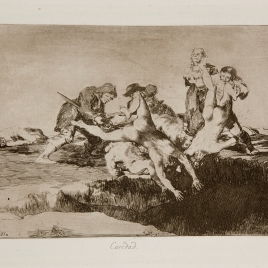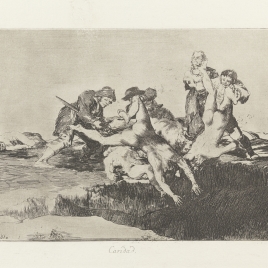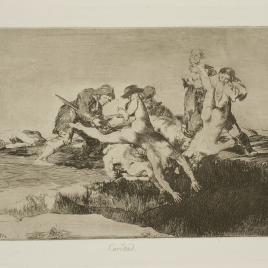
Charity
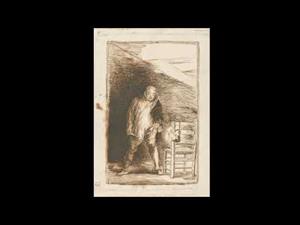
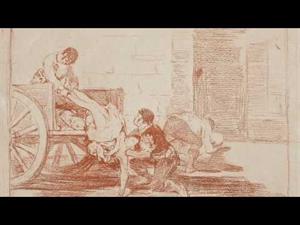
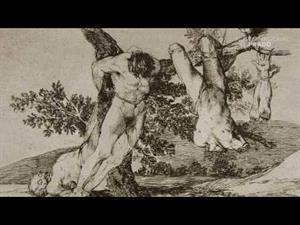
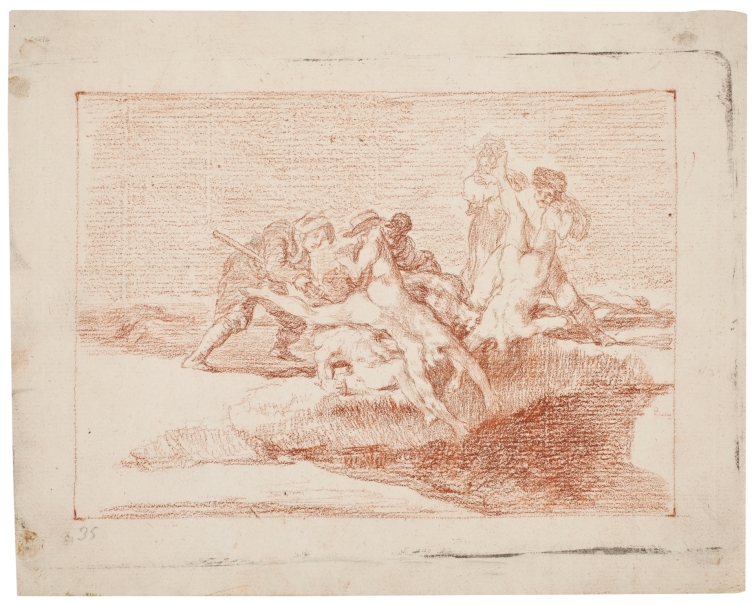
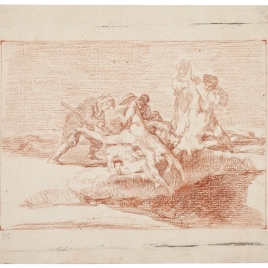
1810. Red chalk, Conté crayon on laid paper.Not on display
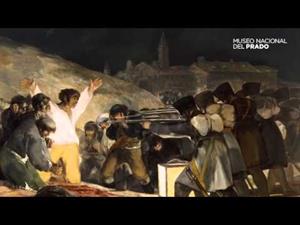
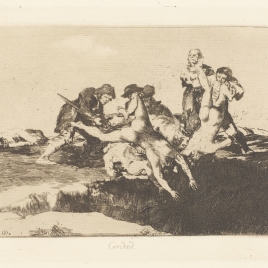
A preparatory drawing for Disasters of War, 27, Charity. Once more, Goya eliminates any reference that could specifically identify the event being depicted in order to create an emotionally gripping scene whose main idea is once again the lack of respect for a human body. The nature of this subject may be what led Goya to intentionally present it in a way that keeps viewers from clearly identifying its protagonists. Who are the gravediggers and who are the dead? A comparison of the preparatory drawing to the engraving does not shed much light on its interpretation. The fundamental difference between them is the appearance of the two figures standing on the right. In the drawing, the one closest to the edge of the composition sports a hat that closely resembles the colback worn by mounted hunters from the Napoleonic Guard, who were most responsible for the repression under the command of Murat. This low cylindrical fur-lined hat distinguished these troops from the French infantry, which wore a higher schako of the sort that appears on the members of the firing squad in the artist’s Third of May. Goya often used this part of the uniform to distinguish the French soldiers responsible for most of the series’ most violent scenes. A serious figure wearing a sort of turban stands behind the rightmost figure, contemplating the scene without moving. Here, “charity” could be understood as a collaborative gesture between French and Spanish troops in order to bury their victims. In the engraving, however, Goya eliminates all of the hats, thus substantially changing its meaning, as now, only Spaniards are involved in the rapid burial that takes place before the figure of a serious old man who appears to close his eyes in the presence of this tragedy. (Text from: Matilla, J.M.: Caridad, in: Goya en tiempos de Guerra, Madrid: Museo Nacional del Prado, 2008, pp. 322-323)