Mendoza Family Donor
1460 - 1470. Oil on baltic oak planks.Room 057
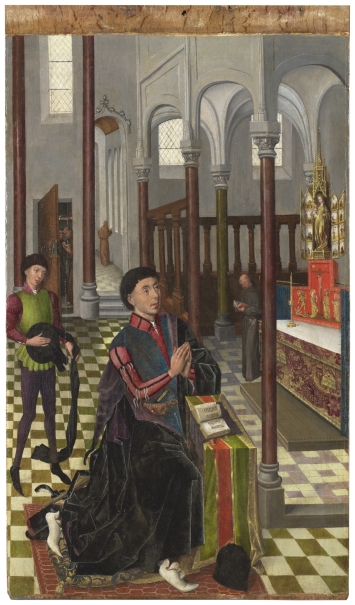
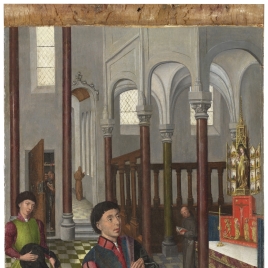
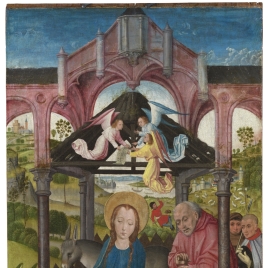
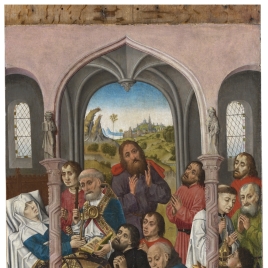
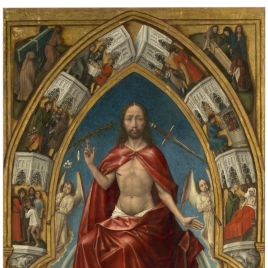
This panel (and P2575, P2577, P2578), formerly in the Benedictine monastery at Sopetrán (Guadalajara), were part of an altarpiece. The scene of the donor, the latter is depicted in the foreground praying before a church altar, half-kneeling on a prie-dieu covered in rich textiles. He is dressed in fifteenth-century costume: a half-donned tabard over one of his shoulders, doublet and jerkin with a wide collar and pointed shoes with tassels, and his hair is shaved at the temples. The cloth of the prie-dieu bears the coat of arms of the Mendoza family and lying on it is a book, presumably of hours. Beside his left foot is what appears to be his hat. However, it is likely that the donor’s head garment is the one held by the page depicted behind him. As the technical study revealed, the page originally held a sword, which was later dismissed – an iconographical change that affects the image the artist intended to convey of the donor as it focuses more on his devoutness than on his gentlemanly status.
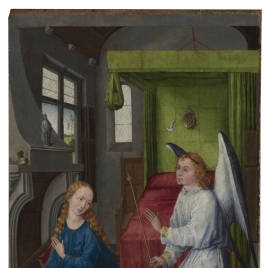
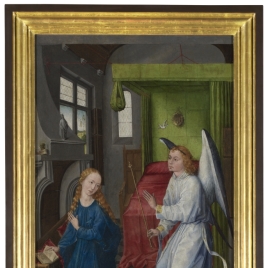
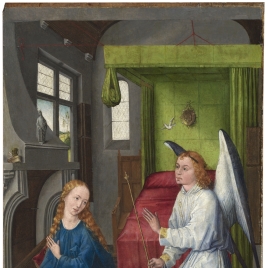
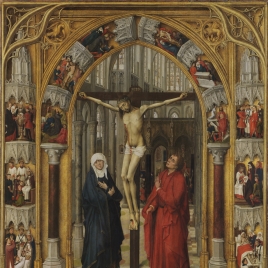
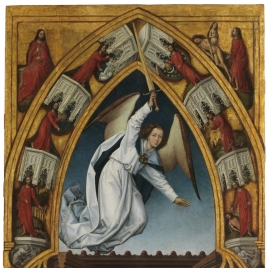
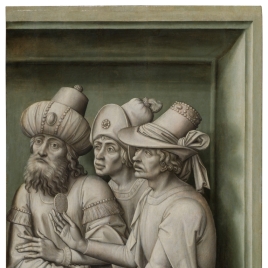
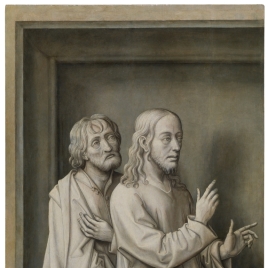
The ensemble (P2576, P2577, P2578) illustrates three scenes from the life of Mary. When they were found, the panels were considered Flemish paintings both by their discoverer, Elías Tormo, and by Lafuente Ferrari, who published them in 1929 and established sound and highly pertinent similarities with artists such as the Master of Flémalle, Rogier van der Weyden and their Brussels followers. These similarities appear to prove that despite the resemblances to the Antwerp Annunciation the master of Sopetrán did not allow himself to be influenced by just one of Rogier’s compositions but was familiar with his entire output, as he incorporated details from several works, showing himself to be a very close follower if not a member of his workshop. Given the abovementioned formal influences and resemblances, most of which can be traced back to Rogier van der Weyden, it is important to note the similarity between these panels and the work of a direct follower of his, the Master of the Prado Redemption, especially the triptych after which the latter is named, now in the Prado (P001888 – P001892).
It may be concluded that the Prado panels were commissioned by the Mendoza family in Brussels, where around the 1460s executed the paintings and a local sculpture workshop did the woodcarving of the Lamentation (The Metropolitan Museum of Art, The Cloisters Collection, 1955 inv. 55.85) as its style appears to reveal. However, these dates do not help clarify the identity of the man portrayed as the donor and the possible patron. The Marquis of Santillana, who promoted the remodelling of the monastery and commissioned the Flemish carving of the Virgin, to which the tabernacle-altarpiece depicted in the painting possibly alludes, appears to be the most likely candidate. It’s possible that we are dealing with an altarpiece featuring a portrait of Santillana that was commissioned after the marquis’s death by his heirs, the Duke of Infantado or Cardinal Mendoza, as a tribute with the aim of glorifying his memory at the monastery of Sopetrán. And nor can we confirm or dismiss the possibility it may be an image of either of his sons, whose dates of birth and death tally more closely with the period in which the paintings were produced.
Pérez Preciado, José Juan, Fifteenth-century netherlandish painting at the Museo Nacional del Prado. Catalogue raisonné, Madrid, Museo Nacional del Prado, 2024, p.270-283 nº.35