Master of the Prado Redemption
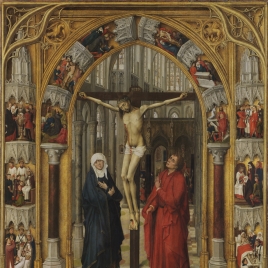
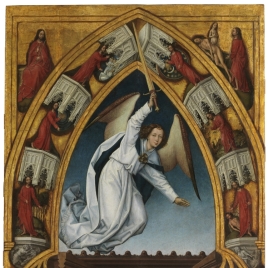
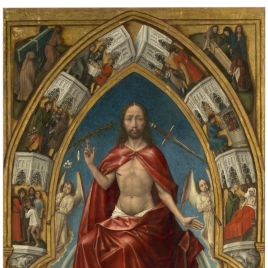
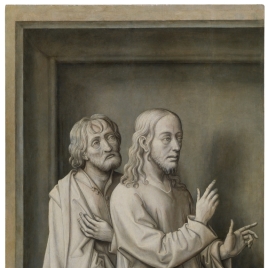
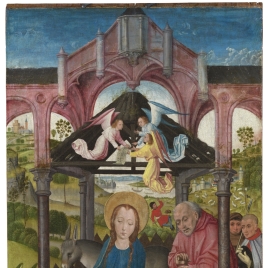
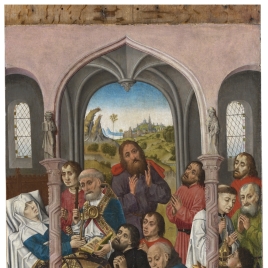
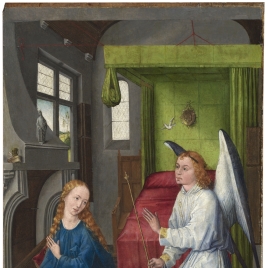
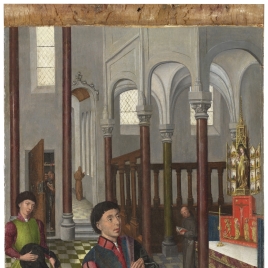
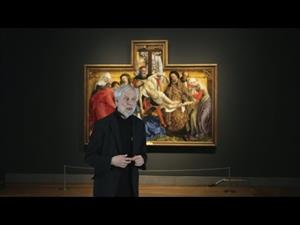
Established in the 1930s for a group of paintings that displayed a common style, the main one being the eponymous work in the Museo del Prado. It was joined by others such as the “Triptych of the Last Judgement”, now distributed between the city hall and the Museo de Bellas Artes in Valencia, the “Presentation of the Virgin in the Temple” (Patrimonio Nacional, inv. 10014404), the Lamentation in Antwerp (Museum Mayer van den Bergh, inv. MMB.0003) and the Munich Descent from the Cross (Alte Pinakothek, inv. 1398). These and other works clearly influenced by Rogier van der Weyden, to whom some had previously been attributed, were grouped together by Georges Hulin de Loo. This scholar argued that the artist would have been the Brussels painter Vrancke van der Stockt (before 1420–1495), whom he considered to be Van der Weyden’s main pupil. His claim was based on the existence of a document that was signed by both men in Rogier’s house but is totally unrelated to artistic matters. Soon afterwards Max Friedländer endorsed the idea that this corpus was the work of a single painter, but doubted he was Van der Stockt. Indeed, as there is no evidence that Van der Stockt produced any of the paintings and drawings in this group and there are not even any documented works by him, his authorship of the corpus was gradually dismissed, leading to the emergence of the conventional name of Master of the Redemption.
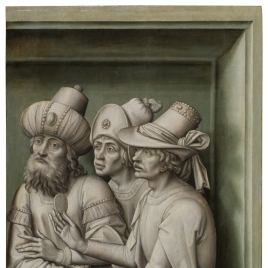
The master’s style reveals that he constantly sought inspiration from Van der Weyden. He often sets the scenes depicted in his large triptychs beneath arches with sculptures resembling church portals – a device made popular by Rogier in the "Miraflores Triptych" now in Berlin – or draws on his most successful iconographies, as evidenced by his Madrid and Valencia pieces, which display the mark of the Antwerp "Triptych of the Seven Sacraments" and the "Polyptych of the Last Judgement" from the Hospices de Beaune (Musée de l’Hôtel-Dieu). Even so, the Master of the Redemption does not borrow specific Rogieresque models for his own creations, though he sometimes uses workshop drawings. This corroborates the initial idea that this master worked directly with Van der Weyden (J.J. Pérez Preciado, "Fifteenth-century netherlandish painting at the Museo Nacional del Prado. Catalogue raisonné", Museo del Prado, 2024, p. 252).