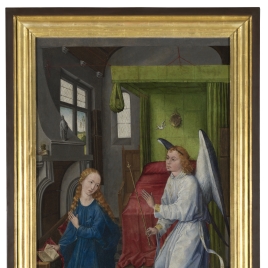
The Annunciation
1460 - 1470. Oil on baltic oak planks.Room 057
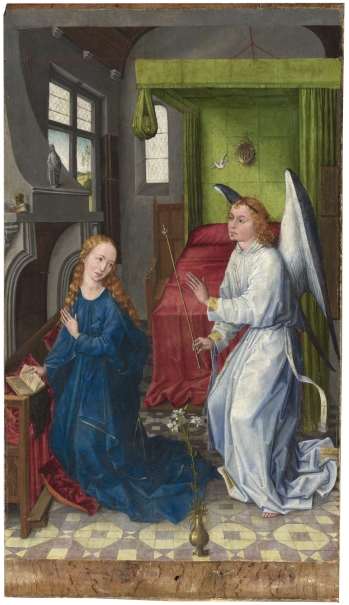
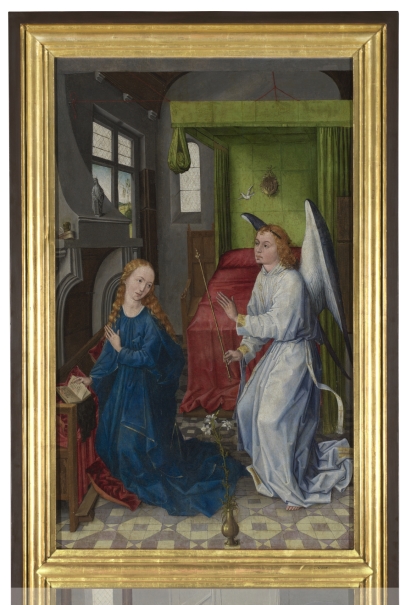
The ensemble (P2576, P2577, P2578) illustrates three scenes from the life of Mary. Mary, dressed in a blue tunic and half kneeling on the red cushion covering the footrest of a bench, looks up from her reading when she is visited by the angel. The text of the book is illegible. The vase of Madonna lilies in the foreground completes the traditional image of the scene. The barefooted angel in a white tunic and stole decorated with crosses carries a very fine gold sceptre. He is about to fall to his knees to utter his salutation to Mary. Above him is the Holy Spirit in the form of a dove. The room includes a canopy bed – from whose headboard hangs a metal medallion inlaid with golden stones and a representation of the Trinity crowning Mary – a chair in the background, and a fireplace with a small sculpture of Moses and a set of writing materials on the mantelpiece. Secondary iconographical allusions are also depicted, such as the relief of Saint Andrew on the side of the bench, which suggests that its perimeter was decorated with a complete series of the apostles. A landscape devoid of figures can be glimpsed through the window. Other finely rendered details attesting to the artist’s keen observation of reality are the red straps holding the bed canopy, which lend the scene a very lifelike appearance of a domestic interior.
When they were found, the panels were considered Flemish paintings both by their discoverer, Elías Tormo, and by Lafuente Ferrari, who published them in 1929 and established sound and highly pertinent similarities with artists such as the Master of Flémalle, Rogier van der Weyden and their Brussels followers. These similarities appear to prove that despite the resemblances to the Antwerp Annunciation the master of Sopetrán did not allow himself to be influenced by just one of Rogier’s compositions but was familiar with his entire output, as he incorporated details from several works, showing himself to be a very close follower if not a member of his workshop.
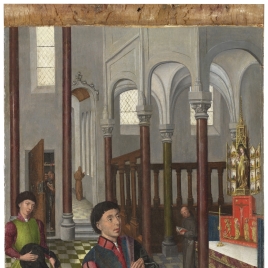
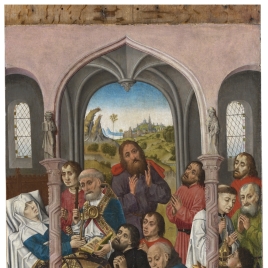
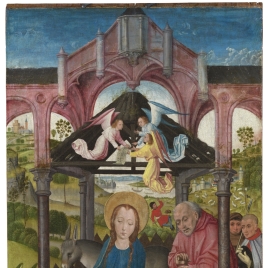
It may be concluded that the Prado panels were commissioned by the Mendoza family in Brussels, where around the 1460s executed the paintings and a local sculpture workshop did the woodcarving of the Lamentation (The Metropolitan Museum of Art, The Cloisters Collection, 1955 inv. 55.85) as its style appears to reveal. However, these dates do not help clarify the identity of the man portrayed as the donor and the possible patron. The Marquis of Santillana, who promoted the remodelling of the monastery and commissioned the Flemish carving of the Virgin, to which the tabernacle-altarpiece depicted in the painting possibly alludes, appears to be the most likely candidate. It’s possible that we are dealing with an altarpiece featuring a portrait of Santillana that was commissioned after the marquis’s death by his heirs, the Duke of Infantado or Cardinal Mendoza, as a tribute with the aim of glorifying his memory at the monastery of Sopetrán. And nor can we confirm or dismiss the possibility it may be an image of either of his sons, whose dates of birth and death tally more closely with the period in which the paintings were produced.
Pérez Preciado, José Juan, Fifteenth-century netherlandish painting at the Museo Nacional del Prado. Catalogue raisonné, Madrid, Museo Nacional del Prado, 2024, p.270-283 nº.35