formularioRDF
The itinerary <em>TITULORECORRIDO</em> has been successfully created. Now you can add in works from the Collection browser
<em>TITULOOBRA</em> added to <em>TITULORECORRIDO</em> itinerary

Close Continuar a ficha de la obra Continuar a ficha de la obra
02-06-2026
Follower of Master of the Prado Redemption See author's file

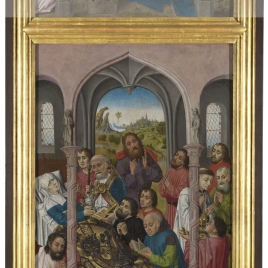
The Death of the Virgin

1460 - 1470. Oil on baltic oak planks.
Room 057

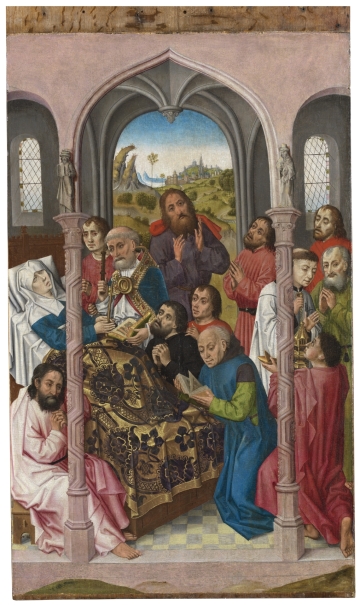
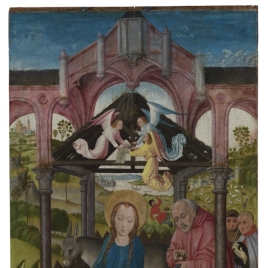
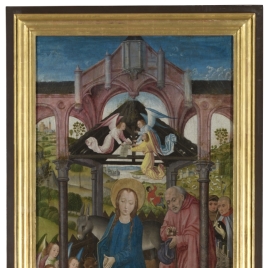
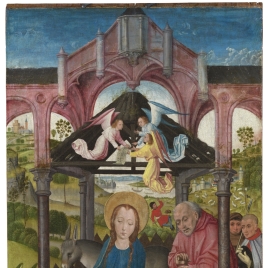
This panel (and P2575, P2577, P2578), formerly in the Benedictine monastery at Sopetrán (Guadalajara), were part of an altarpiece. The second panel combines a Nativity scene in the upper part and a Death of the Virgin in the lower part. The Death of the Virgin, which once again takes place in a porticoed interior, shows Mary lying on her bed holding a candle in one hand and covered by a rich brocade bedspread. Around her the apostles weep, pray, read or attend to Mary in her dormition. Two of those on the right, behind the column, hold the instruments for administering the last rites. The action is performed by Saint Peter, dressed in ecclesiastical vestments beside Mary. In the foreground two columns mark the architecture of the setting. Decorated with rosettes in relief, they support a pointed arch that architecturally links this scene with the one above it. Its capitals are topped with prophets: the one on the left is Moses, and the one on the right has been dubiously identified as Elijah. Only the kneeling angel holding a linen cloth in the carved detail of the bedhead completes the iconographical references. This figure probably replaces the angel hovering above the landscape, who was drawn but not painted.

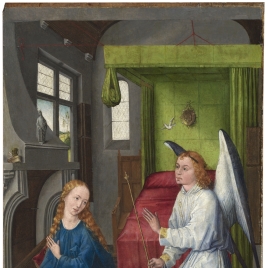
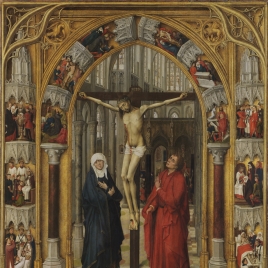
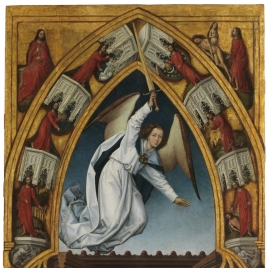
The ensemble (P2576, P2577, P2578) illustrates three scenes from the life of Mary. When they were found, the panels were considered Flemish paintings both by their discoverer, Elías Tormo, and by Lafuente Ferrari, who published them in 1929 and established sound and highly pertinent similarities with artists such as the Master of Flémalle, Rogier van der Weyden and their Brussels followers. These similarities appear to prove that despite the resemblances to the Antwerp Annunciation the master of Sopetrán did not allow himself to be influenced by just one of Rogier’s compositions but was familiar with his entire output, as he incorporated details from several works, showing himself to be a very close follower if not a member of his workshop. Given the abovementioned formal influences and resemblances, most of which can be traced back to Rogier van der Weyden, it is important to note the similarity between these panels and the work of a direct follower of his, the Master of the Prado Redemption, especially the triptych after which the latter is named, now in the Prado (P001888P001892).

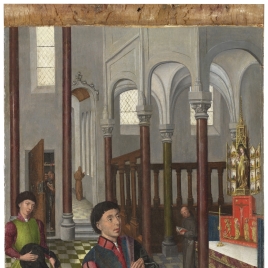
It may be concluded that the Prado panels were commissioned by the Mendoza family in Brussels, where around the 1460s executed the paintings and a local sculpture workshop did the woodcarving of the Lamentation (The Metropolitan Museum of Art, The Cloisters Collection, 1955 inv. 55.85) as its style appears to reveal. However, these dates do not help clarify the identity of the man portrayed as the donor and the possible patron. The Marquis of Santillana, who promoted the remodelling of the monastery and commissioned the Flemish carving of the Virgin, to which the tabernacle-altarpiece depicted in the painting possibly alludes, appears to be the most likely candidate. It’s possible that we are dealing with an altarpiece featuring a portrait of Santillana that was commissioned after the marquis’s death by his heirs, the Duke of Infantado or Cardinal Mendoza, as a tribute with the aim of glorifying his memory at the monastery of Sopetrán. And nor can we confirm or dismiss the possibility it may be an image of either of his sons, whose dates of birth and death tally more closely with the period in which the paintings were produced.

Pérez Preciado, José Juan, Fifteenth-century netherlandish painting at the Museo Nacional del Prado. Catalogue raisonné, Madrid, Museo Nacional del Prado, 2024, p.270-284 nº.36
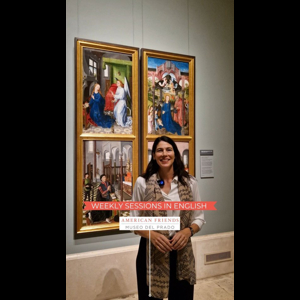
Multimedia

Technical data

Imagen del carrusel
Imagen del carrusel
Imagen del carrusel
Imagen del carrusel

Related artworks

The Annunciation
Oil on baltic oak planks, 1460 - 1470
Master of the Prado Redemption - Follower of
Mendoza Family Donor
Oil on baltic oak planks, 1460 - 1470
Master of the Prado Redemption - Follower of
The Nativity
Oil on baltic oak planks, 1460 - 1470
Master of the Prado Redemption - Follower of
Inventory number
P002578
Author
Follower of Master of the Prado Redemption
Title
The Death of the Virgin
Date
1460 - 1470
Technique
Oil
Support
Baltic oak planks
Dimension
Width: 60 cm; Height: 103 cm
Series
Tríptico o retablo de talla, ermita de la Fonsanta, Guadalajara
Provenance
Monasterio de Sopetrán, Torre del Burgo, Guadalajara, 1934.
Entry date
1934

Bibliography +

Lafuente Ferrari, Enrique, Las tablas de Sopetrán, Boletín de la Sociedad Española de Excursiones, 37, 1929, pp. 89-111.

Lafuente Ferrari, Enrique, Por las Alcarrias. Notas de una excursión a Sopetrán, Hita, Jadraque y Cogolludo, Boletín de la Sociedad Española de Excursiones, 37, 1929, pp. 199-212 [200].

Pemán, César, Sobre las tablas de Sopetrán, Boletín de la Sociedad Española de Excursiones, 28, 1930, pp. 128-130.

Gudiol Ricart, José, Pintura gótica, Ars hispaniae: historia universal del arte hispánico IX, Madrid, 1955, pp. 319.

Camón Aznar, José, Pintura medieval española, Summa artis: historia general del arte XXII, Madrid, 1966, pp. 557.

Post, Chandler Rathfon, A history of Spanish painting, Harvard University Press, Cambridge. Nueva York, 1970, pp. 76.

Sánchez Cantón, Francisco Javier, Museo del Prado. Catálogo de las pinturas, Museo del Prado, Madrid, 1972.

Garrido, Mª del Carmen y Cabrera, José Mª, El dibujo subyacente y otros aspectos técnicos de las tablas de Sopetrán, Boletín del Museo del Prado, III, 1982, pp. 15-31.

Checa Cremades, Fernando, Pintura y escultura del renacimiento en España: 1450-1600, Cátedra, Madrid, 1983, pp. 43-44.

Museo Nacional del Prado, Catálogo de las pinturas, Museo del Prado, Madrid, 1985, pp. 653.

Azcárate Ristori, J.M., Arte gótico en España, Catedra, Madrid, 1990, pp. 382.

Museo Nacional del Prado, Museo del Prado. Inventario general de pinturas (III). Nuevas Adquisiciones. Museo Iconográfico. Tapices., Museo del Prado, Espasa Calpe, Madrid, 1996, pp. nº1673.

Bähr, Ingeborg, Bilderfindungen der frühen niederländischen Malerei im Spiegel der Tafeln des Meisters von Sopetrán, Pantheon, 55, 1997, pp. 46-56.

Yarza Luaces, Joaquín, La nobleza ante el rey: los grandes linajes castellanos y el arte en el siglo XV, El Viso. Fundación Iberdrola, Madrid, 2003, pp. 227.

Kroesen, Justin E. A., Staging the liturgy : the medieval altarpiece in the Iberian..., Peeters, 2009, pp. 103,357-358.

Silva Maroto, Pilar, 'Las relaciones artísticas entre Flandes y Castilla en el s. XV', Aragón y Flandes. Un encuentro artístico (siglos XV-XVII), Universidad de Zaragoza, Zaragoza, 2015, pp. 68-76 [73].

Alba, Laura; Gayo, Mª Dolores; Jover, Maite, Maestro Viajeros, obras importadas. Las tablas del Maestro de Sopetrán, Rogier van der Weyden y España, Actas del Congreso Internacional (Lorne Cambell, José Juan Perez Preciado (eds.) Madrid, Museo Nacional del Prado, Madrid, 2016, pp. 131-141.

Ridderbos, Bernhard, Hugo van der Goes: Question about his artistic development, Simiolus, 45, 2023-2024, pp. 182-209 [196-197 fg.15].

Eising, Erik, 'Hugo van der Goes and the followers of Rogier van der Weyden', en: Hugo van der Goes: Between Pain and Bliss, Hirmer: Gemäldegalerie, Staatliche Museen zu Berlin, 2023, pp. 35-43 [41 f.10].

Pérez Preciado, José Juan, Fifteenth-century netherlandish painting at the Museo Nacional del Prado. Catalogue raisonné, Museo Nacional del Prado, Madrid, 2024, pp. 270-284 nº.36.

Pérez Preciado, José Juan, Pintura flamenca del siglo XV en el Museo Nacional del Prado. Catálogo razonado, Museo Nacional del Prado, Madrid, 2024, pp. 270-283 nº.36.

Other inventories +

Inv. Nuevas Adquisiciones (iniciado en 1856). Núm. 1673.
Autor, Anónimo español. / 1673. Asunto, La muerte de la Virgen. / Tabla, 103 x 60 cm. / Nº Catálogo, 2578. / Adquirido en 1934 con los anteriores...

Location +

Room 057 (On Display)

Expuesto

Displayed objects +

Window glazed with polygonal panes of flat glass: Ventanas acristaladas con piezas de vidrio plano de forma romboidal; presentan una orla de piezas de vidrio plano coloreado y forma cuadrangular que alternan el comatismo entre verde, rojo e incoloro; unidas mediante emplomado y con refuerzos horizontales.

Update date: 02-06-2026 | Registry created on 28-04-2015

Visor 360

Drag with the cursor to rotate the piece

Other works by Master of the Prado Redemption

Print on demand

Print artworks available in our catalogue in high quality and your preferred size and finish.

Image archive

Request artworks available in our catalogue in digital format.

Up