formularioRDF
The itinerary <em>TITULORECORRIDO</em> has been successfully created. Now you can add in works from the Collection browser
<em>TITULOOBRA</em> added to <em>TITULORECORRIDO</em> itinerary

Close Continuar a ficha de la obra Continuar a ficha de la obra
02-06-2026
Francisco de Goya y Lucientes - Engraver
Fuendetodos, Zaragoza (Spain), 1746 - Bordeaux (France), 1828 - Engraver
Laureano Potenciano Pastor
Madrid, 1837 - ¿Madrid?, 1864
Real Academia de Bellas Artes de San Fernando

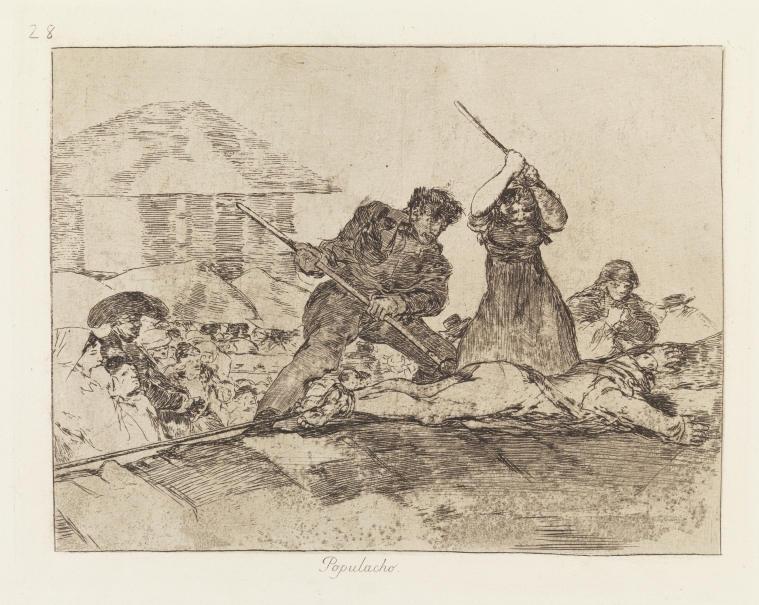
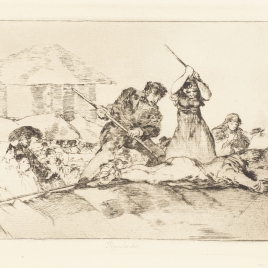
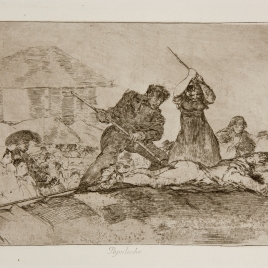
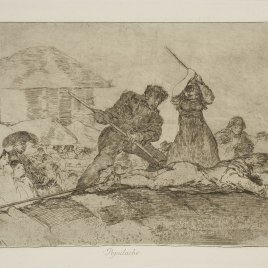
Rabble

1810 - 1815. Wash, Burnisher, Burin, Drypoint, Etching on wove paper.
Not on display

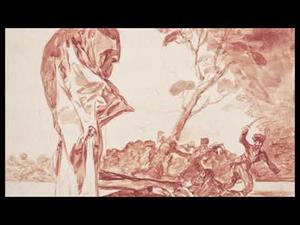
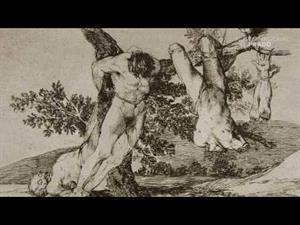
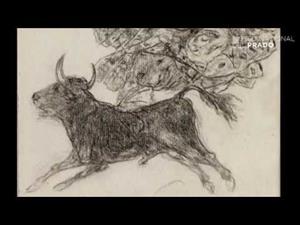
The one-word title that Goya applied to this print has been traditionally interpreted as a pejorative designation for the protagonists of the scene. Indeed, the first definition for populacho in the Royal Spanish Academy´s dictionary offers the lowest class of people, although it is also defined as an unruly or disorderly crowd (as in the English rabble). Writers from the period, such as Leandro Fernández de Moratín or José María Blanco White, who coincide ideologically with Goya, apply this term to vociferous, ignorant commoners. As is apparent in this print, the image presents the concepts associated with both definitions: the common people, their behaviour devoid of any logic, capable of committing acts of brutality against the lives of others, or to observe such acts with a certain degree of apathy, taking refuge in the crowd and in the disorder.There are numerous surviving accounts that refer to the actions of the common people against the French, the afrancesados (Spaniards sympathetic to the French) and the defenders of the legal system in force during the early days of the uprisings in May 1808. These accounts were disseminated in the press and later in memoirs or histories. Every one of these accounts describes the inhumanity of the crowds who -after bringing their captives to justice- dragged the corpses through the streets of Madrid.Making use of his habitual expressive devices, Goya leaves the figure of the victim white, contrasting with the heavy etching applied to the two sadistic Spaniards mistreating the lifeless body. The formal similarities between this print and plate 12 from Goya´s series of bullfighting etchings La Tauromaquia, entitled Desjarrete de la canalla (The rabble hamstring the bull), are noteworthy: the afrancesado in this print and the bull in the other have both become defenceless victims of a frenzied mob. These formal similarities suggest the chronological and ideological proximity of the two series of etchings. The gestures and the facial expressions, as in so many of his other works from these years, eloquently communicate the idea of violence and irrationality. The rope tied to the cadaver´s feet emphasises the manner in which it is being dragged, pulling the man´s clothes up around his torso and exposing his legs and buttocks, over which a patriot prepares to stab him with a long-handled sickle used to hamstring bulls -perhaps suggesting that he is intending to castrate the corpse. The violence is also evident in the faces of the mob observing the event. Some figures betray expressions of fear or compassion, like the women on either side of the print, but others, like the priest wearing a shovel hat, appear to view the scene with no reaction: indifference, perhaps, or tacit approval (Matilla, J. M.: Portrait of Spain. Masterpieces from the Prado, Queensland Art Gallery-Art Exhibitions Australia, 2012, p. 218).
Multimedia

Technical data

Related artworks

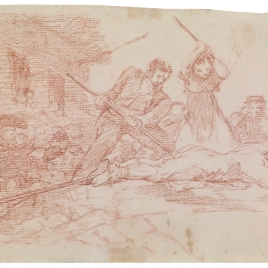
Rabble
Red chalk on laid paper, 1810 - 1814
Francisco de Goya y Lucientes
Rabble
Etching on wove paper, 1810 - 1814
Francisco de Goya y Lucientes - Engraver
Real Academia de Bellas Artes de San Fernando - Editor
Laureano Potenciano Pastor - Estampador
Inventory number
G000696
Authors
Francisco de Goya y Lucientes -Engraver-; Laureano Potenciano Pastor; Real Academia de Bellas Artes de San Fernando
Title
Rabble
Date
1810 - 1815
Technique
Wash; Burnisher; Burin; Drypoint; Etching
Support
Wove paper
Dimension
Height of the plate mark: 177 mm; Height: 226 mm; Width: 305 mm; Width of the plate mark: 220 mm
Series
Desastres de la guerra [estampa], 28
Provenance
Bequest of Tomas Harris, 1964
Entry date
1964

Bibliography +

Brunet, M.G., Étude sur Francisco Goya sa vie et ses travaux, Aubry, Paris, 1865, pp. 52.
Viñaza, Cipriano Muñoz y Manzano Conde de la, Goya: su tiempo, su vida, sus obras, Tip. M.G. Hernández, Madrid, 1887, pp. 376.

Delteil, Loys, Francisco Goya, I, Chez L'Auteur, Paris, 1922.

Mayer, August L., Francisco de Goya, Labor, Barcelona, 1925, pp. 231.

Lafuente Ferrari, Enrique, Goya: el dos de mayo y los fusilamientos de la Moncloa, Juventud, Barcelona, 1946, pp. 15.

Lafuente Ferrari, Enrique, Los desastres de la guerra de Goya y sus dibujos preparatorios, Instituto Amatller de Arte Hispánico, Barcelona, 1952, pp. 62.

Harris, Tomas, Goya, engravings and lithographs, II, Bruno Cassirer, Oxford, 1964, pp. 219.

Gassier, Pierre y Wilson-Bareau, Juliet, Vie et oeuvre de Francisco de Goya: l' oeuvre complet illustré: peintures, dessins, gravures, Office du Livre, Fribourg, 1970.

Derozier, C., La Guerre D'Independance Espagnole a Travers L'Estampe (1808..., II, Universidad de Lille, Lille, 1976, pp. 884.

Pita Andrade J.M. y Alvarez Lopera J., Goya y la constitución de 1812, Ayuntamiento, Madrid, 1982, pp. 12-13.

Bozal, Valeriano, Imagen de Goya, Lumen, Barcelona, 1983, pp. 209.

Tomlinson, Janis, Graphic Evolutions. The Print Series of Francisco Goya, Columbia University Press, New York, 1989, pp. 32.

Vega, Jesusa, Museo del Prado: catálogo de estampas, Museo del Prado, Madrid, 1992, pp. 90.

Vega, Jesusa, Fatales consecuencias de la guerra. Francisco de Goya, pintor, Francisco de Goya, grabador: instantáneas, Caser y Calcografía Nacional, Madrid, 1992, pp. 35.

Blas J., Matilla J.M. y Aguilar I, El libro de los desastres de la guerra: Francisco de Goya, I, Museo Nacional del Prado y Calcografía Nacional, Madrid, 2000, pp. 146.

Calvo Serraller, Francisco (dir.), Goya: la imagen de la mujer, Goya: la imagen de la mujer, Fundación Amigos del Museo del Prado, Madrid, 2001, pp. 317.

Obras adscritas al Museo Nacional del Prado en el año 2000, Boletín del Museo del Prado, XIX, 2001, pp. 200.

Nieto Alcaide, Víctor, La guerra y lo imaginario en la pintura de Goya, Barcelona, 2003, pp. 319-329.

Calcografía Nacional (España), Calcografía Nacional: catálogo general, II, Calcografía Nacional, Madrid, 2004, pp. 462.

Bozal, Valeriano, Francisco Goya: vida y obra, II, T.F., Alcobendas (Madrid), 2005, pp. 90, 123.

Matilla, José Manuel, Goya: en tiempos de guerra, Museo Nacional del Prado, Madrid, 2008, pp. 314.

Matilla, José Manuel, Estampas españolas de la Guerra de la Independencia: propaganda, conmemoración y testimonio, Universidad de Salamanca, 2008.

Bordes J., Matilla J.M. y Balsells S, Goya, cronista de todas las guerras: los "desastres" y la fotografía de guerra, Centro Atlántico de Arte Moderno y Real Academia de Bellas Artes de San Fernando, Las Palmas de Gran Canaria; Madrid, 2009, pp. 136.

Hofmann, Julius, Francisco de Goya: Katalog seines graphischen Werkes, Gesellschaft für vervielfältigende Kunst, Viena, 2014, pp. 91-145.

Pérez Francés, José Antonio, Aragón en los Desastres de la guerra de Francisco de Goya, Institución Fernando el Católico,, Zaragoza, 2025, pp. 39-62 [189-204].

Inscriptions +

28 // Populacho.
Lettered in the plate. Front

TH [monograma en un círculo. Lugt, n. 4922] // Thomas Harris. [Lugt, n. 4921]
Brown ink stamp. Back, left side

Exhibitions +

Portrait of Spain. Masterpieces from the Prado
Houston TX
15.12.2012 - 31.03.2013

Portrait of Spain. Masterpieces from the Prado
Brisbane
22.07.2012 - 04.11.2012

Update date: 02-06-2026 | Registry created on 13-12-2016

Visor 360

Drag with the cursor to rotate the piece

Other works by Francisco de Goya y Lucientes; Laureano Potenciano Pastor; Real Academia de Bellas Artes de San Fernando

Print on demand

Print artworks available in our catalogue in high quality and your preferred size and finish.

Image archive

Request artworks available in our catalogue in digital format.

Up