Bury Them and Keep Quiet
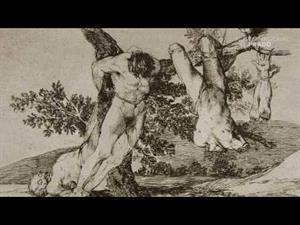
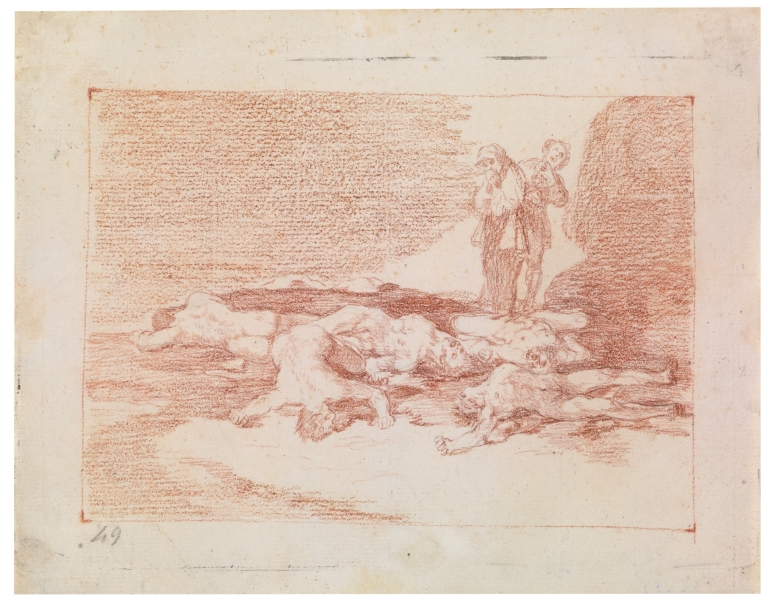
1810 - 1814. Red chalk, Pencil ground on laid paper.Not on display
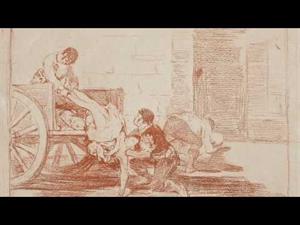
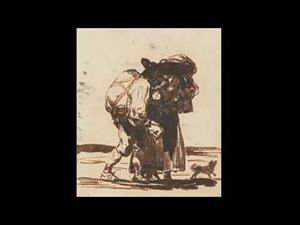
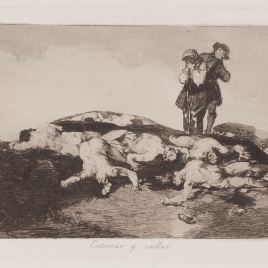
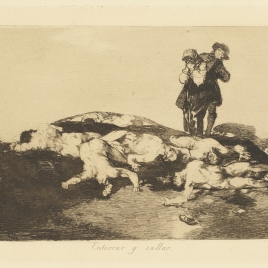
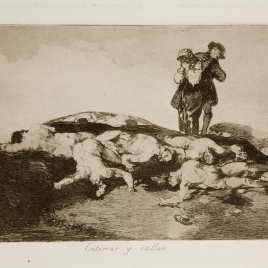
This preparatory drawing for Disasters of War 18, Bury Them and Keep Quiet, suggests that the worst consequence of a war is undoubtedly death. As we have seen, the representation of the victims is one the Disasters’ principal objectives. Almost from the start, Goya emphatically conveys the collective nature of the slaughter. Depicting a cadaver is a way of expressing violence, but showing a disorderly pile of dead bodies exacerbates the tragic import of such an event. The cadavers are frequently unclothed, and their classical presentation with accentuated foreshortening contrasts ideal beauty with the tragedy of death. [...] This subject’s frequency leads Goya to eliminate the scant spatial references that existed in the drawing, presenting the macabre scene on a sloped and undefined terrain. Various nuances imbue it with an extreme conceptual violence. First, the placement of the naked bodies, which had previously been stripped of their clothing in a manner depicted by Goya in Disaster 16, They Make Use of Them; second, the violent foreshortening of the bodies, which reflects both their rigor mortis and the idea that they have been tossed aside in a haphazard way, like mere objects. Third, their grimaces, which indicate how painful their final moments were; and finally, the manner in which their shoes have been abandoned in the foreground, symbolizing the violent loss of life. But Goya further augments the expressivity of this drawing by conveying the smell of rotting bodies through the postures of two figures -a man and a woman- whom he presents as witnesses to the slaughter (Text drawn from Matilla, J. M.: Enterrar y callar, in: Goya en tiempos de guerra, Madrid: Museo Nacional del Prado, 2008, 318 and 319).