formularioRDF
The itinerary <em>TITULORECORRIDO</em> has been successfully created. Now you can add in works from the Collection browser
<em>TITULOOBRA</em> added to <em>TITULORECORRIDO</em> itinerary

Close Continuar a ficha de la obra Continuar a ficha de la obra
02-06-2026
Francisco de Goya y Lucientes - Engraver
Fuendetodos, Zaragoza (Spain), 1746 - Bordeaux (France), 1828 - Engraver
Laureano Potenciano Pastor
Madrid, 1837 - ¿Madrid?, 1864
Real Academia de Bellas Artes de San Fernando

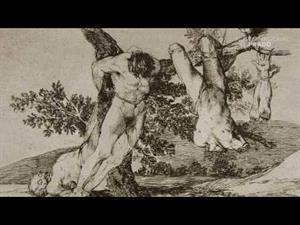
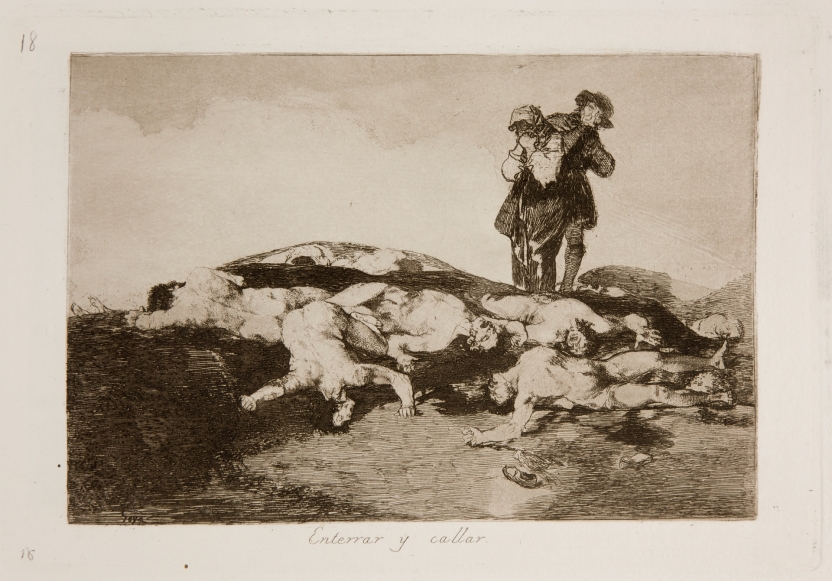
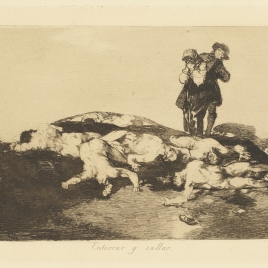
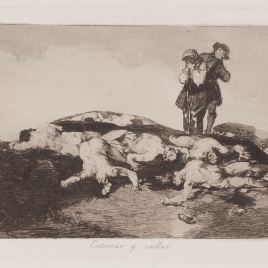
Bury Them and Keep Quiet

1810 - 1814. Burin, Burnished wash, Etching, Drypoint on wove paper.
Not on display

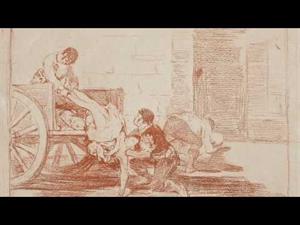
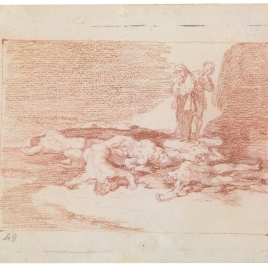
Bury Them and Keep Quiet, suggests that the worst consequence of a war is undoubtedly death. As we have seen, the representation of the victims is one the Disasters’ principal objectives. Almost from the start, Goya emphatically conveys the collective nature of the slaughter. Depicting a cadaver is a way of expressing violence, but showing a disorderly pile of dead bodies exacerbates the tragic import of such an event. The cadavers are frequently unclothed, and their classical presentation with accentuated foreshortening contrasts ideal beauty with the tragedy of death. [...] This subject’s frequency leads Goya to eliminate the scant spatial references that existed in the drawing, presenting the macabre scene on a sloped and undefined terrain. Various nuances imbue it with an extreme conceptual violence. First, the placement of the naked bodies, which had previously been stripped of their clothing in a manner depicted by Goya in Disaster 16, They Make Use of Them; second, the violent foreshortening of the bodies, which reflects both their rigor mortis and the idea that they have been tossed aside in a haphazard way, like mere objects. Third, their grimaces, which indicate how painful their final moments were; and finally, the manner in which their shoes have been abandoned in the foreground, symbolizing the violent loss of life. But Goya further augments the expressivity of this drawing by conveying the smell of rotting bodies through the postures of two figures -a man and a woman- whom he presents as witnesses to the slaughter (Text drawn from Matilla, J. M.: Enterrar y callar, in: Goya en tiempos de guerra, Madrid: Museo Nacional del Prado, 2008, 318 and 319).
Multimedia

Technical data

Related artworks

Bury Them and Keep Quiet
Pencil ground on laid paper, 1810 - 1814
Francisco de Goya y Lucientes
Inventory number
G002348
Authors
Francisco de Goya y Lucientes -Engraver-; Laureano Potenciano Pastor; Real Academia de Bellas Artes de San Fernando
Title
Bury Them and Keep Quiet
Date
1810 - 1814
Technique
Burin; Burnished wash; Etching; Drypoint
Support
Wove paper
Dimension
Height: 248 mm; Height of the plate mark: 163 mm; Width: 345 mm; Width of the plate mark: 237 mm
Series
Desastres de la guerra [estampa], 18 (16)
Provenance
Real Academia de Bellas Artes de San Fernando, Madrid; Eduardo Luis Moreda Fernández; Museo del Prado, 2000
Entry date
2000

Bibliography +

Brunet, M.G., Étude sur Francisco Goya sa vie et ses travaux, Aubry, Paris, 1865, pp. 51.

Viñaza, Cipriano Muñoz y Manzano Conde de la, Goya: su tiempo, su vida, sus obras, Tip. M.G. Hernández, Madrid, 1887, pp. 371.

Delteil, Loys, Francisco Goya, I, Chez L'Auteur, Paris, 1922.

Mayer, August L., Francisco de Goya, Labor, Barcelona, 1925, pp. 231.

Lafuente Ferrari, Enrique, Los desastres de la guerra de Goya y sus dibujos preparatorios, Instituto Amatller de Arte Hispánico, Barcelona, 1952, pp. 61.

Harris, Tomas, Goya, engravings and lithographs, II, Bruno Cassirer, Oxford, 1964, pp. 203.

Gassier, Pierre y Wilson-Bareau, Juliet, Vie et oeuvre de Francisco de Goya: l' oeuvre complet illustré: peintures, dessins, gravures, Office du Livre, Fribourg, 1970.

Sayre, Eleanor, The Changing Image. Prints by Francisco Goya, Museum of Fine Arts, Boston, 1974, pp. 153.

Derozier, C., La Guerre D'Independance Espagnole a Travers L'Estampe (1808..., II, Universidad de Lille, Lille, 1976, pp. 867.

Bozal, Valeriano, Imagen de Goya, Lumen, Barcelona, 1983, pp. 201.

Vega, Jesusa, Museo del Prado: catálogo de estampas, Museo del Prado, Madrid, 1992, pp. 87.

Vega, Jesusa, Fatales consecuencias de la guerra. Francisco de Goya, pintor, Francisco de Goya, grabador: instantáneas, Caser y Calcografía Nacional, Madrid, 1992, pp. 27.

Biblioteca NacionalEspaña, "Ydioma Universal": Goya en la Biblioteca Nacional, Biblioteca NacionalLunwerg, Madrid, 1996, pp. 209.

Cuenca M. L., Docampo J. y Vinatea P., Catálogo de las estampas de Goya en la Biblioteca Nacional, Biblioteca Nacional y Lunwerg, Madrid, 1996, pp. 141.

Matilla, José Manuel y Blas, Javier, El libro de los desastres de la guerra: Francisco de Goya, Museo Nacional del Prado; Calcografía Nacional, Madrid, 2000, pp. 40-42.

Obras adscritas al Museo Nacional del Prado en el año 2000, Boletín del Museo del Prado, XIX, 2001, pp. 200.

Nieto Alcaide, Víctor, La guerra y lo imaginario en la pintura de Goya, Barcelona, 2003, pp. 319-329.

Calcografía Nacional (España), Calcografía Nacional: catálogo general, II, Calcografía Nacional, Madrid, 2004, pp. 461.

Bozal, Valeriano, Francisco Goya: vida y obra, II, T.F., Alcobendas (Madrid), 2005, pp. 117.

No se puede mirar: Goya, Desastres de la guerra, Zoran Musi..., 2007.

Wilson-Bareau [et alt], Catalogue, Goya graveur, Chaudun y Paris musées, Paris, 2008, pp. 237.

Matilla, José Manuel, Goya: en tiempos de guerra, Museo Nacional del Prado, Madrid, 2008, pp. 318-320.

Matilla, José Manuel, Estampas españolas de la Guerra de la Independencia: propaganda, conmemoración y testimonio, Universidad de Salamanca, 2008.

Bordes J., Matilla J.M. y Balsells S, Goya, cronista de todas las guerras: los "desastres" y la fotografía de guerra, Centro Atlántico de Arte Moderno y Real Academia de Bellas Artes de San Fernando, Las Palmas de Gran Canaria; Madrid, 2009, pp. 116.

Hofmann, Julius, Francisco de Goya: Katalog seines graphischen Werkes, Gesellschaft für vervielfältigende Kunst, Viena, 2014, pp. 91-145.

Iarocci, Michael P., The art of witnessing: Francisco de Goya's Disasters of war, University of Toronto Press, 2023, pp. 102-107.

Pérez Francés, José Antonio, Aragón en los Desastres de la guerra de Francisco de Goya, Institución Fernando el Católico,, Zaragoza, 2025, pp. 39-62 [261-264].

Other inventories +

Inv. Nuevas Adquisiciones (iniciado en 1856). Núm. 2564.
Inscriptions +

18 // Goya // Enterrar y callar. // 16
Lettered in the plate. Front

Update date: 02-06-2026 | Registry created on 28-04-2015

Visor 360

Drag with the cursor to rotate the piece

Other works by Francisco de Goya y Lucientes; Laureano Potenciano Pastor; Real Academia de Bellas Artes de San Fernando

Print on demand

Print artworks available in our catalogue in high quality and your preferred size and finish.

Image archive

Request artworks available in our catalogue in digital format.

Up