formularioRDF
The itinerary <em>TITULORECORRIDO</em> has been successfully created. Now you can add in works from the Collection browser
<em>TITULOOBRA</em> added to <em>TITULORECORRIDO</em> itinerary

Close Continuar a ficha de la obra Continuar a ficha de la obra
02-06-2026
Francisco de Goya y Lucientes - Engraver
Fuendetodos, Zaragoza (Spain), 1746 - Bordeaux (France), 1828 - Engraver
Laureano Potenciano Pastor
Madrid, 1837 - ¿Madrid?, 1864
Real Academia de Bellas Artes de San Fernando

Even worse

1810. Wash, Burin, Etching on wove paper.
Not on display

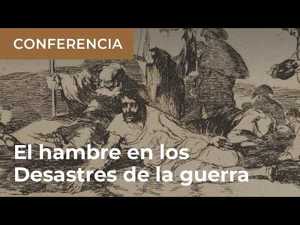
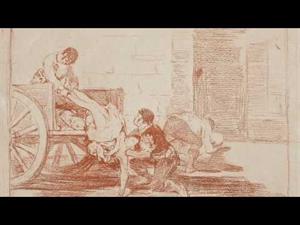
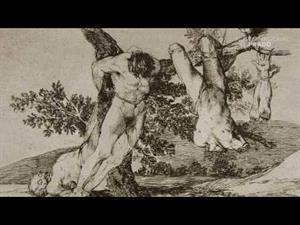
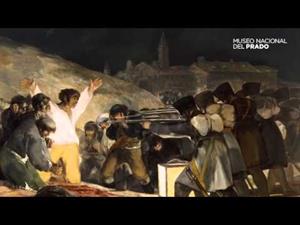
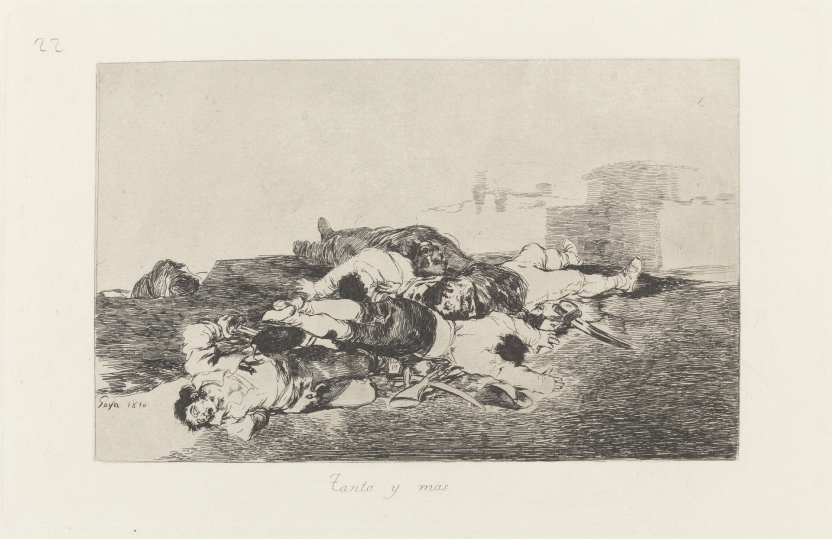
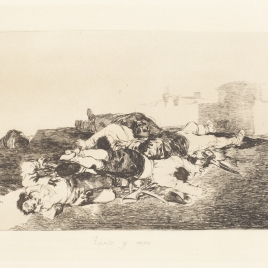
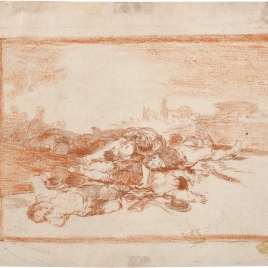
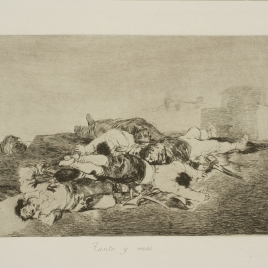
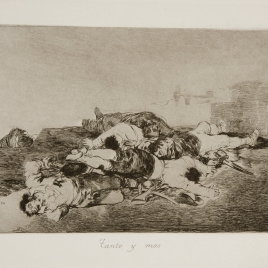
Within the Disasters series, Goya repeats subjects to emphasise certain aspects of war and its consequences. The connections he establishes through the titles reinforces this, as may be appreciated in this print that is included in a sequence showing scenes of collective slaughter. The previous etching, Será lo mismo (It will be the same, plate 21), shows corpses of combatants being carried away before a disconsolate woman. It is followed by this one, Tanto y más (Even worse), in which the bodies have accumulated in a pile outside a town, in the same manner as is depicted in the next print, Lo mismo en otras partes (The same elsewhere, plate 23).Goya´s vehemence is clear in this repetition of tragic scenes and in the expressive force of the language used in the titles. Tanto y más emphasises the unspeakable magnitude of the slaughter, impossible to describe with a simple adjective, a futility suggested here with the addition of the comparative y más (and more). Goya´s working method in the Disasters series is based on a limited range of devices. Far from producing monotony, however, he achieves very diverse effects by combining these in different ways. Tanto y más is a good example of this approach. While in Enterrar y callar (Bury them and keep quiet, plate 18) we witness the nausea produced by the smell of death contrasted with the beauty of the human body, in the present etching we see the immediate consequences of recent combat or perhaps a mass execution carried out by the French soldiers. The corpses -unequivocally Spaniards from their civilian dress- lie in a disorganised pile covering the space from the foreground to the background.The setting, characterised by vaguely delineated architectural forms in the distance, alludes to the rural context in which most of the slaughter of Spanish guerrilla fighters took place. The precision with which each of the cadavers is represented lends verisimilitude to the scene. Owing to this realistic treatment, the victims here are not mere figurines, as had been the case in representations of war before Goya. Rather, they appear as human beings capable of transmitting emotions and provoking them in the viewer. The contorted faces, the forced postures and the cadaverous rigidity are all signs of a violent death.As in other prints from the series, Goya signed the plate (visible in the lower left-hand corner of the print) and added the date, 1810. This image -whether or not he witnessed it or imagined it- undoubtedly served as a point of departure for his emblematic paintings of 1814 depicting French soldiers executing citizens of Madrid: The second of May 1808, Madrid: the charge of the Mamelukes (P748); and The third of May 1808, Madrid: the executions on Príncipe Pio hill (P749) (Matilla, J. M.: Portrait of Spain. Masterpieces from the Prado, Queensland Art Gallery-Art Exhibitions Australia, 2012, p. 221).
Multimedia

Technical data

Inventory number
G000693
Authors
Francisco de Goya y Lucientes -Engraver-; Laureano Potenciano Pastor; Real Academia de Bellas Artes de San Fernando
Title
Even worse
Date
1810
Technique
Wash; Burin; Etching
Support
Wove paper
Dimension
Height: 249 mm; Width of the plate mark: 253 mm; Height of the plate mark: 162 mm; Width: 335 mm
Series
Desastres de la guerra [estampa], 22 (7)
Provenance
Bequest of by Tomas Harris, 1964
Entry date
1964

Bibliography +

Brunet, M.G., Étude sur Francisco Goya sa vie et ses travaux, Aubry, Paris, 1865, pp. 52.
Viñaza, Cipriano Muñoz y Manzano Conde de la, Goya: su tiempo, su vida, sus obras, Tip. M.G. Hernández, Madrid, 1887, pp. 373.

Delteil, Loys, Francisco Goya, I, Chez L'Auteur, Paris, 1922.

Mayer, August L., Francisco de Goya, Labor, Barcelona, 1925, pp. 231.

Lafuente Ferrari, Enrique, Los desastres de la guerra de Goya y sus dibujos preparatorios, Instituto Amatller de Arte Hispánico, Barcelona, 1952, pp. 61.

Harris, Tomas, Goya, engravings and lithographs, II, Bruno Cassirer, Oxford, 1964, pp. 211.

Gassier, Pierre y Wilson-Bareau, Juliet, Vie et oeuvre de Francisco de Goya: l' oeuvre complet illustré: peintures, dessins, gravures, Office du Livre, Fribourg, 1970.

Sayre, Eleanor, The Changing Image. Prints by Francisco Goya, Museum of Fine Arts, Boston, 1974, pp. 156.

Derozier, C., La Guerre D'Independance Espagnole a Travers L'Estampe (1808..., II, Universidad de Lille, Lille, 1976, pp. 875.

Bozal, Valeriano, Imagen de Goya, Lumen, Barcelona, 1983, pp. 205.

Vega, Jesusa, Museo del Prado: catálogo de estampas, Museo del Prado, Madrid, 1992, pp. 90.

Matilla, José Manuel y Blas, Javier, El libro de los desastres de la guerra: Francisco de Goya, Museo Nacional del Prado; Calcografía Nacional, Madrid, 2000, pp. 44-49.

Obras adscritas al Museo Nacional del Prado en el año 2000, Boletín del Museo del Prado, XIX, 2001, pp. 200.

Nieto Alcaide, Víctor, La guerra y lo imaginario en la pintura de Goya, Barcelona, 2003, pp. 319-329.

Calcografía Nacional (España), Calcografía Nacional: catálogo general, II, Calcografía Nacional, Madrid, 2004, pp. 461.

No se puede mirar: Goya, Desastres de la guerra, Zoran Musi..., 2007.

Wilson-Bareau J., [et alt.], Catalogue, Goya graveur, Chaudun y Paris musées, Paris, 2008, pp. 239.

Matilla, José Manuel, Estampas españolas de la Guerra de la Independencia: propaganda, conmemoración y testimonio, Universidad de Salamanca, 2008.

Bordes J., Matilla J.M., Balsells S., Goya: cronista de todas las guerras : los "desastres" y la fotografía de guerra, Centro Atlántico de Arte Moderno y Real Academia de Bellas Artes de San Fernando, Las Palmas De Gran Canaria Y Madrid, 2009, pp. 124.

Matilla J.M. y Mena Marques M.B., Goya : luces y sombras, Fundación: La Caixa y Museo Nacional del Prado, Barcelona Y Madrid, 2012, pp. 214.

Hofmann, Julius, Francisco de Goya: Katalog seines graphischen Werkes, Gesellschaft für vervielfältigende Kunst, Viena, 2014, pp. 91-145.

Jacobs, Helmut C., Nacionalismos en la pintura de Francisco de Goya, Acta artis, 4 / 5, 2016-2017, pp. 55-75 [63 f.5].

Pérez Francés, José Antonio, Aragón en los Desastres de la guerra de Francisco de Goya, Institución Fernando el Católico,, Zaragoza, 2025, pp. 39-62 [134-151, Anexo 2].

Filigree +

Motive: Venera y J. G. O. (mitad derecha)


65 x 33 mm
Principal
Yes
En el centro del margen superior
José García Oseñalde
Marca de agua en forma de venera e iniciales "J. G. O." característica del papel fabricado por José García Oseñalde, establecido en La Cabrera, Guadalajara. En esta localidad existió fábrica de papel desde por lo menos 1733, como así es recogido por Eugenio Larruga en sus "Memorias políticas y económicas sobre los frutos, comercio, fábricas y minas de España...", de ese año y de 1746. Esta antigua fábrica de papel blanco debió de ser la que José García Oseñalde compró en 1847, junto a un molino de harina llamado "Los Heros", colindante entre las localidades de La Cabrera y Aragosa. La fábrica también debió conocerse con el nombre del molino de harinas, pues así consta en 1886, cuando la fábrica de papel sellado "Los Heros" era propiedad de Pedro García Oseñalde (véase: "El obispado de Sigüenza, ó sea Nomenclátor descriptivo, Geográfico y Estadístico de todos los pueblos del mismo, por un sacerdote de la diócesis", Zaragoza, 1886, p. 21 [Aragosa])

La primera edición de los "Desastres de la Guerra" de Goya se imprimió en papel con esta filigrana, en 1863.

Bibliography
Biblioteca Nacional de España, Catálogo de las estampas de Goya en la Biblioteca Nacional, Biblioteca Nacional, Sociedad Estatal Goya 96 y Lunwerg, Madrid, 1996, pp. 280, fil. 22.
Fundación Lázaro Galdiano, Goya en la Fundación Lázaro Galdiano, Fundación Lázaro Galdiano, Madrid:, 1999, pp. 386-387, fil. 14-15.

Inscriptions +

22 // Goya 1810 // Tanto y mas // 7
Lettered in the plate. Front

Thomas Harris [Lugt, n. 4921]
Brown ink stamp. Back, lower left area

Exhibitions +

Portrait of Spain. Masterpieces from the Prado
Houston TX
15.12.2012 - 31.03.2013

Portrait of Spain. Masterpieces from the Prado
Brisbane
22.07.2012 - 04.11.2012

Goya: luces y sombras. Obras maestras del Museo del Prado
Barcelona
15.03.2012 - 24.06.2012

Update date: 02-06-2026 | Registry created on 13-12-2016

Visor 360

Drag with the cursor to rotate the piece

Other works by Francisco de Goya y Lucientes; Laureano Potenciano Pastor; Real Academia de Bellas Artes de San Fernando

Print on demand

Print artworks available in our catalogue in high quality and your preferred size and finish.

Image archive

Request artworks available in our catalogue in digital format.

Up